U.S. President Donald Trump was forced to extend the ceasefire, originally set to expire on April 22, after Washington and Tehran failed to agree on a second round of talks. The first round in Islamabad had already fallen short of narrowing the gap between the two sides. The extension came despite Tehran making good on its warning not to attend further negotiations. Its decision followed Washington’s refusal to meet key Iranian demands: lifting the blockade on its ports and releasing the Iranian vessel Tosca. Those measures had been imposed during the ceasefire itself, steps Iran framed as a violation of the truce and a blow to the negotiation track. Compounding matters were Trump’s chinging and contradictory public remarks. At times, he projected progress that had little basis in reality. At others, he issued blunt threats toward Iran. The mixed messaging deepened mistrust and ultimately discouraged Tehran from returning to the table. The ceasefire may have halted open war.
Yet the Strait of Hormuz has quietly transformed into a tightly managed arena of confrontation, one shaped by overlapping strategic tensions and unresolved legal questions. The risk now is whether this controlled standoff can hold, or whether it will tip into the very escalation both sides appear keen to avoid.
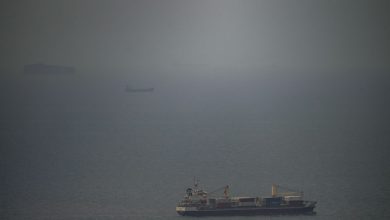
During the ceasefire, Washington moved to what it framed as a calibrated escalation, tightening a blockade on Iranian ports. Tehran answered in kind. It announced the renewed closure of the Strait of Hormuz and placed it under heightened control. Tensions rose another notch when U.S. forces seized an Iranian vessel that had attempted to breach the blockade. Iran responded with a limited show of force, deploying drones against U.S. naval assets in the Gulf of Oman and intercepting several commercial ships. The message was measured, but unmistakable. At the negotiating table, Donald Trump struck a different tone. He claimed Iran had agreed to abandon any pursuit of nuclear weapons, hand over what he called “nuclear dust,” and halt enrichment of uranium “forever.” Iranian officials flatly rejected those assertions. They reiterated that Tehran would not accept a permanent end to enrichment and intended to retain control over its nuclear file. The contradiction was hard to miss. Trump’s claims of sweeping concessions made by Iran sat uneasily alongside his threats that the United States would “destroy every power plant, every bridge” in Iran. The rhetoric suggested negotiations conducted under duress. That portrayal, however, does not reflect the reality on the ground, where the fighting had already stopped and the ceasefire had taken hold, against a backdrop of balance between force and resilience.


The first round of talks, facilitated by mediators from Pakistan, Egypt, and Turkey, did not move beyond the contours set in earlier negotiating rounds before the war. Progress was modest. The discussions edged toward a broad framework, but left the core differences unresolved. That dynamic was reflected in a memorandum of understanding that focused on several key files, foremost among them the nuclear issue and the fate of Iran’s enriched uranium stockpile. Washington sought firm guarantees that Tehran would not retain the stockpile in its current form, proposing that all nuclear material be shipped to the United States. Iran, by contrast, explored transferring part of its highly enriched uranium to a third country, while diluting the remainder domestically under international supervision. The talks also featured a U.S. proposal for a temporary “voluntary” halt to uranium enrichment lasting twenty years. Iran countered with a five-year period. The memorandum further recognized Iran’s right to maintain research reactors for producing medical isotopes, on the condition that all nuclear facilities remain above ground and that underground sites be taken out of operation.
The Strait of Hormuz also featured in the memorandum, though “significant gaps” appear to have persisted between the negotiating sides. During the war, Iran had leveraged its geographic position and its capacity to control the strait as a powerful bargaining chip, one that, given the waterway’s strategic weight, yielded results arguably more consequential than those achieved through direct military force. Another file in the memorandum centered on the scale of Iranian funds frozen abroad that Washington might be willing to release, along with the conditions governing their use. Figures around $20 billion were discussed, while Tehran pushed for a higher amount. Notably absent from the document were Iran’s ballistic missile program and its support for regional proxies, issues long championed by Israeli officials and Republican hawks as central to any negotiation. Taken together, these details point to Iran’s firm insistence on retaining its sovereign right to uranium enrichment, preserving its peaceful nuclear program, and maintaining its position in the strait.
Following the collapse of plans for a second round of talks, oil prices climbed again, while the dollar weakened. The global economy remains unsettled, strained by the ongoing disruption tied to the closure of the Strait of Hormuz. Public messaging from Donald Trump and much of the U.S. media has focused on the toll on Iran’s economy, particularly under the blockade of its ports. At home, however, Trump is facing mounting criticism. Opponents accuse him of being drawn into a war that does not serve core U.S. interests, but rather Israel’s, while driving up prices in ways that are fueling public anger. This pressure helps explain the constraints shaping Trump’s approach. It pushed him toward embracing the ceasefire in the first place. It also leaves him under growing urgency to bring the conflict to a close and resolve the crisis in Hormuz. Time, increasingly, is not on his side.
The current crisis is not simply the product of stalled diplomacy or the risks of military and security instability in the Strait of Hormuz, with all their damaging economic fallout. It also extends into the strait’s complex legal status, which may yet prove the next trigger for escalation, after once being seen as a potential pathway to resolution. In practice, Hormuz now operates in a space marked by a visible legal vacuum. Navigation is no longer reliably free or secure. It has become, instead, an exercise in calculated risk.
What is unfolding in Hormuz no longer fits neatly within established legal models. It is neither a full closure nor a classic blockade. Instead, it reflects a form of “selective control” over passage, an emerging pattern that lacks a precise legal definition and is not governed by settled rules.
The gap is clear: the law was designed for scenarios that the current reality in the Strait of Hormuz has plainly outgrown. Other layers of legal ambiguity deepen the problem. One concern is, how the strait itself is characterized under international law. It falls under the regime of “transit passage” as an international strait, yet it is also treated, in practice, as part of territorial seas. That dual framing opens the door to competing claims over the extent of Iran’s authority, whether its restrictions can be justified or must be deemed unlawful. Here, the vacuum takes on another form. It is not simply the absence of a clear rule, but the absence of agreement on which rule applies.
With the strait drawn into the calculus of the U.S.–Israeli strike on Iran, and Tehran’s claimed right of self-defense, extending to mine-laying and blockade, Hormuz is no longer governed solely by the law of the sea. It now sits, at least in part, within the legal framework of naval armed conflict. The tension is stark. The law of the sea makes it difficult to impede passage through an international strait. The law of naval warfare, by contrast, allows restrictions under certain conditions. The problem is that international law offers no clear rule of priority when the two regimes collide, no settled answer as to which prevails.
The central question remains: even where clear legal rules exist, who ensures their enforcement? There is no standing institutional framework to manage vital straits in times of crisis, and reaching decisive action through the United Nations system is notoriously difficult. Its structure rests on a balance of power among major states, where the veto often blocks resolutions precisely when they are most needed. What the crisis in the Strait of Hormuz reveals, then, goes beyond a regional dispute or a political standoff. It raises a deeper, more unsettling question about the future of the international order itself.
The views expressed in this article belong to the author and do not necessarily reflect the editorial policy of Middle East Monitor.
🚨BREAKING: Watch The Video Clip Here ➤