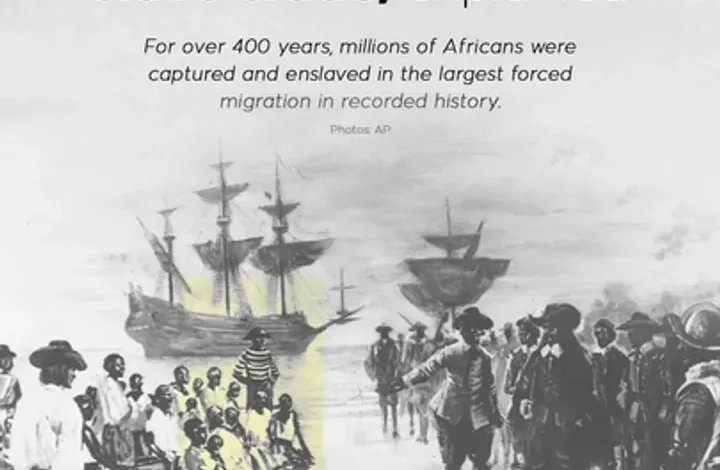
They must address the structural injustices that persist today, the unfair trade rules, the biased financial architecture, and the unequal representation in global governance.
True reparations demand a reconfiguration of global trade systems to end Africa’s dependence on raw commodity exports.
Related
They demand transforming the international financial architecture that imposes an “African premium”, higher borrowing costs simply because of our geography. They demand the restitution of African sovereignty over our natural resources and policy choices.
These are not gifts to be requested. They are changes to be demanded, negotiated, and, where necessary, enforced through unified continental action.
When Africa speaks with one voice, the world listens.
Look at what is emerging under leaders like Ghana’s President Mahama, who has articulated a coherent reparations doctrine linking historical injustice to contemporary economic distortion.
His argument, advanced at the United Nations, the World Economic Forum, and the African Union, reframes reparations not as charity but as structural correction.
This is the right approach. Not asking for handouts, but demanding a level playing field.
Not pleading for compensation, but insisting that the rules of the global economy be rewritten to end centuries of extraction and exploitation.
The West will never hand us dignity; we must claim it. The chains that bind us now are invisible, the chains of economic dependency, cultural imitation, and psychological inferiority, but they can be broken by consciousness. True freedom is not given; it is reclaimed.
Look around Africa and ask hard questions.
Why do our lawyers and judges still wear grotesque wigs that belong to another era and another people, remnants of humiliation rather than symbols of wisdom?
Why do our presidents wear suits and ties under the blazing African sun?
Why do our children study the rivers of Europe but not the watersheds of their own homelands? Why do we name our regions Eastern, Western, and Northern, as though we have no heritage worth naming ourselves after?
No nation has developed by denying its roots. None has prospered by feeding on the leftovers of another’s harvest.
America listened to Emerson’s call to detach from Britain’s shadow and grew. Japan developed teaching in Japanese.
China teaches in Mandarin. Only in Africa does one still believe fluency in another’s tongue is a badge of intelligence.
Borrowed eyes
Language is the first battlefield of liberation. To speak another man’s language is to think in his logic and dream in his symbols. The coloniser knew this well, which is why he taught us to despise our mother tongues.
But we can reclaim them. We can develop Swahili, Hausa, Yoruba, Igbo, Shona, Bemba and a hundred others as languages of education, technology, and governance. Until we do, we will continue to think of ourselves through borrowed eyes.
The same applies to our natural resources. We must process our minerals before export. We must refine our oil.
We must manufacture our chocolate. We must build our own industries. This is not protectionism; it is the path every developed nation has taken.
The deterioration of global aid frameworks, with OECD assistance falling nine percent in 2024 and projected to decline further, should be viewed not as a crisis but as an opportunity.
Just a reminder that relying on external financing is a dead end. Mobilising domestic resources, strengthening tax collection, curbing illicit financial flows, and harnessing our sovereign wealth funds are the only sustainable paths forward.
Africa needs at least an additional $245 billion annually for development. This gap will not be filled by reparations cheques.
It will be filled when we collect the taxes owed to us, stop the $90 billion lost annually to illicit outflows, and negotiate extractive contracts that truly benefit our people .
Let me be clear: I am not saying forget. Never forget. The slave trade and colonialism were crimes whose scars still mark our continent. We should teach our children the full truth of what happened.
We should demand that Western nations acknowledge their historical responsibility. We should pursue the restitution of looted artefacts and the return of stolen remains.
Time for building
But we must stop defining ourselves by what we are owed. We are not victims awaiting compensation. We are architects of our own renaissance.
The West wronged us. They will never fully admit it, never fully compensate, never fully change. That is their moral failure. Our failure would be to wait for them.
Let us instead focus on what we can control: our mindset, our priorities, our resources, our future. Let us build the Africa our ancestors fought for, not one begging for justice, but one demanding respect through strength.
Let us treat every Western transaction with the scepticism it deserves, negotiate every agreement with the toughness our interests require, and build every institution with the resilience our children deserve.
The time for asking is over. The time for building is now.
🚨BREAKING: Watch The Video Clip Here ➤