BOOK REVIEW: Paradise Deferred: Structural Violence, Neocolonialism, and the Politics of Survival in Iyorwuese Hagher’s A Portrait of Paradise

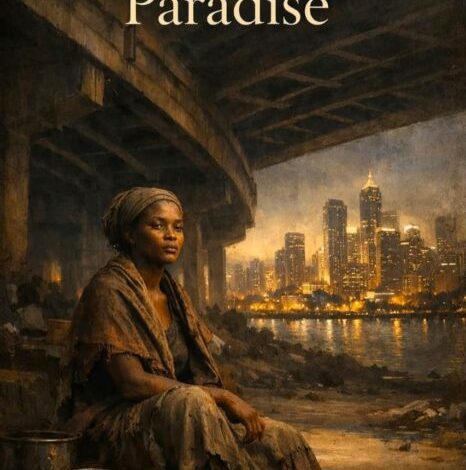
Reviewer: Rita Iorbo, PhD
A Portrait of Paradise crafts a world that is fictional in name but unmistakably real in feeling. Sofalia, the novel’s setting, is not merely a backdrop—it is a living, breathing environment shaped by inequalities, excesses, and neglect. From the very first pages, the reader is drawn into a society where gleaming wealth exists just a short distance from profound deprivation, where the promise of democracy masks a deeper reality of exclusion and control.
A Portrait of Paradise is intense in its refusal to soften the edges of reality or offer easy consolation.
What unfolds is not simply a narrative, but an invitation to reflect. The reader is asked to consider uncomfortable questions: How does a society come to accept such deep inequality as normal? Who benefits from systems that marginalize the vast majority? And perhaps most importantly, what does “paradise” truly mean when it is accessible only to a privileged few? The irony embedded in the title becomes increasingly apparent as the story progresses—paradise exists, but only for those positioned at the very top.
Structural Violence and Everyday Inequality
One of the most powerful elements of the novel is its portrayal of division. The separation between the “Ogas,” (the elite) who occupy positions of wealth and influence, and the “Atsan,” (the poor masses) who struggle daily for survival, is not just a matter of income—it is a complete social divide that shapes identity, opportunity, and dignity. Hagher paints this divide in vivid detail. The elite live behind tall walls—both physical and symbolic and are protected by security, insulated by privilege, and sustained by systems that work in their favour. Their environments are marked by order, comfort, and abundance. In contrast, the Atsan, or the poor masses, inhabit spaces of improvisation: makeshift shelters, overcrowded neighbourhoods, and neglected shanties where survival depends on ingenuity and resilience.
This is where the concept of structural violence becomes tangible. As articulated by peace researcher Galtung (1969), violence is not always visible; it can be embedded in the very economic and political structures that organize society. In Sofalia, the absence of healthcare, education, and formal recognition for the poor is not accidental—it is systemic. People are not simply struggling; they are being systematically denied the means to live with dignity. The recurring image of life beneath the bridge is especially striking. It is more than a physical location—it is a metaphor for invisibility. Above the bridge, life moves quickly, efficiently, and with purpose.
Neocolonialism and Global Influence
While Sofalia’s internal inequalities are deeply entrenched, the novel also makes it clear that these conditions do not exist in isolation. There are forces beyond the nation’s borders shaping its trajectory—financial institutions, multinational corporations, and global systems of exchange that dictate terms rather than negotiate them. Hagher’s portrayal resonates strongly with Kwame Nkrumah’s (1965) idea of neocolonialism, where political independence does not equate to true autonomy. Instead, control is exercised through economic dependency, policy influence, and the strategic flow of capital. Sofalia may appear sovereign, but its decisions are constrained by external pressures and expectations.
Immanuel Wallerstein’s (1974) world-systems theory further illuminates this dynamic. Sofalia occupies a peripheral position within a global hierarchy, supplying resources, cheap labour and absorbing pressures while receiving limited benefits in return. Development, in this sense, becomes uneven and selective, benefiting elites while bypassing the vast majority.
What makes the novel particularly compelling is its refusal to present Sofalia as merely a victim. The local elite are deeply implicated in maintaining this system. They negotiate deals, facilitate extraction, and secure their own positions within the global order. This dual role, as both participants and beneficiaries, adds a layer of complexity that challenges simplistic narratives of blame.
Power as Performance
Power in Sofalia is not subtle; it is staged, displayed, and performed. Senator Kanyi Mulaake stands at the center of this spectacle, embodying a form of leadership that is as theatrical as it is exploitative. His presence is overwhelming: long convoys, crowds, gestures of generosity that appear spontaneous but are carefully calculated. Hagher captures the sensory dimension of this performance—the noise of engines, the spectacle of wealth, and the choreography of public appearances. These are not incidental details; they are central to how power operates. Authority is reinforced not only through policy or coercion, but through visibility and repetition.
This aligns with Mbembe’s (2001) analysis of the postcolony, where power often manifests through excess and spectacle. In such contexts, the line between governance and performance becomes blurred. Leaders do not simply govern. They act, they display and they command attention. Yet beneath this performance lies a deeper emptiness. The gestures of generosity do little to address systemic issues of division and inequality. Instead, they create momentary relief while reinforcing long-term dependency. Hagher’s satire exposes this contradiction with sharp clarity, revealing a system that prioritizes appearance over substance.
Gender and the Cost of Survival
The experiences of Aishatu and her mother bring the novel’s broader themes into intimate focus. Through their lives, Professor Hagher, whose writings spans over five decades seek justice for the downtrodden, shows how structural inequality is felt on the body—how it shapes choices, limits possibilities, and leaves lasting marks. Their story is not told in abstraction; Hagher grounds it in lived experience and pushes the reader to encounter moments of vulnerability, fear, and quiet endurance. These are not extraordinary events; they are part of everyday life for those navigating poverty without protection.
Feminist scholars like bell hooks (2000) significantly advanced the understanding of inequality by emphasizing that gender cannot be analyzed in isolation. Her work argues that sexism, racism, and classism are interlocking systems of domination, requiring a comprehensive approach to liberation that goes beyond single-issue activism, and Hagher’s narrative reflects this insight. Women in Sofalia face layered challenges, where economic hardship intersects with social expectations and vulnerability to exploitation. What is particularly striking is the absence of sentimentality. The novel does not frame suffering as heroic or redemptive. Instead, it presents it as it is—complex, painful, and often unresolved. Aishatu’s story lingers, not because it offers closure, but because it resists it.
Conclusion
A Portrait of Paradise is a novel that stays with the reader long after it ends. It is not easily categorized as either fiction or critique. It is both, woven together in a way that challenges and provokes. Through its portrayal of Sofalia, the novel invites readers to confront difficult realities about inequality, power, and survival. It asks what it means to live in a society where opportunity is unevenly distributed and where systems designed to serve instead exclude. The idea of “paradise” becomes deeply ironic. For some, Sofalia offers comfort, security, and abundance. For others, it offers struggle, invisibility, and endurance. This duality is at the heart of the novel’s power.
Ultimately, Iyorwuese Hagher’s novel is not just about Sofalia. It speaks to broader patterns that can be recognized across different contexts. The novel reminds us that systems of inequality are not abstract; they are lived, experienced, and felt. And in doing so, A Portrait of Paradise leaves its readers with a lingering question: if this is paradise, for whom does it truly exist?
Rita Iorbo, PhD
Jindal School of International Affairs
O.P. Jindal Global University, Sonipat, India
🚨BREAKING: Watch The Video Clip Here ➤