When Muhammadu Buhari came to power in 2015, he rode on a singular promise: kill corruption before it kills Nigeria.
Nearly a decade later, that promise is being tested in the harshest possible way—not by opposition rhetoric, but by a trail of investigations, court cases, and explosive allegations involving some of the most powerful figures in his own cabinet.
Across critical sectors—humanitarian services, power, aviation, justice, and monetary policy—billions of naira meant for national development are now subjects of scrutiny. The question is no longer whether there were lapses. The question is how deep the rot really goes.

Feeding the Poor—or Feeding a System?
At the Ministry of Humanitarian Affairs, the mandate was clear: protect Nigeria’s poorest citizens.
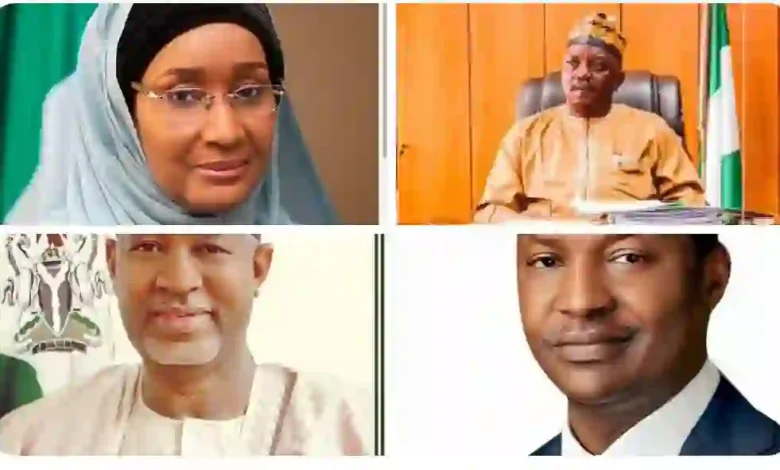
Yet, under Sadiya Umar Farouq, funds meant for social intervention programmes are now under investigation. Billions allocated to ease poverty have become the focus of probing by anti-graft agencies.
For a country battling extreme inequality, the implications are devastating.
If the safety nets fail—or worse, are compromised—what remains for the millions who depend on them to survive?
Power Sector: Darkness, Debt, and Damning Allegations
Nigeria’s electricity crisis has long been a national embarrassment. But the case against Saleh Mamman suggests something far more troubling than inefficiency.
Standing trial over alleged ₦33.8 billion fraud linked to the Mambilla Hydropower Project, Mamman’s case cuts to the heart of Nigeria’s development paralysis.
This is not just about missing money.
It is about a project that could have powered millions of homes—now overshadowed by claims of financial diversion.
In a country where darkness cripples industry, every naira lost to alleged corruption has real, measurable consequences.
Nigeria Air: National Pride Grounded by Controversy
The proposed national carrier, Nigeria Air, was sold as a bold return to global aviation relevance.
Instead, it has become a lightning rod for allegations.
Former Aviation Minister Hadi Sirika is facing charges over claims that public contracts were funneled to entities allegedly linked to his family.
What should have been a symbol of national ambition now raises a different question:
Was Nigeria Air ever about national interest—or private networks cloaked in public policy?
Justice in Question: The Watchdog Under Watch
As Attorney General, Abubakar Malami was Nigeria’s chief legal gatekeeper.
But his tenure has been dogged by allegations of unexplained wealth and controversial decisions that drew widespread criticism.
No court has pronounced him guilty of the massive figures often cited in public discourse. Yet, the scale and persistence of the allegations raise a fundamental concern:
If the custodian of justice is repeatedly questioned, what happens to public confidence in the system itself?
Central Bank: Power Without Transparency?
Few offices wield as much influence as the Central Bank. Under Godwin Emefiele, that power expanded dramatically—and controversially.
Now facing multiple charges, Emefiele’s tenure is being dissected in courtrooms and public discourse alike. Allegations range from procurement irregularities to broader questions about financial governance.
For many observers, this is bigger than one man.
It is about how much unchecked authority can exist in institutions meant to stabilize the economy.
—
A Government of Contradictions
Individually, these cases are still subject to legal determination. The principle of innocence until proven guilty remains sacrosanct.
But taken together, they reveal a disturbing pattern:
Critical ministries under investigation
Massive sums tied to alleged misconduct
Flagship national projects clouded by controversy
This is not an isolated failure.
It is a systemic warning sign.
—
The Verdict Beyond the Courts
The courts will decide guilt or innocence. But Nigerians are already delivering a different kind of judgment—one shaped by lived experience.
Persistent poverty.
Unstable power supply.
Unfinished projects.
Eroded trust.
These are the real-world consequences of governance failures—alleged or otherwise.
—
The Question That Will Not Go Away
For an administration that defined itself by anti-corruption, the legacy now faces a stark and uncomfortable question:
Did the system fight corruption—or did corruption adapt and thrive within it?
Until every allegation is tested, every case concluded, and every kobo accounted for, that question will remain—
loud, unresolved, and deeply unsettling.
🚨BREAKING: Watch The Video Clip Here ➤