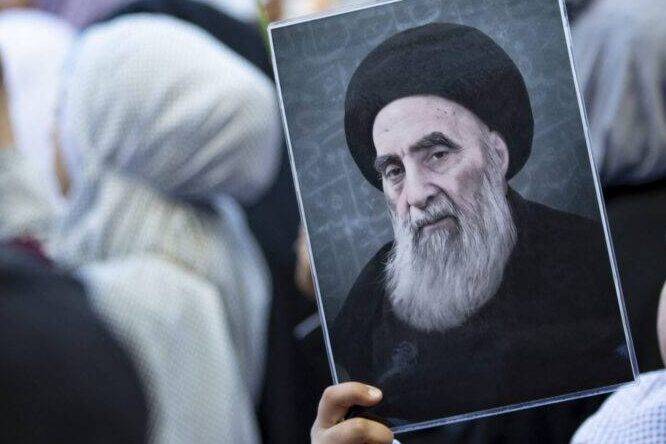
The question posed by the title of this article is more than just a political inquiry. At its core, it is a question about the nature of authority in Iraq, the limits of the state, and the role that a single cleric can play when domestic crises intersect with regional confrontation. Although the question borders on wishful thinking, many people inside and outside Iraq believe that the answer could be yes — if Grand Ayatollah Ali al-Sistani chooses to act. However, this “yes” is neither simple, nor guaranteed, nor risk-free.
Today, Iraq is at the centre of an open confrontation between the United States and Iran, with its territory serving as a convenient arena for this conflict. Iran-aligned armed factions target US positions, Washington responds with strikes inside Iraq, and Iran launches attacks under the pretext of hitting ‘US interests’. The same factions also target Iraqi state institutions. It is an absurd situation: a country under attack from both outside and within, with armed groups operating on its soil that do not answer to its government yet claim to speak in its name.
In this context, turning to Sistani seems like an attempt to return to the last remaining source of national legitimacy. The man whose portrait is displayed more frequently than that of any president on Iraqi streets has become the figure successive governments invoke whenever they face an existential crisis. However, the key question is not whether Sistani could issue a binding religious edict calling for the dissolution of armed factions, but whether such an edict would be obeyed. A fatwa that fails to result in action would undermine the prestige of the religious authority and reveal the extent of its influence at a critical moment.
The crisis is no longer purely domestic. In the space of a week, three Iraqi diplomats were summoned to Washington, Riyadh and Kuwait in protest at attacks attributed to Iraqi factions with links to Iran. The United States labelled an attack near Baghdad airport as a ‘terrorist attack’; Saudi Arabia informed the Iraqi ambassador of its rejection of ‘attacks originating from Iraqi territory’; and Kuwait protested the storming of its consulate in Basra. These synchronised summonses reveal the extent of Iraq’s diplomatic vulnerability and the government’s inability to rein in the factions that act as parallel power centres to the state.
Against this backdrop, appealing to Sistani has become an almost unavoidable option for Prime Minister Mohammed Shia al-Sudani, who lacks real authority over these groups. Yet Sistani’s political role remains enigmatic.
Although he publicly rejects the fusion of religion and politics, he finds himself — willingly or not — serving as the ultimate arbiter, called upon to bless constitutions, electoral laws and even the creation of the Popular Mobilisation Forces (PMF).
When the PMF later slipped beyond state control and Sistani was asked to issue a fatwa to dissolve it, he responded that his 2014 ‘defensive jihad’ edict had been intended to mobilise Iraqis against the advance of the Islamic State, not to found a permanent paramilitary structure, and therefore could not be used as a basis to dismantle the PMF.
This contradiction is embodied in a small, old house located in one of Najaf’s narrow alleys, which are too narrow for cars to pass through. The dwelling itself is modest, yet since 2003 it has been a political centre of gravity. Paul Bremer, the US civil administrator of Iraq, recognised this within days of the invasion, as did Iraqi politicians soon after: the road to power runs through the threshold of that house.
Despite retaining his Iranian passport and repeatedly refusing Iraqi citizenship, and despite the pleas of politicians; Sistani has become the figure who effectively defines the boundaries of political legitimacy in Baghdad.
The deeper paradox is that a man who has appeared in public only a handful of times and whose daily life remains largely unknown has become the most influential figure in the future of a decaying state. Those close to him insist that he has lost faith in the political class and closed his door to its members. Yet that same class continues to cling to his oft-cited phrase, ‘in accordance with the guidance of the wise religious authority’.
The question remains unresolved:
Can Sistani save Iraq?
The answer depends on three key factors.
Firstly, it depends on the willingness of armed factions to comply.
This is far from assured. These groups have their own sources of funding and weaponry, and they are part of regional networks that go beyond the Iraqi state.
Secondly, there is the capacity of the Iraqi state to implement any fatwa.
Even if Sistani were to issue a clear and forceful edict, its implementation would require a capable state apparatus, which Iraq currently lacks.
Thirdly, there is Iran’s position.
These factions play a role in a broader regional strategy. Any change in their status inside Iraq must be considered in the context of Tehran’s calculations and its use of Iraqi territory and actors as tools of deterrence and leverage.
Therefore, the real question may not be whether Sistani can save Iraq, but whether Iraq can save itself from relying on one man.
A state whose political legitimacy is effectively anchored to the doorstep of a small house in a cramped Najaf alley cannot fully reclaim its sovereignty without redefining the nature of its authority.
The views expressed in this article belong to the author and do not necessarily reflect the editorial policy of Middle East Monitor.
🚨BREAKING: Watch The Video Clip Here ➤