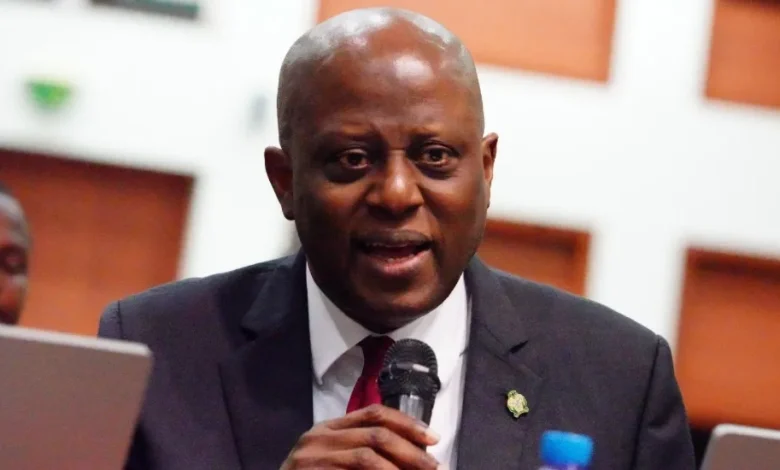
Nigeria’s determination to achieve single digit inflation rate is fully on course despite sudden rise in March figures due to ongoing Middle East crisis and other related headwinds. Governor of the Central Bank of Nigeria (CBN) Olayemi Cardoso said Nigeria will achieve single digit inflation rate despite marginal rise in inflation rate to 15.38 per cent in March from 15.06 per cent in February.
The economy’s growth prospects and resilience to global shocks in the face of headwinds are positive results gained from the CBN-led financial sectors reforms and quest for stronger economy.
Globally, inflation has been acknowledged as the biggest enemy of growth, the biggest enemy of the common man.
For Nigeria, over two-years economic reforms have boldened the economy, preparing it withstand shocks and thrive in the face of diverse headwinds.


Nigeria is today well positioned to with stand external shocks. There exists, strong recognition and recommendations that Nigeria’s economic reforms have gained domestic and global investors’ confidence.
Speaking during the International monetary Fund (IMF)/World Bank Spring Meetings in US, Central Bank of Nigeria (CBN) Governor, Olayemi Cardoso, said Nigeria’s experience indicates that spillover effects from the Middle East crisis which led to marginal rise in inflation rate in March has been relatively contained.
He said the ability of the economy to contained the economic headwinds from the crisis reflects positive reform outcomes, including exchange rate stability, stronger reserve buffers and an enhanced monetary policy framework.
Cardoso said, “We are not relenting on continuing to build resilience and also to stay the course with respect to something we have constantly been talking about, and that is bringing down inflation to single digits. In spite of all that is going on, we will stay that course.”
Already, the National Bureau of Statistics (NBS) led by the Statistician-General of the Federation and NBS CEO, Prince Adeyemi Adeniran, says Nigeria’s headline inflation rate has increased to 15.38 percent in March 2026 up from the 15.06 percent in February.
The increase is the first in 12 months since the inflation rate started declining in April 2025. “The Headline inflation rate rose to 15.38 per cent, up from 15.06 per cent in February 2026 and stood 27.35 per cent in the same month of the preceding year (March 2025),” NBS said.
The bureau said the headline inflation rate showed an increase of 0.32 percent compared to the February 2026 headline inflation rate.
“However, on a month-on-month basis, the Headline inflation rate in March 2026 was 4.18 per cent which was 2.17 per cent higher than the rate recorded in February 2026 (2.01 per cent),” NBS said.
President Bola Tinubu has also directed the economic managers to institute policies that will reduce the impact of the Middle East crisis on the masses.
CBN’s Inflation Targeting Measures
The CBN says structural reforms are beginning to filter through to the broader economy, helping to stabilise the naira and ease lending rates as inflation continues to moderate.
For the apex bank, the monetary policy actions reflect a deliberate strategy to restore macroeconomic stability after years of fiscal and external pressures.
These developments reflect the commitment and focus of the bank’s leadership in restoring stability to the financial system, lowering lending rates are emerging as one of the tangible outcomes of the CBN’s policy trajectory.
The CBN said alignment of fiscal and monetary policies is indispensable at a time when technological innovation and digital finance are rapidly transforming the financial landscape.
The CBN under Cardoso is cultivating multiple FX sources to increase dollar inflows, boost dollar access to manufacturers and retail end users.
From moves to improve diaspora remittances through new product development, the granting licenses to new International Money Transfer Operators (IMTOs), implementing a willing buyer-willing seller FX model, and enabling timely access to naira liquidity for IMTOs, the apex bank has simplified dollar-inflow channels for authorized dealers and other players in the value chain.
The move has led to substantial accretion to the gross FX reserves and supported the stability of the naira.
Given that FX inflows to the economy are strategic in achieving monetary and fiscal policy stability, the CBN under Cardoso puts in a lot of efforts in attracting more inflows into the economy.
Diaspora remittances to Nigeria, estimated at $23bn annually remain a reliable source of forex to the domestic economy. There are also other sources and policies that are being explored by the apex bank to keep dollar inflows coming.
Cardoso said Nigeria makes roughly $600m monthly from diaspora remittances inflows to the economy.
He said recent gains, including lower inflation, FX market stability and stronger reserves, have boosted investor confidence and capital flows.
The International Monetary Fund (IMF) applauded Nigeria’s economic policies, saying the domestic reforms have brought visible results.
IMF Director, African Department, Abebe Selassie, disclosed this during the presentation of the Regional Economic Outlook for Sub-Saharan Africa, at the Annual meetings in Washington DC.
He said the effects of sound domestic policy choices instituted by the Nigeria fiscal and monetary authorities were increasingly visible.
Selassie disclosed that macroeconomic reforms and stabilization efforts, including strengthening of fiscal positions, created conditions for stronger growth and lower inflation.
What do you think about this?
Drop your opinion in the comment section.
FOLLOW US & Share this with someone who needs to see this.
🚨BREAKING: Watch The Video Clip Here ➤