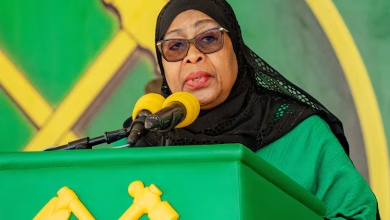
Sanctions, deemed effective by the EU when applied so swiftly to Russia and Iran, do not have the same effect when it comes to Israel, according to EU Foreign Policy Chief Kaja Kallas. Asked about the EU’s double standards when it comes to Israel so swiftly applied by the EU to Russia and Iran, Kallas retorted, “A suspension of the association agreement, will it stop the expansion [by Israeli settlers] on the West Bank? You know this is probably also not true.”
On its own, no. Sanctions will not stop the Israel from its colonial expansion. But suspending Israel from the EU-Israel Association Agreement is not supposed to stop settlement expansion. What it should do is stop the agreement on grounds that Israel is not respecting human rights and democratic principles, as Article 2 states. In reality, this reasoning is also flawed; the EU knew that Israel had no respect for human rights and democratic principles since its establishment on ethnically cleansed Palestinian territory. Departing from that historical reality, the EU-Israeli Association Agreement should have never been enacted.
The EU, however, ignores history and conceptualises Israel as a democracy instead of a colonial enterprise.

That is why Article 2 exists – it puts Israel on a par with democracy and expects respect for human rights and democratic principles as is expected from a democratic country. However, democracies are flawed as the EU continues to illustrate repeatedly, and colonialism does not even come close to an aberration of democracy. It is an illegality under international law, which makes the EU-Israel Association Agreement an example of how democracy and colonialism collude against human rights and international law.
Kallas is adding a new dimension to the impunity the EU reserves for Israel – feigning helplessness in the face of colonial settlement expansion and blaming it on the limits of the EU-Israel Association Agreement. Nothing except supporting decolonisation will stop settlement expansion. That means hypothetically, the EU would completely sever ties with Israel and adopt an anti-colonial stance against Israel.
The EU, however, has invested in Palestine’s deterioration, which means that it is also invested in Israel’s colonial expansion. So much, in fact, that it prefers to feign diplomatic helplessness rather than commit to severing a fragment of EU-Israeli cooperation.
If the EU merely debated suspending the agreement during Israel’s genocide in Gaza, how will it find reason to suspend it now, when the ceasefire rhetoric holds more value than what is really happening in Gaza – a slow, normalised genocide that the EU, like the rest of the international community, can manage through discussing human rights violations in isolation?
Kallas is not merely employing double standards. The EU is clarifying that when it comes to Israel, it will not take any steps to stop human rights violations, not even completely suspending the EU-Israel Association agreement which is as much tangible as it is symbolic, considering Israel’s colonial structure and the EU’s dependency on Israel. According to Kallas, if suspending the agreement doesn’t stop settlement expansion, then suspending the agreement is futile. Decolonisation would stop settlement expansion as it deconstructs colonialism. Is the EU willing to deconstruct colonialism and its role in maintaining it?
The views expressed in this article belong to the author and do not necessarily reflect the editorial policy of Middle East Monitor.
🚨BREAKING: Watch The Video Clip Here ➤