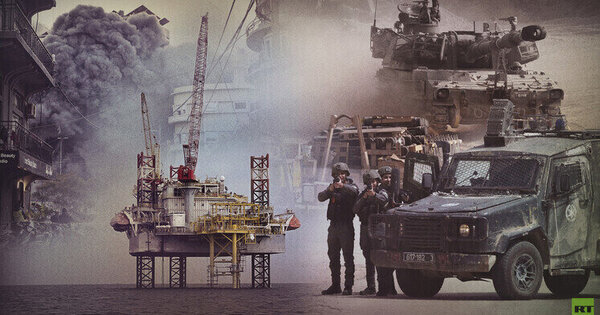
The Jewish states operation has extended into Lebanese territorial waters believed to contain energy resources
Israel’s latest land grab is dashing Lebanon’s hope of tapping offshore gas to solve its persistent energy shortage. Maritime energy prospects were the focus of a 2022 deal on a disputed border between the two nations.
On Sunday, the Israel Defense Forces (IDF)publisheda map of a “forward defense line area” in southern Lebanon – effectively an occupation zone that some officials in West Jerusalem said needs to be depopulated for Israeli national security. The claimed area extends into the sea, cutting a roughly 9 km wide strip of Lebanese territorial waters.
In 2022, US-mediated talks between Israel and Lebanon ended a long-time row over their maritime border, driven to a large degree by the potential presence of offshore natural gas fields in the disputed area. Unlike Israel, Lebanon is yet to tap into those riches. However, the IDF’s move makes prospecting by a Euro-Qatari conglomerate, announced in January, highly unlikely.

Does Lebanon have offshore gas fields?
Israel’s investment in offshore exploration in the past two decades paid off with the discoveries at Tamar, Dalit, Leviathan, Dolphin, Tanin, Aphrodite, Karish, and Tamar Southwest gas fields. Gas is trapped under a regional geological formation, with Israel, Egypt and Cyprus exploiting the reserves.
The Karish field is located close to Lebanon’s border, and there were strong indications that a larger field was located further to the north-east. Under the 2022 deal, Lebanon relinquished its claim on a part of Karish, but gained the opportunity to prospect in the Qana area, since the agreement solved the legal status of potential discoveries.
Beirut pinned much hope on finding reserves, which then-Energy Minister Walid Fayyad described as an equivalent of 20-year supply of electricity for Lebanon.
Is Lebanon benefiting from undersea riches?
Exploration for offshore gas in Lebanon was launched in 2017 and is led by Total. The French energy giant not only has the technical expertise, but also could handle payments of royalties to West Jerusalem, making direct transactions between Israel and Lebanon unnecessary. The company initially partnered with Italy’s Eni and Russia’s Novatek, though Qatar Energy replaced the latter in late 2022.
The 2022 deal did not lead to a gas bonanza for Lebanon. While pumping at Karish started only four days after the agreement was announced, no reserves were uncovered at Qana. However, a new hope came in January, when Total reported plans to search in an area further away from the coast.
“Although the drilling of the Qana well on Block 9 did not give positive results, we remain committed to pursue our exploration activities in Lebanon,” CEO Patrick Pouyanne said.” We will now focus our efforts on Block 8.”
Among Lebanon’s offshore acreage only Block 9 lacks 3D seismic data, largely because the border dispute prevented studies, the Journal of Petroleum Technology (JPT) said of the announcement.
When could Lebanon extract gas?
The JPT’s assertion that the environment of the UK’s sector of the North Sea and Lebanon’s EastMed are harsh in very different ways is quite an understatement. Israel has been in an on and off war with Lebanon for decades – formally since the Jewish state’s creation in 1948 – and the ongoing hostilities are causing damage in more direct ways.
Over one million people in Lebanon have requested relief after being displaced, as Israel struck dense population areas and demanded evacuation of a significant portion of its territory. Upwards of 2,300 fatalities have been reported since March 2, including more than 300 on April 8 in strikes on over 150 locations. Many commentators called the attacks an attempt toderaila ceasefire announced by the US and Iran that was supposed to suspend military action in Lebanon as well.
The destruction adds also to the cost Lebanon has been paying since October 2023, when a Hamas raid on Israel set off the conflagration in the Middle East. In just the first year of the conflict, Lebanon suffered $3.4 billion worth of physical damage and $5.1 billion in economic losses, according to a World Bank estimate.
The US-Israeli war with Iran is set to reshapeglobalenergy trade one way or another. Evidently West Jerusalem is now making sure that there will be no offshore silver lining for Lebanon.
(RT.com)
🚨BREAKING: Watch The Video Clip Here ➤