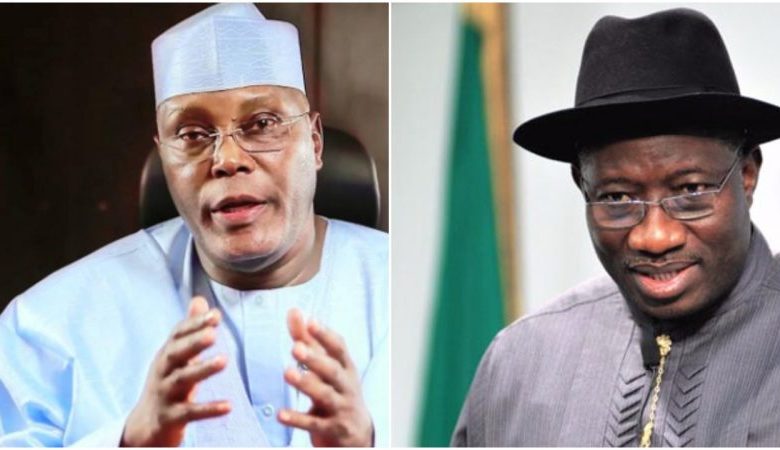
Former Nigerian President Goodluck Jonathan has responded to recent remarks by Atiku Abubakar, who described him as a “decent” yet “inexperienced” leader during his time in office.
Atiku, a prominent figure within the African Democratic Congress (ADC), made the comment during an appearance on Arise Television, where he linked some of the challenges faced under Jonathan’s administration to what he characterised as insufficient leadership preparation.
Although Jonathan did not directly mention Atiku by name, he addressed the criticism while speaking on Monday at the 2025 awards ceremony organised by the Association of Retired Career Ambassadors of Nigeria in Abuja.
Reflecting on the remarks, Jonathan questioned the notion that age or prior experience alone determines effective leadership. He acknowledged that mistakes are an inevitable part of governance, noting that no leader assumes office without encountering challenges.

“All human beings must make mistakes,” he said, adding that it would be unrealistic to expect perfection from anyone occupying such a demanding role. He further challenged the idea that leadership competence is tied to age, asking rhetorically whether one must reach an advanced age before being considered capable of running a nation’s affairs.
Jonathan also defended his record, suggesting that his ability to navigate the complexities of Nigeria’s political landscape demonstrated a level of competence that contradicted claims of inexperience.
“If I were so naive, I don’t think I would have been able to navigate that process,” he remarked, pointing to the political transitions and pressures that defined his tenure.
Jonathan assumed office as President following the death of his predecessor, Umaru Musa Yar’Adua, in 2010. His administration oversaw a period marked by economic challenges, security concerns, and political reforms, all of which have continued to shape public debate about his legacy.
The exchange highlights ongoing tensions and differing perspectives among Nigeria’s political elite, particularly as discussions around leadership, governance, and accountability remain central to the country’s democratic discourse.
Observers note that such public disagreements are not uncommon, especially among senior political figures with longstanding influence. However, they also reflect broader questions about the qualities required for effective leadership in a complex and evolving political environment.
🚨BREAKING: Watch The Video Clip Here ➤