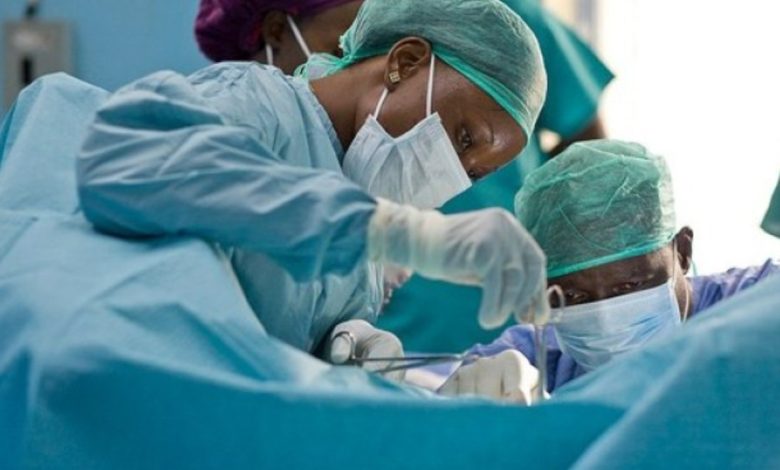
For quite a number of years now, Nigerians have been lamenting the preference by public officials to travel overseas for medical treatment of ailments that are as simple as malaria instead of fixing and making use of the country’s medical facilities.
This practice is particularly more pronounced among politicians and some top government officials, as well as some wealthy private individuals.
Most often, politicians and government officials embark on such trips using the public funds at the expense of the poor masses, whose wealth is being squandered, and who ordinarily deserve good, efficient and effective medical facilities.
Many Nigerians are not happy over the development. Their anger stems from the fact that these public officers have deliberately refused to fix the country’s health sector.


Those who express this sentiment also argue that these sets of public officers control the levers of power at different levels of government, meaning that they are in a vantage position to fix the country’s health sector so that both the rich and the poor can have access to good medical care. Another worry is that most of these foreign hospitals where Nigeria’s public officers rush to for medical care are dominated by Nigerian medical personnel, who escaped from the country in search of greener pastures.
Last year, Nigeria’s former president, Muhammadu Buhari, who was on such a medical trip to London passed on. It was the Federal Government that took care of every bill ranging from the hospital bill to the cost of transport back home.
Concerned Nigerians are of the view that such huge expenses could have been avoided if he had fixed the country’s health sector during the eight years that he ruled the country.
Apart from ordinary Nigerians, medical experts have also decried the loss incurred by the Nigerian government to medical tourism yearly.
In fact, the experts revealed that Nigeria loses an average of $1.3billion to medical tourism annually.
This revelation was made recently when experts and stakeholders in the health sector gathered at the University of Medical Sciences (UNIMED), Ondo, for the fourth annual Public Health Grand-round, which was organised by the university’s Faculty of Public Health.
The university’s Public Relations Officer, Isaac Oluyi, who was the keynote speaker at the programme, themed, ‘Health Systems Strengthening: Building Resilience for the Future,’ said the World Health Organisation’s (WHO) Coordinator in Ondo State, Dr. Habibu Yahaya, submitted that health systems fragility results in about US$1.2 billion loss from the Nigerian economy to medical tourism yearly.
According to him, “This is not unconnected with the shocks often experienced by the country’s health system. Nigerian health systems face acute shocks including epidemics, pandemics and chronic stressors like poor funding and persistent strikes.”
Earlier, the acting Vice-Chancellor of the university, Professor Adolphus Loto had stressed the importance of system resilience in public health, saying, “A system has both input and output. Resilience is the ability of the system to withstand pressure without breaking.
“Building our health system to resist shocks, while continuing to deliver essential services, is non-negotiable.”
The medical experts posited that one of the factors responsible for weak health systems is the human resource gap.
The panelists at the event, drawn from the academia, the government and the health sectors spoke with one voice on the need for task shifting, improved remuneration, sustainable health financing, emergency preparedness and health security, community engagement and equity, innovation and research, better referral systems and use of accurate workforce data to strengthen the health systems in Nigeria.
Acting Dean of Public Health, Professor Ofonime Johnson, described the grand-round as an annual scientific gathering that provides a platform for discussing emerging public health challenges.
However, speaking on the revelation that Nigeria spends over $1.3 billion annually on medical tourism, a public affairs analyst, James Osewele, decried the situation, describing it as a shame.
He was of the view that public officials, such as the president and his vice, governors and their deputies, as well as state and federal legislators, should be banned from accessing medical care overseas. He noted that such a drastic measure would be the first practical step to fixing the country’s sector so that it can serve all persons, irrespective of class or position in society.
He said: “The figure, as far as I am concerned, is a modest estimation. I am sure that when proper statistics are taken, it could even double that amount.
“But, it is very shameful that a country as big as Nigeria cannot fix its own health sector, such that its presidents see foreign medical trips as part of governance.
“Look at what happened to former President Umar Musa Yar’Adua; he died in a London hospital. Thereafter, he was brought back to Nigeria in a body bag and buried.
“A similar thing repeated itself last year with the death of former President Muhammadu Buhari in the same London hospital. He was also brought back in a body bag and buried.
“Our current President Bola Tinubu has made foreign medical trips a routine since he assumed office as president. The same applies to so many other politicians in Nigeria.
“I strongly believe that unless there is a law in place to stop them from such foreign medical trips, our health sector can never work. But, if they are prevented from accessing foreign medical assistance, they would fix the health sector because they know they will equally use it.
“It is just like the argument that public officials should stop sending their children abroad for education. It is also believed that when such a thing happens, the issue of the incessant Academic Staff Union of University, ASUU strikes and other teething problems in the education sector would be a thing of the past.
“Public officials in Nigeria should be banned from going abroad for medical care. After all, most of the medical personnel, ranging from doctors to nurses, pharmacists and lab scientists, who attend to them over there are Nigerians.
“So, why won’t they build and equip hospitals with state-of-the-art modern medical equipment so that these medical professionals will stop migrating and stay back home to offer their services to their fatherland?
“When they do that, they would have killed even more than two birds with one stone. First, it will create jobs for the country’s medical personnel who are moving in droves to foreign lands in search of greener pastures.
“Secondly, it would reduce unnecessary wastage for the country as they would no longer be spending foreign currency to get medical help but Nigeria’s local currency, the Naira. Thirdly, it will also attract outsiders, who would also come to Nigeria for medical services. In fact, the benefits are many.”
Also speaking, a medical doctor with a private hospital in Lagos, Davies Olanrewaju, equally agreed that the figure released by the experts at the medical university in Ondo was moderate.
He stated that the actual figure is far more than that.
He decried the way medical personnel, particularly doctors, are treated in Nigeria.
He noted that apart from inadequate incentives to motivate them, the working environment is also not encouraging.
“So, when one has an opportunity to go out of the country, he or she doesn’t think twice. This is because apart from the passion to save lives, doctors also want to make money and be able to solve family and other personal financial problems.
“And with what they are paid in Nigeria, no doctor will think twice when the opportunity to travel overseas to practice beckons,” he told DAILY POST.
Also, a nurse, Mrs Omoruyi Victoria condemned the state of health facilities in Nigeria, stressing that she feels nostalgic each time she remembers that there was a time when foreigners came to Nigeria to receive medical care.
“Each time I remember what we were told about the royal family of the Saudi Arabian king coming to Nigeria for medical care sometimes in the past, I shudder.
“The question is: what went wrong? I think our leaders just stopped financing the health sector.
“Nigeria’s annual health budget is far below the United Nations’ minimum standard. It is a shame.
“If we expect our health care system to be like what obtains in developed economies, then our government must be serious with the health sector financing,” she stressed.
🚨BREAKING: Watch The Video Clip Here ➤