Donald Trump has leaned on a simple argument throughout the Iran war: the United States produces so much oil that the Strait of Hormuz is no longer America’s problem. It is an appealing line because it sounds like strength and independence at once. It is also deeply misleading. The real question is not whether the US still imports as much Gulf oil as it once did. It does not. The real question is whether Americans live inside a global energy system whose prices are still shaped by what happens in Hormuz. They do. And that means a serious shock in the strait would still hit the United States hard, not through dependence in the old import sense, but through exposure to globally priced oil, fuel, freight and inflation.
On paper, Trump can point to real changes. US crude production hit a record 13.6 million barrels per day in 2025, and only eight per cent of US crude imports came from the Middle East Gulf region that year. Those numbers help explain why many Americans assume the country has outgrown Hormuz. But they do not prove what Trump wants them to prove. They show that America imports less Gulf oil than before. They do not show that America is insulated from a shock in the world’s most important oil chokepoint. That is the sleight of hand in Trump’s rhetoric: he treats lower direct dependence as if it meant safety from global price transmission.
Hormuz still matters on a scale no slogan can erase. Around 20 million barrels a day move through the strait, roughly a quarter of the world’s seaborne oil trade, along with a major share of global liquefied natural gas. Pipelines can bypass part of this flow, but nowhere near enough to replace it all. That is why even short disruptions in Hormuz can have consequences far beyond the Gulf. The geography has not changed just because American drillers have become more productive. The waterway remains a pressure point for the entire energy system, and any US president who pretends otherwise is either ignoring the arithmetic or hoping the public will.
READ: Trump faces intense pressure to end “costly” Iran war as unilateral victory plan considered
The last few weeks have made that reality impossible to miss. After a brief ceasefire raised hopes that traffic might normalise, oil jumped again as renewed US-Iran tensions left shipping through the strait broadly disrupted and kept markets pricing in severe risk. Before the war began, Brent had already risen to around $70 a barrel as investors braced for military confrontation.
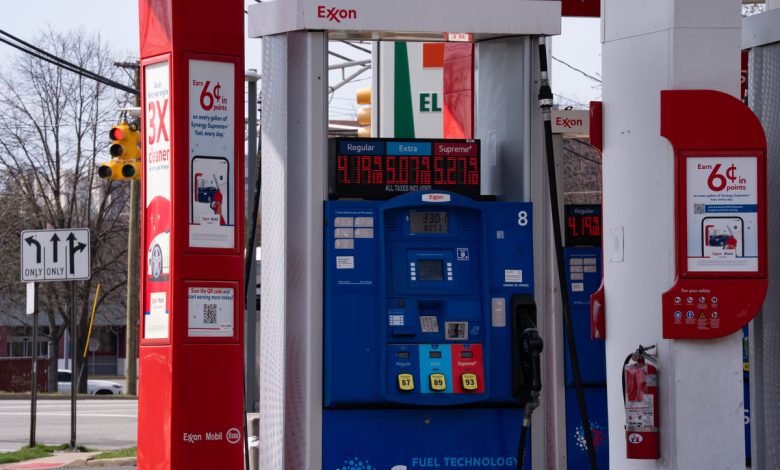
US crude climbed sharply, and the national US gasoline average moved above $4 a gallon for the first time since 2022. That was not because America suddenly ran out of oil. It was because the global market repriced risk. Trump’s illusion collapses the moment traders, refiners, shippers and insurers start acting on the fear that Hormuz is no longer secure.
This is where the economic argument becomes more important than the headline about imports. Gasoline in the United States is not priced by a patriotic count of how many barrels were pumped in Texas or North Dakota.
The largest component of the retail gasoline price is still the cost of crude oil, and crude is priced in a world market. Higher US production can slow the rise of fuel prices at the margins, but it does not break the link between American households and global oil shocks.
When Hormuz tightens, crude becomes more expensive, and that cost moves quickly into what Americans pay to drive, fly, ship goods and heat homes. Trump may want voters to think America can produce its way out of vulnerability. Energy markets do not work that way.
Nor does the damage stop at the pump. The IMF has already described the current conflict as a shock moving through energy, trade and finance, one that acts like a sudden tax on income for fuel-importing economies. The United States is not the most exposed country in that picture, but it is hardly exempt from the mechanism. Higher fuel costs spread through trucking, aviation, deliveries, agriculture and consumer expectations. The price of war does not stay confined to oil traders and diplomats. It appears in airline fares, food costs, corporate margins and political pressure on households already stretched by years of inflation. That is why the real issue is systemic exposure. America does not have to be heavily dependent on Gulf barrels to be hurt by a Hormuz crisis. It only has to remain part of the market that prices them.
That point matters politically because Trump’s misconception is not just an economic mistake. It is also a way of selling war. If Americans can be persuaded that the country is energy-dominant enough to shrug off Hormuz, then the administration can present escalation against Iran as strategically forceful but economically low-cost. That is the fantasy. In reality, the war’s costs are already spreading far beyond the battlefield. They are falling on consumers, on allies facing fuel shortages and inflation, and on governments scrambling to stabilise markets and calm voters. The language of energy independence becomes, in this context, less a description than a cover story for externalising risk.
For an American reader, the lesson should be plain. The United States is not protected from Hormuz because it drills more than it used to. It is still exposed because it cannot opt out of the global energy system while claiming to dominate it.
That is why Trump’s rhetoric is so dangerous. It invites the public to believe that a wider war with Iran can be fought without meaningful economic blowback at home. But the evidence points the other way. The strait remains critical, the market remains global, and the costs of confrontation are already reaching American households. The real vulnerability is not dependence in the narrow sense Trump prefers. It is the far more modern and far more inescapable reality of systemic exposure.
READ: Iran ties lifting of blockade to reopening Hormuz Strait as US reviews proposal
The views expressed in this article belong to the author and do not necessarily reflect the editorial policy of Middle East Monitor.
🚨BREAKING: Watch The Video Clip Here ➤