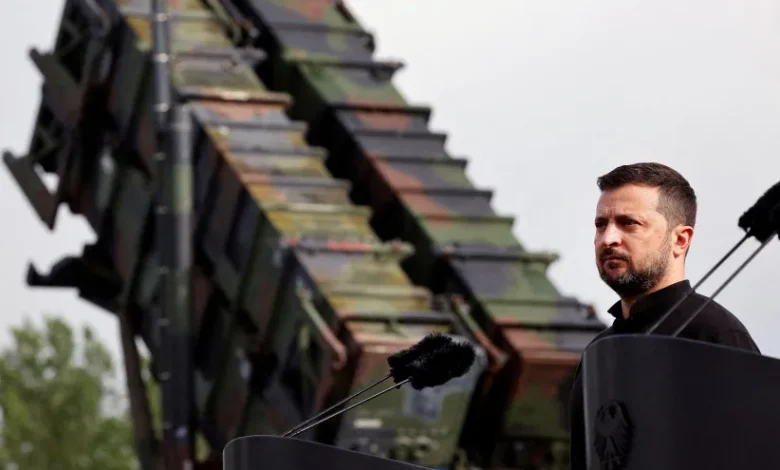
On April 13, Ukrainian President Volodymyr Zelensky announced that his country’s unmanned defense systems, including robotic ground platforms, had achieved new successes. “The future is already on the front line – and Ukraine is building it. These are our ground robotic systems. For the first time in the history of this war, an enemy position was taken exclusively by unmanned platforms – ground systems and drones. The occupiers surrendered, and the operation was carried out without infantry and without losses on our side.”
Ukraine has been a major innovator in the use of drones on the battlefield. Necessity is the mother of invention, so the saying goes, and Ukraine has had to innovate. It has produced a large number of drones for use on the front lines. This is necessary because the front line with Russia is very long, and Ukraine doesn’t have an unlimited number of troops. As such, the use of unmanned aerial systems, including small and medium-sized drones, is key to Ukraine’s success. Ukraine has taken this further than just throwing small drones into the fight. It has created a whole drone revolution in military defenses and offensive doctrine.
Ukraine is so successful in fighting off drone threats that Zelensky was recently touring the Gulf during the Iranian drone and missile war targeting Gulf countries. This is because Iran exported a drone to Russia, particularly the Shahed 136.
The third way that Ukraine is innovating, after drone offense and defense, is using unmanned ground vehicles, or robotic systems. This is changing the ground war. Small drones, such as quadcopters, can conduct surveillance and drop small bomblets, or kamikaze, into troops and armored vehicles. However, using ground robots to beef up frontline units is another way to deploy drones. The robots, basically small, armed vehicles, help troops defend a position or carry out logistics. Robots can also clear minefields or can be sent to do dangerous, exposed missions. They can also evacuate the wounded. The sky is the limit in terms of what you can do with these small robotic vehicles; it’s just a question of adapting them.


Zelensky pointed to several systems Ukraine is using. “Ratel, TerMIT, Ardal, Rys, Zmiy, Protector, Volia, and our other ground robotic systems have already carried out more than 22,000 missions on the front in just three months. In other words, lives were saved more than 22,000 times when a robot went into the most dangerous areas instead of a warrior. This is about high technology protecting the highest value – human life.” He added.
Zelensky spoke about other innovations. “The capabilities of Ukraine’s defense industry mean millions of FPV drones per year, our deep strikes, our interceptors, and millions of shells. Ukraine has its own long-range missile weapons. Not just in development, but a real force already at work. Flamingo and Ruta, Peklo and Neptune, Palianytsia and Vilkha – we can already be proud of all of this, but we will not stop here for sure. These are only our first steps – the industry will grow, and the enemy will feel it,” he spoke about the long range of Ukraine’s drones, which he says can now reach around 1,750km.
He also spoke about the naval war. “No one else has carried out missions like Ukrainians have in the Black Sea. When people talk about security in the Strait of Hormuz, it is often a theoretical discussion. Those who speak about it have not conducted such operations themselves. Ukrainians have. We have fought an enemy fleet, air strikes, and naval mines – we have been through all of it. And if partners offer us cooperation on equal footing, Ukraine can help.” He mentioned a few systems, such as “our naval drones, Sea Baby, Magura, and Sargan, are well-known, and this is Ukraine’s export offering too. As is our artillery, which we produce at the largest scale in Europe. As are our shells, which are now growing in numbers. As is our armor, which becomes more effective every year. All of this is delivered by our defense industry – our defense industry professionals, Ukrainian arms makers.”
Ukraine has a strong industrial base
Ukraine entered the war with a strong industrial base. It already had defense officials and innovators prepared to scale up innovation and production. In the last few years, the country has seen a huge revolution in these unmanned systems. Ukraine has had to do this during wartime, meaning it produces systems quickly and also has to sort through what works and what doesn’t.
Israel is another country that has been innovating in unmanned systems. Like Ukraine, Israel has faced a long and complex war in recent years. This war has also spurred innovation in air defenses and the development of new unmanned systems. There are systems that Ukraine and Israel are using that have some commonalities, such as small drones on the frontline as well as one-way attack drones, or what are called kamikaze drones or loitering munitions.
In many cases, Israel was an innovator in loitering munitions and drones going back to the 1980s and 1990s. What the Ukraine war has shown, as well as Israel’s complex wars in places like Gaza and Lebanon, is how these systems need to be scaled up and integrated into fighting forces. For instance, the need for systems to be man-packable or lightweight. The need for unmanned vehicles that can drive into areas that may be exposed to mines, IEDs, or enemy fire from anti-tank guided missiles or RPGs.
The battlefields that Israel and Ukraine have faced are different. Israel is a hi-tech army that is more powerful when it comes to its adversaries, who tend to be terrorist or insurgent groups. Ukraine, by contrast, has a smaller army than Russia and is fighting a conventional war on its own territory. However, the challenges remain the same for ground troops, including the use of new small drone systems and other unmanned systems, such as robotic systems. As the future of warfare changes, Ukraine and Israel are both pointing the way forward.
🚨BREAKING: Watch The Video Clip Here ➤