New posts
21:25
White House Confirms Mulling New Iranian Peace Proposal
White House Press Secretary Karoline Leavitt holds a briefing at the White House in Washington.
White House Press Secretary Karoline Leavitt confirmed that US President Donald Trump discussed a new Iranian proposal to resolve the two-month-old war, now under a cease-fire, with his top security aides on April 27.
While there was no immediate confirmation of the new plan by Tehran, Axios earlier cited three sources, including a US official,reportingthat Iran had proposed a new way to end the conflict. The proposal reportedly suggested that the United States reopen the Strait of Hormuz and that both sides postpone negotiations over Iran’s nuclear capabilities to a later stage.
“Well, only because it’s been reported, I will confirm the president has met with his national security team this morning,” Leavitt told journalists in Washington, adding that the meeting “may be ongoing.”
“The president’s red lines with respect to Iran have been made very, very clear, not just to the American public,” she said, refusing to get into the details before Trump.
Hours earlier, US Secretary of State Marco Rubio had also confirmed toFox Newsthat Washington has received the new proposal. He said he believed Iranian leadership was “serious” about making a peace deal amid the great economic pressure and shortage of industrial and military capabilities.
However, Rubio also suggested one of the obstacles to diplomatic resolution of the conflict was “fractured” leadership in Iran: “One of the impediments here is that our negotiators aren’t just negotiating with Iranians.”
“Those Iranians then have to negotiate with other Iranians in order to figure out what they can agree to,” he said, adding that Iranian hard-line policymakers “have the ultimate power in that country.”
As for the Strait of Hormuz, Rubio added US wouldn’t allow Iran to control the Strait of Hormuz. He said the United States wouldn’t “tolerate them trying to normalize, a system in which the Iranians decide who gets to use an international waterway, and how much you have to pay them to use it.”
The key waterway used to account for around one fifth of the global oil trade before US-Israeli military campaign which started on February 28.
Map: Strait of Hormuz (no title)
Share
Share
Copy link
Facebook
X (Twitter)
LinkedIn
Email
19:00
Naser Bakrzadeh’s Parents Demand His Death Sentence Be Overturned
The Iranian Human Rights Organization published a video of the parents of Naser Bakrzadeh, a 26-year-old Kurdish political prisoner sentenced to death in Iran, in which they call on all religious and human rights authorities to prevent his execution.
In the video, posted by the rights group on X on April 27, the father of Bakrzadeh, who is accused of spying for Israel and who has been in prison for three years, insisted that his son is innocent and that his death sentence was only upheld “because of the recent war.”
He said his son’s sentence has already been overturned twice in the Supreme Court, but the branch that initially sentenced him has once again upheld his death sentence.
Earlier in November 2024, Human Rights Watch had mentioned Bakrzadeh in a statement, saying that he, along with four other Kurdish citizens, had been accused of spying for Israel.
Iran, which is considered to have one of the highest execution rates in the world, has ramped up the rate of executions in recent months in a nationwide crackdown.
Human rights organizations have stated in various reports that the Iranian government uses the death penalty to create fear in society.
Share
Share
Copy link
Facebook
X (Twitter)
LinkedIn
Email
17:36
Putin Praises Iran’s ‘Heroic’ Fight, Says ‘Strategic Relationship’ Will Continue
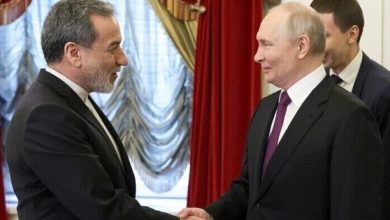
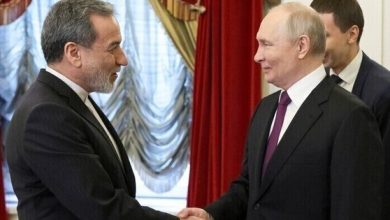
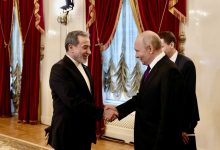
Russian President Vladimir Putin voiced strong support for Tehran in its conflict with the United States and Israel as he greeted Iranian Foreign Minister Abbas Araqchi for talks in St. Petersburg on April 27.
Meeting nearly two months after US and Israeli air strikes on Iran started a war that sent shock waves around the world, both Putin and Araqchi underlined the strength of ties between their countries.
“We see how bravely and heroically the Iranian people are fighting for their independence, for their sovereignty,” Putin said after meeting Iran’s top diplomat.
He added that he had received a message last week from Mojtaba Khamenei, who has not been seen since being announced as Iran’s new supreme leader on March 8 following the killing of his father, Ayatollah Ali Khamenei, in an air strike on February 28.
To read the full report, clickhere.
Share
Share
Copy link
Facebook
X (Twitter)
LinkedIn
Email
15:04
US Offers $10 Million For Information On Iran Proxy Commander
The US State Department, through its Rewards for Justice Program, is offering a reward of up to $10 million for information related to an Iraqi militia commander linked to Iran-backed militias operating in the country.
The official Rewards for Justice account on X posted on April 27 a request for information on Haider M. al-Saidi — sometimes known as Haider Ibrahim al-Gharawi. Al-Saidi is said to be the commander and secretary-general of Harakat Ansar Allah al-Awfiya (HAAA), which is considered an Iranian proxy group and is close to the Quds Force, the overseas branch of Iran’s Islamic Revolutionary Guards Corps.
According to the US State Department message, HAAA was involved in attacks on US diplomatic sites and bases in Iraq, Jordan, and Syria and “killing US servicemembers.”
The Washington Institute for Near East Policy, a think tank, wrote in its introduction of this proxy group: “This faction, which branched off from the Sadrist group, is one of the prominent proxy forces supported by the Quds Force of the Iranian Revolutionary Guard Corps in Iraq, which has long been stationed on the Syrian border and has actively participated in the killing of Iraqi protesters to prove its loyalty to Iran.”
Share
Share
Copy link
Facebook
X (Twitter)
LinkedIn
Email
13:47
Iran Facing Cleanup Of 10 Million Tons Of Debris From War, Says Official
The site of a destroyed building following a missile strike on a neighborhood of the Iranian capital, Tehran, on February 28.
An Iranian environmental official announced on April 27 that there is “about 10 million tons of construction debris” resulting from the destruction in the recent US-Israeli war with Iran.
According to IRNA, Iran’s official state news agency, Abu Ali Golzari, a member of the Environmental Protection Organization’s strategic council, said that “about 200,000 trucks” will be needed to move this volume of waste.
Referring to the large volume of debris generated, especially construction debris resulting from the war, he added that “a large amount of this waste is contaminated with chemicals and various types of oils, which definitely requires special attention.”
Golzari also added that since the war began, environmental crises — including water, air, soil pollution, and waste management — have “escalated” in Iran.
“We need a different perspective to continue and rebuild because the path we had previously taken was not the right path, at least in terms of rebuilding,” he cautioned.
The Israeli military had previously said it had carried out around 10,800 strikes against targets in Iran during the 40-day war.
Iran’s authorities have not provided accurate statistics on war damages and have only published statistics and figures in various fields on a case-by-case basis.
Share
Share
Copy link
Facebook
X (Twitter)
LinkedIn
Email
13:33
Germany’s Merz Says US Lacks ‘Strategy’ For Iran War
German Chancellor Friedrich Merz said on April 27 that the United States lacks a clear strategy in the war with Iran and warned that the situation may not end anytime soon.
“The Iranians are apparently stronger than expected, and the Americans apparently have no really convincing strategy,” Merz said during a visit to a school in the German city of Marsberg.
“The problem with such conflicts is always that it’s not enough to just get into them — you also have to get out again. We saw this painfully in Afghanistan over 20 years. It is similar in Iraq,” he added.
German Chancellor Friedrich Merz visits the Carolus-Magnus Gymnasium in Marsberg as part of the EU Project Day in Schools on April 27.
“The United States has entered this conflict without a clear strategy,” Merz said, making it more difficult to end the war.
“A very complicated situation has developed at the moment and it is costing us a lot. This conflict has a direct impact on our economic performance,” he added.
He also said that Germany’s offer to send minesweepers to help reopen the Strait of Hormuz remains valid, but the precondition is an end to the fighting.
After Iran’s violent crackdown on nationwide protests in January, the German chancellor was the first high-ranking international political figure to say that the Islamic republic’s use of violence to remain in power was a sign of the end of the regime. After the closure of the Strait of Hormuz, he also spoke of the European Union’s readiness to reduce sanctions.
This comes while Ursula von der Leyen said on April 27 that lifting sanctions against Iran is conditional on making “fundamental changes” and that it is still “too early” to ease them.
Share
Share
Copy link
Facebook
X (Twitter)
LinkedIn
Email
12:30
Analyst: Putin May Try To Push Iran Into Nuclear Concessions
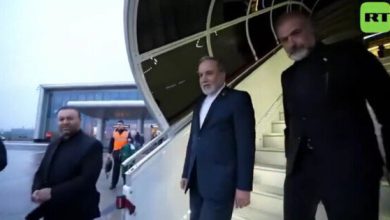
Iranian Foreign Minister Abbas Araqchi talks with officials, according to Iran’s media, during his visit to Russia for talks with Russian President Vladimir Putin, in a place given as St. Petersburg, Russia, in a screenshot from video released on April 27.
Exiled Iranian political analyst Amir Chahaki told RFE/RL’s Radio Farda that Russian President Vladimir Putin may seek to push Iran to make concessions in negotiations with the United States as a way of currying favor with US President Donald Trump.
Speaking after Iranian Foreign Minister Abbas Araqchi arrived for talks with Putin in St. Petersburg, Chahaki said he believed there could now be an opportunity for diplomatic progress.
“Today, Russia can, in my opinion, persuade Tehran to step back on the nuclear issue, because the Strait of Hormuz will reopen with the end of the war, while at the same time pushing the United States toward partial concessions — such as allowing some enrichment under stricter limits, perhaps after 10 years. These possibilities are now on the table for Putin,” the Berlin-based analyst said.
Meanwhile, Russia’s TASS news agency cited Kremlin spokesman Dmitry Peskov as saying the significance of the talks, which he said would take place at the presidential library in St. Petersburg, “could hardly be exaggerated.”
One of several key stumbling blocks in the US-Iran diplomatic deadlock is the fate of some 450 kilograms of highly enriched uranium that Iran reportedly holds.
“The nuclear issue, specifically the 450 kilograms and the enrichment, remains the central axis. If Russia can, through engagement with Trump and Tehran — either with [Supreme Leader] Mojtaba Khamenei or any other group — resolve the issue by having Iran dilute some of it or transfer the remainder to Russia in a way that is accepted, that would be a major favor from Putin to Trump,” Chahaki said.
Share
Share
Copy link
Facebook
X (Twitter)
LinkedIn
Email
11:53
Trump Says China Could Have Helped Iran ‘A Lot More’
US President Donald Trump said in an interview with Fox News that China has offered limited support to Iran.
“I don’t think they’ve helped much. Maybe they’ve helped some, but not much. They could have helped a lot more than that,” Trump said.
Referring to US backing of allies such as Ukraine, he added that similar behavior could be expected from China in supporting its partners.
Despite this, Trump stressed he was “not too discouraged” by Beijing’s actions and said he did not view China as “too bad” in this context.
The president is expected to travel to Beijing on May 1415 for talks with Chinese President Xi Jinping.
Share
Share
Copy link
Facebook
X (Twitter)
LinkedIn
Email
11:44
Qalibaf Suggests Iran Could Escalate By Restricting Bab el-Mandeb Strait
Parliament speaker Mohammad Baqer Qalibaf, who led the first round of talks with the United States in Pakistan on April 11-12, warned in a post on X that Iran still holds strategic leverage despite the United States’ “winning cards.”
“They’re looking at their winning cards. Let’s examine: supply-side cards [Iran] versus demand-side cards [America],” he wrote. He listed “the Strait of Hormuz (partially opened) plus Bab al-Mandab (not opened) plus pipelines (not opened)” against US measures such as “reserve releasedemand reduction[and] further price adjustments.
He added pointedly: “Add summer vacationunless they want to cancel it for America!”
Qalibaf’s remarks suggest Iran could escalate tensions by restricting key waterways like the Bab el-Mandeb Strait or targeting regional pipelines. His reference to “reserve release” points to the US use of strategic oil stocks, while “demand reduction” reflects lower consumption due to high prices.
He previously stated: “We do not accept negotiations under the shadow of threats.”
Share
Share
Copy link
Facebook
X (Twitter)
LinkedIn
Email
11:43
Starmer, Trump Discuss Need To Reopen Strait Of Hormuz
British Prime Minister Keir Starmer and US President Donald Trump discussed the need to reopen the Strait of Hormuz during a phone call on April 26.
A spokesperson for Downing Street said that “the leaders discussed the urgent need to resume shipping through the Strait of Hormuz, given the severe consequences it has for the global economy and the cost of living for people in the UK and around the world.”
“The prime minister also shared the latest developments in his joint initiative with French President Emmanuel Macron to restore freedom of navigation,” the spokesperson added.
Earlier official statements from Downing Street have used similar wording, emphasizing “the importance of reopening the Strait of Hormuz to end the disruption to global shipping, which is driving up costs worldwide.”
Britain and France, alongside other countries, are working on mechanisms to ensure the security of shipping in the Strait of Hormuz following the conflict in the Middle East.
Share
Share
Copy link
Facebook
X (Twitter)
LinkedIn
Email
Load more
🚨BREAKING: Watch The Video Clip Here ➤