The AUKUS defence pact received much-needed momentum at the Shangri-La Dialogue, an annual defence and security forum.
AUKUS members Australia, the UK and US unveiled efforts to enhance their combined capabilities in undersea intelligence gathering and safeguarding critical undersea infrastructures, such as cables and pipelines.
The defence pact, founded in 2021 to counter China’s growing influence in the Indo-Pacific, comprises two pillars. Under Pillar 1, the UK and US will support Australia’s acquisition of nuclear-powered submarines, while Pillar 2 aims to increase cooperation in combined advanced defence capabilities.
There have been concerns recently, however, that the pact was under threat, given its slow progress, particularly on Pillar 2.

The UK’s Defence Chief of Staff, Air Vice-Marshal Sir Richard Knighton, told The Straits Times in an interview that the first signature project under Pillar 2 will see the deployment of Extra Large Uncrewed Undersea Vehicles (XLUUVs).
They are expected to be deployed from 2027.
“The advantage of this capability is that it doesn’t need a person; it can survive underwater for long periods of time, so it gives you that persistent stare, and that provides really great assurance to the AUKUS’ partners,” Knighton said.
“The XLUUV is the first project that will deliver a new capability into the hands of our war fighters as part of Pillar 2, but that’s just the first,” he said, adding that there are ideas for other follow-on projects.
Pillar 2 aims to enhance the three nations and their partners’ capabilities in wide-ranging areas, from hypersonic missiles to quantum technologies and artificial intelligence. However, an immediate area of security vulnerability underscored by defence officials during the Shangri-La Dialogue were those relating to undersea infrastructure.
In his address to the forum, Australia’s Deputy Prime Minister and Defence Minister Richard Marles said that in the last few years, several undersea cables in the region and other parts of the world had been severed, and highlighted it as a key vulnerability that needed urgent attention.
“Within our region, the area where the strategic environment is most complex, where the strategic contest is greatest, is the maritime domain. The seabed has become a major field of contest,” he said, without identifying a source for the threat.
“Around 99 per cent of Australia’s internet traffic flows through just 15 subsea cables. Consider that number for a moment. Fifteen cables – 15 physical assets on the ocean floor – carry essentially the entirety of our international digital connectivity.
“Our financial systems, our health systems, our communications, our intelligence partnerships, our ability to operate as a modern economy and a functioning state: All of it is critically dependent on infrastructure that is exposed, that cannot move and – as we have now seen demonstrated in the Baltic – can be cut with an anchor in the middle of the night,” Marles added.
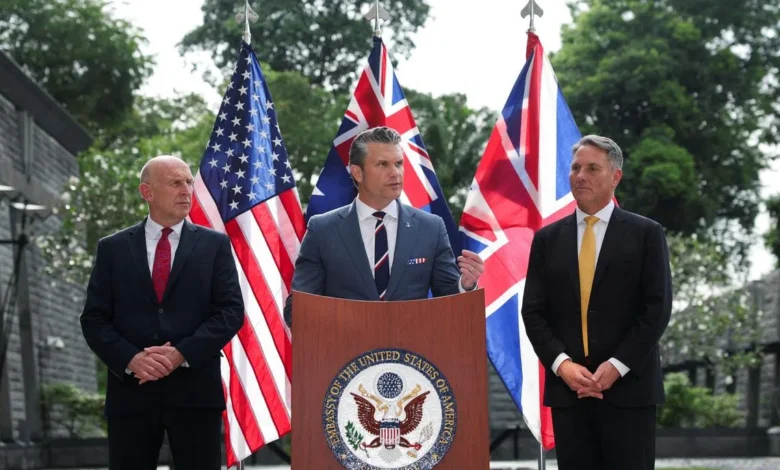
Following a meeting at the US Embassy in Singapore on May 30, Marles, US Secretary of War Pete Hegseth and UK Secretary of State for Defence John Healey confirmed that the first pillar of the AUKUS pact remains on track, while reaffirming the importance of expediting the delivery of advanced capabilities under Pillar 2.
As Knighton told ST: “We all rely on these pipelines and these cables for our prosperity, security and our economy… they are the lifeblood of the economy in many ways. So this commitment is about providing reassurance and understanding, so that we can sustain the economic benefits that we get from this undersea infrastructure.”
The leaders’ reaffirmations to AUKUS was an important boost to the pact that had been losing steam lately.
The UK House of Commons’ Committee, in its April 2026 report on AUKUS, observed: “Cross-trilateral progress on advanced technology under Pillar 2 has been inadequate and it is rapidly losing credibility; priority programmes must be agreed and delivered at pace if this is to be reversed.”
While the decision to deploy the UUVs suggests concrete progress and provides momentum to the AUKUS defence pact, broader questions over the US’ commitments to its allies linger.
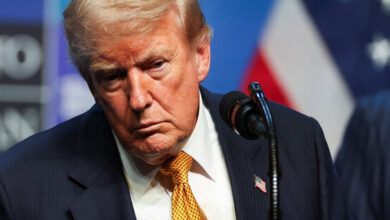
Under the Trump administration’s “America First” approach, the US expects its allies to contribute more towards their own defence.
“Alliances only work when they are true partnerships. It is a two-way street. You don’t have a strong alliance unless everyone has skin in the game. No freeloading,” Hegseth reminded the US’ allies in his keynote address at the forum.