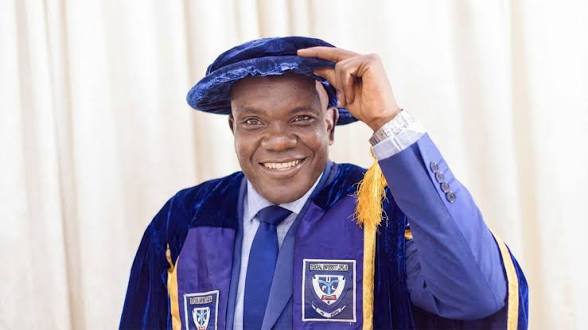
From Noah Ocheni, Lokoja
The Vice-Chancellor of Federal University Lokoja (FUL), Gbenga Solomon Ibileye, has outlined key achievements recorded within his first 100 days in office, highlighting major progress in infrastructure, academic development, research, and institutional reforms.
In a statement issued on Tuesday in Lokoja, Professor Ibileye said the milestone was being observed not as a celebration, but as a period of reflection, accountability, and renewed commitment to strengthening the university’s systems and structures.
“I said on the day of my inauguration that this administration would be remembered not for how loudly it spoke, but for how well the University worked, for the strength of its systems, the clarity of its processes and the stability of its calendar,” the statement read.


Among the major achievements listed by the vice-chancellor was the securing of a ₦3 billion intervention from the Tertiary Education Trust Fund (TETFund) for the establishment of a Centre of Excellence in Artificial Intelligence, Robotics and Cyber Sciences.
According to him, the centre will position the university at the forefront of emerging technologies while serving as a hub for advanced research, postgraduate training, and high-level skills development.
Professor Ibileye also disclosed that the university secured TETFund Annual Intervention support alongside a ₦335 million NEEDS Assessment intervention aimed at improving infrastructure, academic facilities, and other institutional priorities.
He added that special TETFund interventions of ₦700 million and ₦400 million had been approved for the upgrade of laboratories and classrooms, while an additional ₦300 million zonal intervention had also been secured to support infrastructure development.
The vice-chancellor further revealed that a ₦3 billion Public-Private Partnership (PPP) investment for the development of a model hotel, initiated under the previous administration, had been consolidated and advanced as part of efforts to strengthen the university’s long-term financial sustainability.
On academic advancement, Professor Ibileye announced that the National Universities Commission (NUC) granted full accreditation to eight academic programmes in the university.
The programmes include Mass Communication, Computer Science, Education Mathematics, Integrated Science, Biochemistry, Biotechnology, Microbiology, and Sociology.
He said the accreditation outcome further strengthened the university’s academic standing and affirmed the quality of its teaching, facilities, and faculty.
The vice-chancellor also disclosed that the pioneer students of the College of Health Sciences had successfully passed the Basic Medical Examination and progressed to Basic Clinical Training.
According to him, the development positions the students to become the first set of medical doctors trained entirely within Kogi State upon completion of their programme.
Professor Ibileye said several strategic committees had been established to improve institutional governance and academic quality assurance. These include the Central Accreditation Committee, Professor of Practice Committee, Professorial Endowment Committee, and Security Committee.
He also announced the establishment of a Central Examination Office to coordinate and standardise examinations across the university.
The vice-chancellor noted that his administration had strengthened engagement with external stakeholders through meetings with security, intelligence, and paramilitary agencies to ensure a stable and secure learning environment.
He added that visits had also been made to traditional institutions across Kogi State to reinforce town-and-gown relationships and community support for the university.
Looking ahead, Professor Ibileye pledged to sustain the momentum of the administration’s first 100 days by prioritising accreditation for the Nursing programme, formal adoption of the university’s Vision Plan 2026–2031, and continued development of the College of Health Sciences.
He described the progress made so far as a foundation for long-term institutional growth and academic excellence.