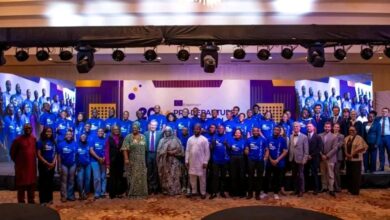
War-time military Head of State, General Yakubu Gowon, had a date with history on Tuesday as he presented his autobiography, ‘My Life of Duty & Allegiance’ at the Bola Ahmed Tinubu International Conference Centre, Abuja. It was a promise kept by Gowon, who said he would release his memoir to recall his time in the corridors of power. For those who doubted him, this week proved to them that the old soldier was never wrong. For some people, the memoir was expected to clear all doubts on certain issues that have continued to dominate public discourse.

Advanced Warning
In line with his nature not to ruffle feathers, the former man of war, but now a chief advocate of ‘One Nigeria’, issued a caveat in the early pages of the book when he says: “By choosing to write, I made a conscious decision not to reopen old wounds but to clarify my thinking on policies and plans at a period too often narrated by others. My story is one of conviction evaluated by circumstances at the crossroads of expectations and reality. Without prejudice, I also seek to simplify the rationale for certain issues and situations that defined my position on some events in the life of government that I led”.
With this clearly stated in the preface by the author, he was distancing himself from any act capable of causing rumbling discord over his narration straight from the horse’s mouth. In his book, the author attempts to set the record straight rather than fight the past. Written with the elegance of a peaceful personality that the author is famed for, the narration is anchored on the writer’s decision not to stir the honest nest, but to recall his footprints in the corridors of power. With most of the major actors now deceased, those whose fiery response to his narration could have ignited reverberating echoes have grown weary and enmeshed in surviving the despair of a dream for a nation that has yet to deliver on its promises to its citizens.
Endless Discourse
Most of the issues troubling Nigeria can be tied to the unfortunate circumstances that led to the civil war. Before the country caved into the valley of uncertainties and frightening dread, the 15 January and July coups left a dark, emasculated hope on the then newly independent Nigeria. Gowon states in the book’s preface that his support was anchored in his role as the General Officer Commanding. General Johnson Aguiyi-Ironsi and his military colleagues told him that the civilian leadership had willingly surrendered power to the army. While a different account by Chief Richard, then a member of the Nigerian parliament, who later rose to become Minister of Justice, insisted that Aguiyi-Ironsi had threatened the First Republic ministers: “You either hand over as gentlemen or you hand over by force”.
No doubt, without contradiction, the author deploys an excellent narrative to recall his upbringing in a Christian background, with education providing hope for the future. Growing up in Wusasa, Zaria, provides an inspiring journey to a world of opportunities. Coming from a family built on trust, endowed with the qualities of old-time Christianity, these virtues would define his future endeavours. According to the author, his parents’ role would shape his future behaviours.
Military Career
The many courses Gowon enjoyed early in his career, according to him is tied to his bachelorhood days. At a time when married officers were bypassed or unwilling to undertake courses, he was always included in military courses. This, of course, led some of his colleagues to tag him as the favoured candidate. Professionally inclined and not willing to be involved in any coup, the mantle of leadership fell on him when loyalty was threatened after the revenge coup of 29 July 1966.
His account of the Nigerian civil war is written to ignite a pugnacious tone. Throughout his accounts, he speaks to the roles of military officers and his reactions to having to whip them into line. Gowon recalls that one of the commanding officers in the war, Col Olusegun Obasanjo, who later became the Head of State in 1976 after the assassination of General Murtala Muhammad, refused to serve under Murtala during the war. In humility anchored on the vision of ensuring the survival of the Nigerian state during one of its darkest eras, Gowon moved Nigeria from the flames of conflagration that should have disintegrated Africa’s giant.
Positive Fatalist
His period as Head of State was not devoid of challenges. He realised early in the military profession that it was almost impossible to be a leader without certain forces seeking to create a crack between the leader and his most trusted armour-bearers. When he received a report that the Commander of the Brigade of Guards, Col Joe Garba, and Anthony Ochefu were plotting to oust him from power, his response was that of a positive fatalist whose faith in the divine powers to deliver a just recompense for an unjust act was never in doubt.
Even when all signals pointed to the fact that the coupists were ready to strike, Gowon left for the OAU summit in Uganda and told Garba to ensure no bloodshed. The announcement of the coup on 29 July 1975, while attending the Kampala summit, and his speech accepting the new government set him apart as someone at peace with his destiny. His many travails in exile and his eventual return to Nigeria after the pardon revealed a leader who recognised the transience of power.
After achieving an athletic feat for which he was known during his school days in Barewa College, the school sergeant major, RSM Usaini Mako, once declared that ‘Gowon Y has brukun the school reckoo’. Gowon shattered his previous records when he presented his autobiography at 91. As Nigerians cope with hard times to get the book, the possibility of rumbling reactions may be diminished by its non-annoying narrative style.