Losers flood APC NASS Primary Election Appeal Committee with petitions
The outcome of the recently held primaries of the All Progressives Congress (APC) indicates that the ruling party shut its doors against defectors from the Peoples Democratic Party (PDP), Labour Party (LP), and other opposition parties.

APC held its nationwide primaries, beginning with the House of Representatives on 16 May and culminating in the presidential primary election on 23 May 2026, to nominate candidates for next year’s general election.
The outcome of the exercise has elicited hue and cry from aspirants who lost out, especially those who dumped their political parties for the ruling party in the National Assembly.
LEADERSHIP Sunday reports that over 120 members of the National Assembly, comprising both the Senate and the House of Representatives, defected from the political parties that brought them into the Red and Green Chambers.
Most of these defectors sought the party’s tickets to run for re-election in various contests, but to no avail, sparking outrage.
Those affected include Hon. Nicholas Mutu, the lawmaker representing Bomadi/Patani Federal Constituency of Delta State, who defected from PDP, the party that took him to the National Assembly for seven terms, to APC; Hon. Mike Etaba, a third-term lawmaker representing Obubra/Etung Federal Constituency of Cross River State, who dumped PDP for APC; and the member representing Aniocha/Oshimili Federal Constituency of Delta State, Hon. Ngozi Okolie, who left LP for APC.
Others are Hon. Esosa Iyawe, the member representing Oredo Federal Constituency of Edo State, who defected from the Labour Party to APC; Hon. Matthew Nwogu, the lawmaker representing Aboh Mbaise/Ngor Okpala Federal Constituency of Imo State, who left the Labour Party for APC; Hon. Mansur Musa Jega, the member representing Jega/Gwandu/Aleiro Federal Constituency of Kebbi State, who resigned from PDP and joined APC; and Hon. Bassey Akiba, the Odukpani/Calabar Municipality Federal Constituency representative of Cross River State, who defected from the Labour Party to APC.
Those who also lost APC primaries after dumping their former parties include Hon. Daniel Asama, the lawmaker representing Jos North/Bassa Federal Constituency of Plateau State, who defected from the Labour Party to APC; Hon. Ajang Iliya of Jos South/Jos East in Plateau State, who decamped from the Labour Party to APC; and Hon. Donatus Mathew, an ex-okada rider who won a House of Representatives seat for Kaura Federal Constituency of Kaduna State on the platform of the Labour Party in 2023 but defected to APC in December 2024.
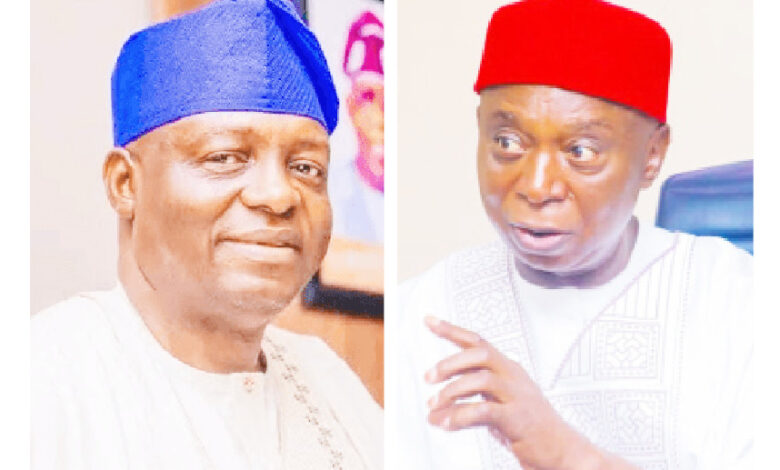
Similarly, Sen. Ned Nwoko (Delta North), who dumped PDP for APC, lost at the primaries, just like Neda Imasuen, the senator representing Edo South, who was elected on the platform of the Labour Party in the 2023 elections and defected to the ruling APC, as well as Hon. Nicholas Ossai, a former lawmaker from the Ndokwa/Ukwuani Federal Constituency of Delta State who dumped PDP for APC.
On the other hand, Hon. Awaji-Inombek Abiante, representative of the Andoni/Opobo/Nkoro Federal Constituency; Hon. Boma Goodhead, who represents Akuku-Toru/Asari-Toru Federal Constituency; retired Air Commodore John Azubuike Opara, aspirant for Port Harcourt Federal Constituency; and Anderson Allison Igbiki, contender for the Okrika/Ogu-Bolo Federal Constituency seat — all from Rivers State who dumped PDP for APC — were disqualified, hence shut out of the primaries.
Also, Senator Benson Agadaga of Bayelsa East was elected to the Senate in 2023 on the PDP platform but defected to the APC earlier this year. Likewise, Senator Garba Maidoki of Kebbi South, another lawmaker who rose through the PDP ranks to the Senate before joining the ruling party, was also disqualified.
Though he claimed to have willingly withdrawn from the race, Governor Siminalayi Fubara, who had dumped PDP for APC, had obtained the party’s N50 million nomination form and undergone screening to seek a return ticket on the ruling party’s platform.
Fubara, who announced his withdrawal from the contest in a statement he personally issued some hours before the governorship primaries, noted that he stepped down out of conviction and to make a sacrifice for the state to move forward in peace and unity.
“Let it be clearly understood that I stepped aside from participating in the upcoming Rivers State gubernatorial election not out of weakness, fear, or surrender but out of conviction and sacrifice so that Rivers State may move forward in peace and unity, and I remain committed to serving the good people of Rivers State till the end of my term,” the statement read.
But his estranged political benefactor and predecessor, the Minister of the Federal Capital Territory, Nyesom Wike, insisted that Fubara was not even supposed to have aspired for the APC ticket under an earlier peace deal.
In an interview with journalists, the FCT minister said, “I’m not surprised that the governor withdrew. In the first place, he ought not to have collected the APC nomination form because the agreement was reached that impeachment should be dropped, while he should also not talk about a second tenure.”
It has been argued that the two methods of primary election, namely consensus and direct primaries, provided for in the Electoral Act 2026, were abused by party stakeholders to shut out aspirants, especially defectors.
Section 87 of the Electoral Act prescribes that: “(1) A political party that adopts a consensus candidate shall secure the written consent of all cleared aspirants for the position, indicating their voluntary withdrawal from the race and their endorsement of the consensus candidate.
“(2) Where a political party is unable to secure the written consent of all cleared aspirants for a consensus candidate, it shall revert to the choice of direct primaries for the nomination of candidates for elective positions.”