An Israeli newspaper owned by Miriam Adelson, one of Donald Trump’s most powerful financial backers, has revealed new details about a secret Mossad branch set up to conduct influence operations inside Iran, including media leaks, fake social media accounts, artificial intelligence-generated influencers and efforts to force senior Iranian officials from power.
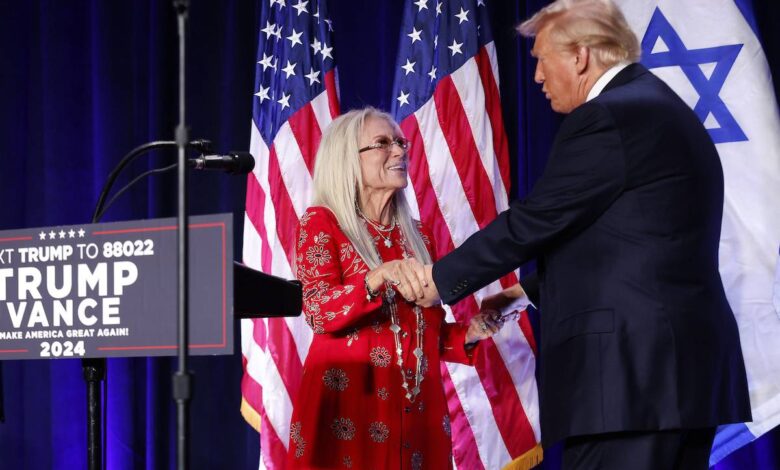
The report was published by Israel Hayom, an Israeli newspaper owned by Adelson. Trump has credited the family with helping secure some of his most consequential decisions on Israel, including recognising Jerusalem as Israel’s capital, relocating the US embassy from Tel Aviv to Jerusalem and recognising Israeli sovereignty over the occupied Syrian Golan Heights.
Read: “Real men go to Tehran” — The Zion-Con fantasy of regime change in Iran

According to Israel Hayom, the secret Mossad branch was created in 2021 by Mossad chief David Barnea as part of a wider restructuring of Israel’s spy agency. The unit was tasked with destabilising Iran from within by moving beyond traditional covert operations towards psychological warfare, political manipulation and subversion that could trigger regime-change.
A senior Mossad officer identified only as “O.” said the new approach was cheaper and simpler than assassination. Describing what is effectively a Mossad kompromat operation, the Israeli agent explained that “Traditionally, the Mossad knew how to get rid of people mainly through assassinations,”. “But when there is a person who is harming you, exposing embarrassing details from his past often leads to an immediate response in which he is removed from the circle.”
Ex-Mossad official: Mossad carried out many operations ‘in heart of Iran’
The article cites the case of Rostam Ghasemi, a former Islamic Revolutionary Guard Corps commander and senior Iranian official close to the late President Ebrahim Raisi. Mossad reportedly leaked a photograph of Ghasemi embracing a woman without a hijab during a visit to Malaysia. The image was released in November 2022, shortly after the killing of Mahsa Amini had triggered mass protests. The report says Mossad had held the image since 2011 and released it at a highly sensitive moment to force Ghasemi out of office and fuel the protests.
Ghasemi resigned within days, officially citing health reasons, and later died of cancer. For Mossad, the report says, the operation delivered a “double gain”: removing an experienced military-political figure from influence while intensifying public anger against the Iranian government.
The Mossad officer said that when he began the work, “it was forbidden in the Mossad to say the two words ‘regime change’.” Since then, he said, the overthrow of the Iranian government has become one of Mossad’s core missions. He described the branch’s work as targeting “people’s hearts, feelings and beliefs”, a domain that the agency had previously avoided because it did not produce an immediate visible result such as a killing or explosion.
Ahead of Israeli operations against Iran, the branch reportedly built what one source described as a social media “poison machine” made up of fictitious accounts designed to spread material undermining the Iranian state. The report also cited claims by Iran International that Iranian state television channels were hacked during Israeli strikes and forced to broadcast speeches by Trump, Benjamin Netanyahu and Crown Prince Reza Pahlavi urging Iranians to take to the streets.
The unit also distributed images of alleged Mossad agents operating on Iranian soil. While Israeli media initially treated the release as public relations for the agency, O said it was an influence operation aimed at weakening the Iranian public’s fear of the state by showing that Israeli intelligence had penetrated Iran’s security apparatus. “Leaking the photo of agents on Iranian soil was meant to sabotage that mechanism,” the Israeli agent said.
The report also describes efforts to cultivate online influencers, including some inside Iran, as well as the use of AI-generated influencers to spread message that would trigger regime-change. Mossad’s wider plan reportedly included operational missions and the training and arming of Kurdish forces inside Iran and along its borders.
Fresh questions are likely to be raised following revelations in the Israeli Hayom article about unrest in Iran during December and January that was presented publicly as an organic uprising. Israel Hayom says Mossad sources claimed that the December 2025 protests in Tehran’s bazaar “caught them by surprise” and that they had “no connection” to their outbreak. However, the same report confirms that Israel had already built an organised infrastructure to shape Iranian public opinion, amplify unrest and turn domestic anger into a regime-change tool.
Read: Iran’s protests and the question of external involvement
The revelations follow Trump’s own claim that weapons were sent to anti-government forces inside Iran during the December-January unrest. Trump said the US had sent “a lot of guns” intended for Iranian protesters, while claiming the weapons were diverted by Kurdish groups. Reuters reported that the weapons were funnelled through Kurdish channels for anti-government protesters, though commanders from the two largest Kurdish militias denied receiving American arms.