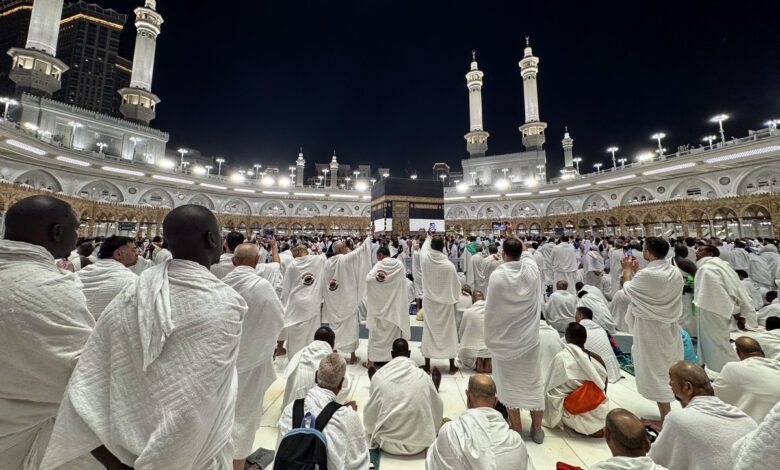
As missiles crossed the Gulf and oil traders braced for another regional inferno, an altogether different procession unfolded in Mecca. More than 1.5 million Muslims arrived for the 2026 Hajj under the shadow of a US–Israeli war against Iran, a conflict that had already rattled shipping lanes, shaken energy markets, and revived fears of a region-wide sectarian rupture. Yet inside Islam’s holiest sanctuary, another logic prevailed — one that neither drones nor deterrence theory could fully explain.
The striking reality was not simply that the Hajj continued. It was that the pilgrimage quietly imposed limits on war itself.
In an era where global diplomacy increasingly appears exhausted, transactional, and militarised, the Hajj revealed an overlooked truth about Middle Eastern order: sacred obligations still possess strategic weight. While Washington and Tel Aviv framed the campaign against Iran through the language of security and deterrence, Mecca became a theatre of restraint. Tehran refrained from escalation near the Hejaz. Saudi Arabia opened its gates to approximately 30,000 Iranian pilgrims despite active hostilities. A fragile but unmistakable diplomatic corridor emerged — not through summits or sanctions, but through ritual.

This was not sentimentality masquerading as geopolitics. It was geopolitics in its oldest form.
For decades, international relations analysis has tended to treat religion either as a source of instability or as a decorative backdrop to ‘real’ statecraft. The 2026 Hajj shattered that assumption.
The pilgrimage functioned as a de facto non-aggression pact, creating what could be described as a temporary sacred security architecture across the Gulf. The consequences mattered far beyond Saudi Arabia.
At the height of tensions earlier this year, fears of direct regional confrontation were acute. Insurance premiums for vessels moving through Hormuz surged. Brent crude prices flirted with levels unseen since the Ukraine energy shock. RAND analysts warned of cascading escalation risks involving Iranian proxy networks stretching from Lebanon to Iraq. The International Crisis Group cautioned that even limited retaliation could spiral into attacks on Gulf infrastructure and civilian transit routes. Yet amid this volatility, the Hajj imposed an invisible red line.
READ: Saudi Arabia says 1.7 million pilgrims performed Hajj this year
No actor wished to be remembered as the force that endangered pilgrims circling the Kaaba. The symbolism carried extraordinary power. Millions of Muslims from rival sects, political traditions, and national loyalties stood shoulder-to-shoulder while the wider region edged toward confrontation.
Yet the deeper significance of the 2026 Hajj reached beyond Islam alone. The final days of the pilgrimage coincided with Eid Al-Adha — the sacred commemoration of Prophet Abraham’s willingness to sacrifice his son before divine mercy intervened. According to Saudi reporting, pilgrims gathered in Mecca at the very moment Muslims around the world reflected upon Abraham’s ultimate act of obedience, compassion, and surrender to God’s will. That symbolism carries immense diplomatic weight in a fractured world.
Abraham is not solely a figure of Islam, but a patriarch shared across the three great monotheistic faiths — Judaism, Christianity, and Islam alike. In the shadow of war involving Israel, Iran, and the United States, the Hajj quietly became something larger than a Muslim gathering. It became a reminder that the Middle East’s deepest spiritual inheritance is profoundly interconnected.
At a time when political leaders increasingly weaponise identity, the image emerging from Mecca offered an altogether different vision of the region — one rooted not in civilisational conflict, but in civilisational kinship. The same Abraham revered in Mecca is also revered in Jerusalem and across the churches of Christendom. The same narrative of sacrifice, mercy, and human dignity echoes through the Torah, the Bible, and the Qur’an. This matters strategically because modern diplomacy in the Middle East has too often ignored the emotional architecture of faith. Military coalitions may impose deterrence, but shared sacred memory can still impose restraint.
The convergence of Hajj and Eid Al-Adha therefore, created an extraordinary moral contrast to the surrounding violence. While missiles, sanctions, and retaliatory threats dominated headlines, millions gathered to commemorate a story centred on mercy overcoming destruction.
In that sense, Mecca offered the region a fleeting but powerful diplomatic metaphor: that the descendants of Abraham remain capable of coexistence even when their governments drift toward confrontation.
For global strategists searching desperately for stabilising narratives in the Middle East, this may be the most overlooked lesson of all. The future of regional diplomacy may depend not only on ceasefires and security guarantees, but on rediscovering the shared moral language buried beneath the politics of war.
Saudi authorities deployed massive security and health operations, including 50,000 healthcare workers and 3,000 ambulances, to ensure the pilgrimage proceeded safely despite temperatures exceeding 45°C. The logistical feat mattered strategically because it reinforced Riyadh’s central claim to legitimacy: custodianship of the Two Holy Mosques.
That custodianship is no longer merely a religious title. It has become a form of soft power unmatched anywhere in the Muslim world.
For Crown Prince Mohammed bin Salman, this represented a sophisticated balancing act. Saudi Arabia remains embedded in the American security umbrella, yet Riyadh has simultaneously pursued détente with Tehran since the 2023 Chinese-brokered rapprochement. The Hajj exposed the limits of binary alliance politics in the Gulf. Even while aligned strategically with Washington, Saudi Arabia could not afford to appear complicit in a regional war targeting fellow Muslims during pilgrimage season.
The kingdom therefore chose neutrality wrapped in sanctity. That decision carried consequences for the wider Islamic world. Riyadh’s refusal to politicise access to Mecca effectively insulated the pilgrimage from sectarian fragmentation.
Saudi bans on political slogans, banners, and demonstrations reinforced the idea that the holy precincts exist outside geopolitical contestation. In practical terms, this transformed Mecca into one of the few genuinely neutral spaces left in the Middle East.
There is historical irony here. Only a decade ago, Saudi–Iranian relations had collapsed after the execution of Shiite cleric Nimr al-Nimr and attacks on Saudi diplomatic facilities in Iran. The memory of the 2015 Mina stampede, which killed hundreds of Iranian pilgrims, deepened mistrust further. Many analysts assumed sectarian hostility had become structurally irreversible.
READ: Saudi Arabia deploys drones, AI to enhance security during 2026 Hajj pilgrimage
Instead, the Hajj has emerged as a mechanism for managed coexistence. What emerged was ‘Hajj diplomacy’ — a rare moment where faith imposed restraint, and rivals chose coexistence over escalation; a narrow but resilient channel of cooperation surviving despite proxy conflicts elsewhere. Technical coordination over visas, transport, health protocols, and pilgrim safety has quietly institutionalised communication between rival states.
That matters because durable diplomacy rarely begins with grand bargains. More often, it starts with limited functional cooperation that gradually reduces strategic paranoia.
The Hajj now appears to be performing exactly that role. Equally important is what this moment says about prevailing Western narratives surrounding Islam and violence. The 2026 pilgrimage represented the world’s largest peaceful annual gathering occurring simultaneously alongside one of the most dangerous geopolitical crises of the decade. Rather than collapsing into disorder, the event demonstrated extraordinary collective discipline, cooperation, and restraint.
That reality directly contradicts the enduring ‘clash of civilisations’ framing that still shadows parts of Western strategic thinking.
Research from Brookings has long suggested that participation in the Hajj increases tolerance and reduces support for extremism. Pilgrims returning from Mecca were found to be significantly more supportive of peaceful coexistence and more resistant to militant narratives. The implications are profound. If mass religious experience can reinforce moderation rather than radicalisation, then prevailing assumptions within counterterrorism discourse require serious revision.
The lesson for policymakers is uncomfortable but necessary: faith-based institutions are not merely security liabilities. Under certain conditions, they can become stabilising geopolitical actors.
This is particularly relevant as the international system enters an age of fractured multipolarity. Traditional diplomatic frameworks are weakening. The United Nations struggles to mediate major conflicts. Great-power competition increasingly paralyses multilateral institutions. In that environment, unconventional stabilisers — religious legitimacy, cultural authority, civilisational symbolism — are gaining strategic importance.
The Hajj demonstrated this with remarkable clarity. At a time when global governance appears brittle, Mecca produced a temporary order that nuclear deterrence and military coalitions could not. Not because religion replaced politics, but because sacred legitimacy constrained political behaviour in ways conventional diplomacy failed to achieve.
There is a wider warning embedded in this moment as well. Had the pilgrimage been disrupted by missile strikes, sectarian reprisals, or state retaliation, the consequences would likely have extended far beyond the Gulf. A direct attack affecting pilgrims could have ignited outrage across Muslim-majority societies from Indonesia to Nigeria, destabilising fragile governments and intensifying anti-Western sentiment worldwide.
Energy markets would have convulsed. Maritime insecurity across the Red Sea and Hormuz corridors would have deepened. The economic aftershocks alone could have reverberated through already strained global supply chains. Instead, restraint prevailed. Not because trust suddenly emerged between adversaries, but because the political cost of violating sacred sanctuary became intolerably high.
That may ultimately be the most important strategic lesson of the 2026 Hajj. In a century dominated by technological warfare, algorithmic escalation, and transactional diplomacy, ancient institutions still possess the power to impose moral boundaries on conflict. The modern Middle East remains deeply fractured, but Mecca briefly reminded the world that even bitter rivals sometimes recognise lines that cannot be crossed.
The tragedy is that global diplomacy rarely knows how to build upon such moments. Yet for a few extraordinary days beneath the desert heat, amid warplanes, sanctions, and nuclear anxieties, the Hajj offered something the international system has not produced in years: a fragile glimpse of restraint grounded not in fear, but in shared sacred responsibility.
As pilgrims marked Eid Al-Adha in the land of Abraham, the Middle East briefly remembered a truth too often buried beneath geopolitics — that the spiritual traditions dividing the region also contain the moral vocabulary capable of saving it.
OPINION: Has the Flotilla finally exposed the West’s moral double standard?
The views expressed in this article belong to the author and do not necessarily reflect the editorial policy of Middle East Monitor.