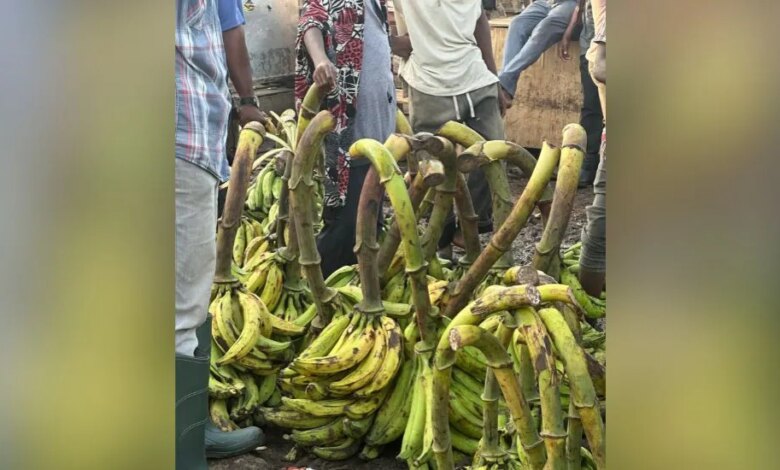
Plantain traders in Zuba Fruit Market, Abuja, have attributed the rising cost of the staple food to seasonal supply shortages, explaining that the commodity is currently in its annual lean season despite a general decline in food prices across the country.
Findings by THE WHISTLER during a visit to the market revealed that traders and consumers are paying more for plantain as supplies from major producing areas shrink, pushing up prices to at most N220,000 per dozen, thus limiting availability.
While many food items have recorded price reductions compared to last year, plantain traders in Zuba told THE WHISTLER that the commodity has remained relatively expensive because production typically drops between March and July, a period they describe as the “dry season” for the crop.
Plantain is typically planted at the onset of the rainy season, between March and May in southern Nigeria and April to June in the Middle Belt, with the crop requiring between nine and 15 months to mature.


As a result, supplies often tighten between May and August when stocks from previous harvests begin to dwindle while newly planted crops are yet to reach the market.
Transportation costs and other seasonal challenges further contribute to higher prices in major markets.
“This is not the season. For us traders, this is the dry season of plantain. Which spun between March and July yearly. So this is the peak season where plantain gets expensive,” a trader, popularly known as MallamAbdul, told THE WHISTLER.
According to him, plantain sold in Zuba, the wholesale market for plantain in Abuja comes from different producing areas, each with distinct characteristics and market appeal.
He identified the wide varieties as Bayelsa from Bayelsa State, Calabar from Cross-River State, Sabo or Edo from Edo State, Yoruba from Ondo State and Gwari plantain sourced from either Abaji a local government Council in FCT, or Kogi or Nasarawa State.
Abdul explained that the Bayelsa and Calabar varieties are particularly prized by consumers because of their size and taste.
“Calabar and Bayelsa are red in colour when peeled, have a bigger bunch and a very sweet taste, when compared to the Yoruba. But the Yoruba plantain is the most attractive and appealing to the eye,” he said.
He added that although the Gwari variety is considered the most visually attractive, many traders place less value on it because of its taste.
“Above all the Gwari species of plantain is the most attractive, however its taste could be compared to Yam. By market preference, most traders do not value it because of the taste,” he said.
The trader noted that transportation costs also play a major role in determining market prices.
According to him, transporting a load of plantain from Bayelsa to Abuja in a J5 truck previously cost about N600,000 but has risen to around N650,000. The journey takes about 48 hours when there are no mechanical issues.
For supplies from Ondo and Akure, transport costs average about N350,000 from N270,000, while transport from Edo State, sits at N320,000.
Abdul told THE WHISTLER that the cost of transportation depends on prevailing conditions.
He explained that the quantity transported varies according to the size of the plantain bunches.
“A J5 truck can carry about 35 dozen large-sized plantain valued between N180,000 and N220,000 per dozen.
“Medium-sized bunches priced between N90,000 and N130,000 per dozen can fill about 45 dozens, while smaller bunches valued between N50,000 and N70,000 per dozen can reach as many as 55 dozens per truck.
Despite the complaints from consumers, Abdul argued that plantain prices are lower than they were during the same period last year.
“Plantain is not expensive this year, but this time last year, a big size dozen, with a bunch having up to 25 seeds, was sold about N330,000. That same plantain is sold for N240,000 currently. Prices of foodstuffs dropped, although we are not happy with sales, but plantain compared to other food items is still expensive,” he said.
He further explained that the value of a fully loaded J5 truck has also dropped significantly.
“Last year, a fully loaded J5 with plantain was valued at about N5.5m now it sells at an average of N3.2m. These prices aren’t fixed, but dependent on the species/size of the plantain,” he said.
The findings suggest that while consumers are feeling the effects of seasonal scarcity, current prices remain below the levels recorded during the height of food inflation in 2025.
For another trader identified as Mr John, lower prices have not translated into stronger sales, as weak consumer purchasing power continues to affect market activity.
John also attributed the financial downside to varieties of options.
John said, “Last year some food items like beans, yams, potatoes and Garri were very expensive, so sales for plantain increased. Now that there are alternatives, sales have dropped.”
However, John told THE WHISTLER that despite a fall in sales, the business wasn’t running at a loss, but a regulated profit.
What do you think about this?
Drop your opinion in the comment section.
FOLLOW US & Share this with someone who needs to see this.