FG raises concern, says admissions outpace releases
The federal government has revealed that Nigeria’s correctional centres admitted no fewer than 15,632 inmates in May 2026 alone, underscoring the enormous pressure facing the country’s custodial system despite ongoing efforts to tackle congestion.

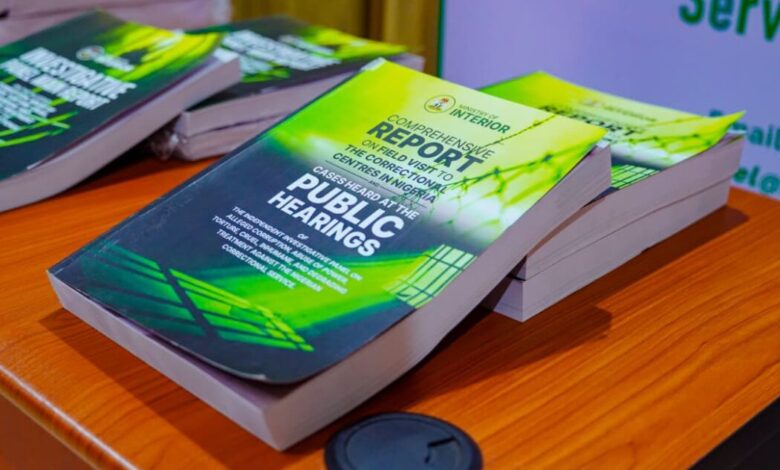
The Minister of Interior, Dr. Olubunmi Tunji-Ojo, disclosed the figure on Wednesday while receiving the report of the Investigative Panel on alleged corruption, abuse of power and human rights violations within the Nigerian Correctional Service.
According to the minister, 14,190 inmates were released during the same period, leaving admissions ahead of releases and highlighting the continued strain on correctional facilities nationwide.
The development, he says comes as Nigeria’s custodial centres currently house about 80,000 inmates, significantly above the nation’s official custodial capacity of 68,486.
Tunji-Ojo said, “Our custodial capacity in Nigeria at the moment is about 68,486, and we have about 80,000 inmates as of this morning.”
This is as he disclosed that the federal government is constructing three new custodial centres expected to add about 15,000 bed spaces to the system upon completion.
According to him, major facilities under construction, including those in Abuja and Kano, are already above the 50 per cent completion mark and are expected to significantly ease overcrowding.
The minister said government is also renovating existing facilities while promoting non-custodial measures aimed at reducing pressure on correctional centres.
The minister added that current records show that 1,004 offenders are serving community service sentences, while 170 are participating in restorative justice programmes. A further 34 offenders are on probation, bringing the total number benefiting from non-custodial measures to 1,227.
Tunji-Ojo maintained that correctional centres must evolve from institutions of incarceration into centres of rehabilitation and second chances.
“We must make the correctional centres places of hope. They must become centres of restoration and transformation,” he said.
The minister pledged that the recommendations of the investigative panel would be translated into concrete reforms aimed at improving inmate welfare, eliminating corruption and strengthening rehabilitation programmes across the country’s correctional facilities.
On her part, the secretary of the Panel and chairman of PRAWA, Prof. Uju Agomoh, described the presentation of the report as a historic moment for Nigeria, noting that it reflected the willingness of government institutions to subject themselves to scrutiny and accountability.
Agomoh disclosed that the panel submitted three volumes of reports to the minister. According to her, the first volume contains a verbatim account of proceedings from the public hearings conducted between December 2024 and August 2025, while the second details the panel’s findings, methodology and recommendations.
She added that the third volume contains reports from field visits to correctional centres across the country, including findings from investigations into specific cases referred to the panel.
Pro Agomo urged the government to make the report publicly available, arguing that Nigerians need to understand the factors that have contributed to challenges within the correctional sector. She said the panel’s findings revealed systemic neglect that requires coordinated intervention from government institutions, the private sector and communities.
According to her, meaningful reform of the correctional system can only be achieved through a whole-of-government and whole-of-society approach aimed at improving conditions and strengthening rehabilitation efforts nationwide.
Earlier, the permanent secretary and chairman of the Investigative Panel, Mrs. Magdalene Ajani, said the panel was constituted by the Minister of Interior in September 2024 following public complaints and concerns about the operations of the Nigerian Correctional Service.
She said the committee was mandated to investigate the allegations and review programmes and activities within the correctional system with a view to strengthening reforms and improving service delivery.
Ajani explained that the panel spent about 20 months carrying out its assignment, visiting correctional centres in 23 states and engaging extensively with officials of the Nigerian Correctional Service and other stakeholders.