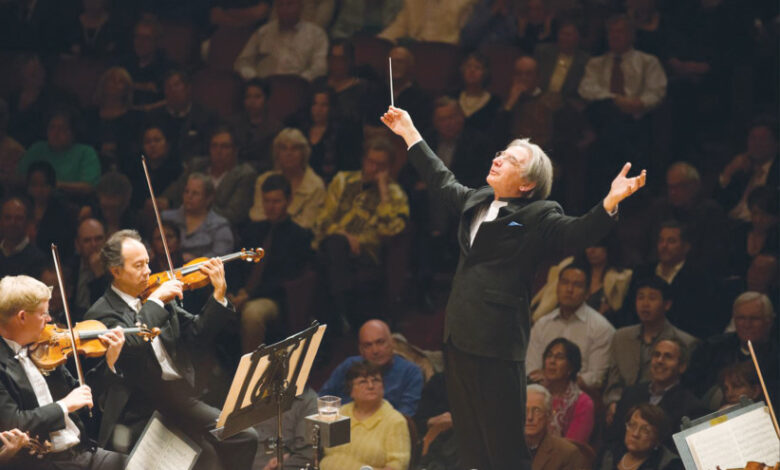
Michael Tilson Thomas was widely recognized as one of the most influential conductors, pianists, and educators of the contemporary era.
His passing in April warrants a closer look at a musical legacy that encompasses not only his extensive podium career and discography, but also his compositions.
Throughout his life, Tilson Thomas dedicated his rare moments of downtime to composing. Much like historical conductor-composers such as Gustav Mahler, his oeuvre was relatively modest, yet these were the works of a master musician with a distinct, well-defined compositional identity.
As a composer, Thomas revealed himself as a clear descendant of Aaron Copland and Leonard Bernstein, yet his music shed a new and important light on the American canon.
This is largely because Tilson Thomas opened and expanded the range of possibilities in his music, spanning from rigorous modernism and gamelan music to jazz and rock, complete with electric guitars, drums, and saxophones.
He achieved this vast, eclectic mix without compromising the integrity of the piece, demonstrating, as James M. Keller wrote, “A refreshing openness and freedom of style.”
From Yiddish theater to a modern master
As the grandson of Ukrainian immigrants to New York, Tilson Thomas came from a family of artists; the Thomashefskys pioneered Yiddish theater in the city, and it was from his grandmother, Bessie, that he inherited his love for the stage.
However, as Tilson Thomas noted in Where Now Is, the 2020 documentary on his life, his stylistic fluidity was traced back to his father, who frequently improvised on the piano in a wide variety of styles at home, and from whom he inherited his profound love for music.
Tilson Thomas was a child prodigy who demonstrated remarkable musical talents from an early age. As a student, he had the privilege of working with some of the great artists who fled Nazi-occupied Europe for America, including violinist Jascha Heifetz and cellist Gregor Piatigorsky.
He went on to study composition with the German émigré composer Ingolf Dahl, who was a great influence on him, as well as with such seminal figures as Pierre Boulez, Luciano Berio, John Cage, and Lou Harrison.
Ultimately, however, his close professional association and personal alignment with Copland and Bernstein proved most definitive to his compositional voice.
In 1988, Tilson Thomas made his official debut as a composer with “Grace,” a piece written for Bernstein’s 70th birthday, setting his own text to capture his impressions of their initial meeting.
Composed in the same year, “Street Song” (scored for brass quintet or symphonic brass) has remained one of his most frequently recorded pieces.
A three-part work, it was deeply influenced by Copland’s ballets, evoking the Great Plains and the endless Western horizon through the open intervals of church-like chorales and a clear emphasis on syncopated rhythms rooted in jazz, Latin music, and folk traditions.
In “Street Song,” Tilson Thomas drew a musical document that captured the multiculturalism and diverse auditory spaces interlaced within American heritage, offering a brilliant contribution not only to brass literature but to the broader American canon.
While much of his oeuvre was deeply indebted to his American identity, several works explicitly engaged with his Jewish heritage.
A seminal example is his compelling 1990 composition, “From the Diary of Anne Frank” for narrator and orchestra.
Dedicated to Audrey Hepburn, who narrated the world premiere, the work received widespread critical acclaim for its integration of verbatim excerpts from Frank’s diary.
Tilson Thomas said that the piece was structurally cast in five variations built entirely on themes derived from traditional Jewish music – most notably the kaddish, the hymn to life and mourning.
The musical narrative develops linearly alongside the tragic circumstances of Frank’s short life, advancing in progression with her growing distress.
As the diary entries chronicle an increasing sense of isolation, the orchestral texture mirrors this psychological shift, becoming desperate and lonely.
For instance, as Anne wrote, “I can’t tell you how oppressive it is… we have to whisper, and tread lightly otherwise someone might hear us,” the orchestration descended into a quiet, menacing atmosphere.
Later, when she asked, “Dear Kitty, I expect you would be interested to hear what it feels like to disappear,” the music dissipated into a fragile, thin texture, pitting a solitary, lonely violin against a threatening brass section.
Yet the work was not merely a somber lament for a clever young life cut short. In key sections, the music surged with immense pride, self-conviction, and force.
It was here that Tilson Thomas effectively injected himself into Frank’s words, using the power of the orchestra to comment on the text and answer her fear with musical courage and strength.
The vocal masterworks: Whitman and Dickinson
Between 1999 and 2002, Tilson Thomas completed two major song cycles for voice and orchestra based on the poetry of Walt Whitman and Emily Dickinson.
These art songs demonstrated a sophisticated command of text-setting, characterized by intricate orchestral shading, distinct timbres, rich harmonic language, and an idiomatic understanding of vocal flexibility – qualities realized in premier performances by vocalists Thomas Hampson and Renée Fleming.
Tilson Thomas noted that his initial exposure to Whitman’s poetry during his 20s was formative, fundamentally shaping his artistic identity. His song cycle, “Whitman Songs,” composed in the mid-90s, reflected this influence.
The opening movement, “Who Goes There?” (set to text from “Song of Myself”), employed syncopation and jagged melodic contours aligning the music with the distinct American idiom of Whitman’s verse.
The second song, “At Ship’s Helm” (from “Sea Drift”), served as a lyrical interlude in which the orchestration text-paints the movement of the sea.
As the piece concluded on Whitman’s text, “Ship of the body, ship of the soul, voyaging,” the orchestra sustained a static, organum-like texture while solo horn and violin lines attenuated, suggesting a distant horizon.
Parallel to this was “Poems of Emily Dickinson” (completed in 2002), which was inspired by and dedicated to Renée Fleming. The cycle showcased Tilson Thomas’s ability to musically capture Dickinson’s wry humor and sharp cynicism.
In “Fame is a Fickle Food,” where Dickinson remarked that men eat of fame “and die,” the music dramatically halted on the word “die” with a sharp pizzicato in the double basses, punctuated by Fleming’s impassioned performance.
Crafting these pieces with fearless integrity, Tilson Thomas masterfully captured Dickinson’s sardonic, cutting observations through a shimmering orchestral palette.
In “Urban Legend” (2001), Tilson Thomas offered another fascinating composition, written for a unique ensemble of saxophone, strings, percussion, electric bass, and piano.
Here, modern dissonant harmonies and syncopated rhythms are seamlessly intertwined with jazz and Latin music, achieving a high level of artistic merit. His versatility is further apparent in “Island Music” (2003) for four marimbas and percussion.
Written following his travels to Bali, the piece’s musical language was deeply influenced by gamelan music, drifting exotically between the sonic landscapes of the Indonesian islands and the Caribbean.
Tilson Thomas’s unapologetic eclecticism culminated in “Four Preludes on Playthings of the Wind” (2016), a decades-in-the-making spectacle based on a 1920 Carl Sandburg poem.
The piece featured a chamber orchestra that periodically morphed into a raucous bar band, complete with electric guitars, saxophones, synthesizers, and drums.
Exploring an array of 20th-century vernaculars – from 1950s rockabilly to punk and funk – the work served as a high-energy, post-apocalyptic commentary on human vanity and the fall of empires, echoing the grand, defiant scale of Bernstein’s “Mass.”
A final testament
One of his final major compositions, “Meditations on Rilke” (2019) for voice and orchestra, was a deeply personal, introspective work.
In the score’s foreword, Tilson Thomas reflected on his father’s cultural fluidity and versatile musicianship – a stylistic pluralism that directly informed the composition.
For instance, the opening song, “Herbsttag,” began with distinct swing and jazz motifs before shifting into a late post-Romantic idiom, disclosing the clear influence of Gustav Mahler’s late works, such as “Das Lied von der Erde.”
However, the perspective remained undeniably Tilson Thomas’s own, firmly rooted in 20th-century Western traditions.
It was masterfully crafted in terms of both composition and orchestration.
Addressing this later work, Tilson Thomas wrote: “My greatest concern has always been about what remains with the listener when the music ends. It is my hope that these musical reflections of many years may stick with you.”
Indeed, it seems certain that these compositions will endure as a vital pillar of his legacy.
For listeners wishing to explore this side of his artistry, the definitive collection of his creative output is captured in Grace: The Music of Michael Tilson Thomas, a comprehensive four-disc box set released by Pentatone.
More information on his compositions can be found at michaeltilsonthomas.com