Hugo Ruiz still cherishes the memory of the 1986 World Cup.
The Argentine retiree vividly recalls Diego Maradona‘s feats against England, his unforgettable goals, and the plays that propelled Argentina to World Cup glory at Mexico City’s Estadio Azteca in 1986.
“I watched it with my wife and friends at home; I’ll never forget it,” he told TRT Español.


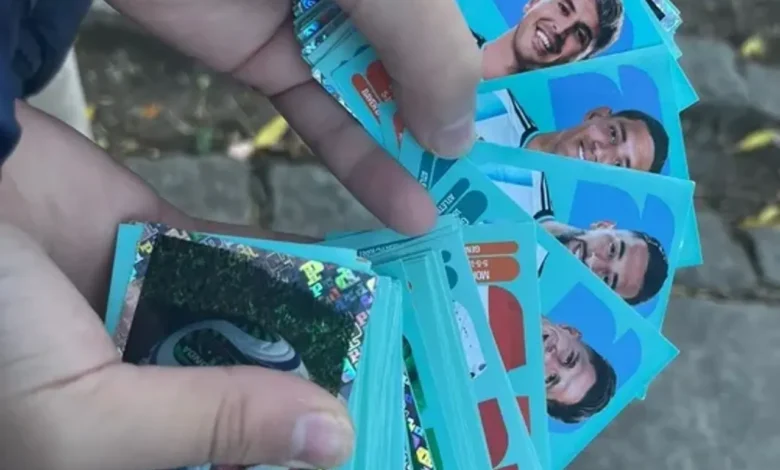
Four decades later, Ruiz shares the ritual of collecting the 2026 World Cup album with his wife, Olga, his son, Sergio, and his grandson, Santiago.
Every week, they buy stickers—also known as trading cards in other countries in the region—and travel to parks in Buenos Aires to exchange them with other children, young people, and adults who are trying to complete the 980-sticker set in this edition.
“It’s an analogue pastime,” the grandparents say.
“When we gave him the album, he was so happy. He got Lionel Messi in one of the first packs.”
Like the Ruiz family, millions across Latin America are pursuing the challenge of completing the sticker album, which has sparked a frenzy among collectors and football fans of all ages since its launch in late April and early May.
Panini, the publisher that has been printing them since 1970, estimates that this edition will surpass all previous sales records in the region, as the company’s marketing manager in Uruguay, Nicolas Lerner, tells TRT Español.
“In my day, there wasn’t the craze that exists now,” says Hugo.
His son Sergio remembers collecting the 1994 World Cup stickers and appreciates sharing the experience with his father and his 10-year-old son.
“The whole family contributes. It’s an analogue form of entertainment that keeps the kids away from screens,” he emphasises.
Trading cards
“The sticker album is a tradition; there’s a widespread craze,” says Ruben Ferrer, owner of a supermarket in downtown Montevideo where sticker sales grow week after week.
“Parents and grandparents are the biggest buyers,” the shopkeeper tells TRT Español.
In Uruguay, sales of the World Cup sticker album have been on the rise since 2010, when the tournament was held in South Africa, and the Uruguayan national team finished fourth, featuring stars like Diego Forlan and Luis Suarez.
“It’s always been a huge hit; the World Cup is always contagious, and Uruguay is a country with a strong football tradition,” says Ferrer.
“Uruguay has the highest per capita consumption of trading cards in the world. It has remained constant for more than a decade, and we expect to surpass it this World Cup. We believe it will be a record-breaking sales figure.”
Panini attributes the craze to the convergence of two Uruguayan passions: football and collecting.
“There’s at least one album per family. There’s individual collecting, by adults who consider it a hobby, and also collective collecting, which involves the whole family. The goal is to complete it before the World Cup starts. Grandparents are the biggest buyers,” he says.
The brothers World Cup album
The history of the World Cup album dates back to Italy in the early 1960s, when the Panini brothers, owners of a publishing house, began selling postcards the size of trading cards featuring the faces of players from “el calcio”, the Italian league.
A decade later, FIFA granted Panini the licence to publish the album for the 1970 Mexico World Cup, the first officially released by the Italian company.
Among the most sought-after stickers was Pele’s, the Brazilian star who that year would win his third World Cup and become a global football legend.
Since then, millions of Latin American children have grown up sticking their favourite idols’ faces into their albums: Pele in 1970, Maradona in 1986 and Messi in 2022.
The tradition of collecting trading cards lasted for 56 years, spanning all social classes, leaving a mark on each generation, surviving technological evolution and transforming into a social ritual.