The activists were confined for several days to a part of the ship’s deck surrounded by containers topped with barbed wire, visible in a highly criticised video released by Israel’s far-right National Security Minister Itamar Ben Gvir.
There, Baouya — who says she suffered a cervical spine fracture after the ordeal — was with “around a hundred others with dishevelled hair and bloodied faces”.
Hadjal, who says her foot was injured, said she saw another detainee “come out of the torture container with a swollen face, in a state of shock”.
The activists said they slept on the freezing metal and wooden floors of the containers, lacking water, hygiene facilities and food, as seawater seeped everywhere.
They accused soldiers of aiming stun grenades and rubber bullets at them.
‘Speaking out’
The activists were taken ashore in Israel and detained in Ktziot prison, where they said they faced further abuse — allegations the Israeli prison service has denied.
Security personnel “were insulting us, making animal noises and hitting us with their rifle butts” as we arrived near the port, 32-year-old Tissot told officers of France’s crimes against humanity unit.
Inside a tent, “a soldier landed a massive punch on my head and ribs”, cracking one, he said in his official statement.
Back in Germany after his release, 29-year-old social worker Johannes Happel told AFP his head had been “slammed against a tent pole” and he “saw a friend being punched and repeatedly thrown to the ground”.
Related
“Cruel, sadistic and inhumane are the adjectives that spring to mind for everything I saw,” he added.
Another Australian activist, Neve O’Connor, described being forcefully taken off the boat and thrown onto a concrete floor.
“All you can hear is the Israeli national anthem as they’re playing it on repeat,” she said. “It’s so loud and you can hear your friends screaming.”
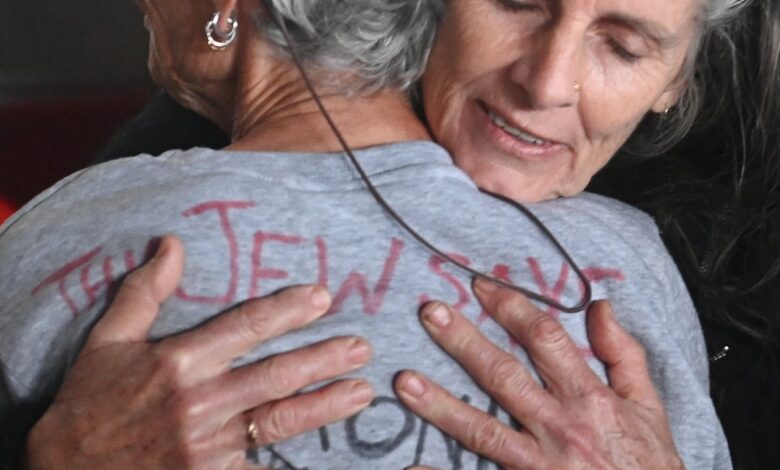
“What we experienced, protected by our passports, is just a taste of what Palestinian prisoners go through,” said Hadjal, who sees her testimony as “a weapon”.
Baouya, who will give evidence in the French investigation, said she and others were “speaking out not for ourselves, but for the Palestinians”.