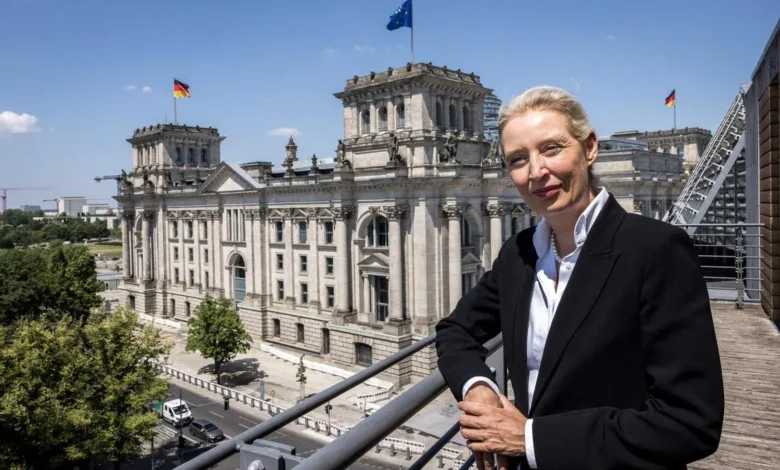
BERLIN, June 30 – Germany should end a boycott of Russian oil and gas to bolster its flagging economy, the leader of the far-right Alternative for Germany, Alice Weidel, told Reuters as she outlined the party’s ambitions to lead a national government.
Weidel said the AfD can win two key federal state elections in the coming months, describing them as milestones to securing the post of German chancellor as soon as the next national elections due by 2029.
“Cheap energy from Russia was the secret of the success of ‘Made in Germany’. We need it back,” Weidel said.
“The loss of this energy has set us back years. Hundreds of thousands of jobs have been lost. It has made us dependent on the United States, which sells us energy at far higher prices.”

SEES ELECTIONS AS ‘DECISIVE MILESTONES’
Before the sanctions imposed over Moscow’s invasion of Ukraine in 2022, Russia supplied more than a third of Germany’s crude oil imports and more than half of its natural gas.
Germany has also struggled to recover from the shock caused by the shutdown of the key undersea Nord Stream pipeline, which was crippled by explosions in September 2022.
The country’s industry, rattled by a spike in energy costs that followed, remains in the doldrums. Adding to the gloom, car giant Volkswagen is considering cutting as many as 100,000 jobs.
Weidel’s comments highlight the potential fragility of the Western alliance underpinning support for Ukraine. Although Germany’s current government backs Ukraine, the population is more divided.
Weidel made the remarks ahead of September elections in two key eastern German states, Saxony‑Anhalt and Mecklenburg‑Vorpommern, where the AfD is dominating polls.
Should the AfD win control, this would see those regional governments challenge Berlin’s policy on migration, which they say is too generous, rejecting the financial burden on local governments.
It would upend the consensus model of committee-style government in Germany and potentially give the AfD a stepping stone to national rule.
“Saxony-Anhalt and Mecklenburg‑Vorpommern are decisive milestones,” Weidel said.
“If we win in Saxony-Anhalt, then Mecklenburg‑Vorpommern will probably follow. I can see the AfD in the chancellery either by the next elections or the ones after.”
For mainstream political parties such as Chancellor Friedrich Merz’s Christian Democrats, which have rejected cooperation with the AfD, a victory by the far-right party in Saxony-Anhalt would deal a blow to the so-called firewall of coalitions to block the AfD from power.
Energy costs and the prospect of cheaper Russian energy could win over voters.
Germany’s relationship with Russia carries more weight in the east, which was under Soviet rule until the fall of the Berlin Wall more than 35 years ago. Many there take a sympathetic stance towards Russia and a critical view of Germany’s military protector, the United States.
‘WE WILL NOT TURN EVERYTHING ON ITS HEAD’
Weidel’s comments on Russia follow a visit earlier this month by senior AfD lawmaker Markus Frohnmaier to Russia. He met Alexei Miller, the head of Russian energy giant Gazprom, and called for a reopening of the Nord Stream gas pipeline.
Frohnmaier rebuffed criticism of his trip, saying he understood that U.S. investors were examining reopening the Nord Stream route to Germany, a move that could see Germany pay a fee to draw Russian gas.
“We have to be careful in Germany that we don’t miss the window of opportunity to get back into the Russian market,” he told Reuters. “Mr Miller said it would take a three-month timeframe for the gas supply to be resumed.”
Roderich Kiesewetter, a member of parliament from Merz’s Christian Democrats, said the AfD’s pro-Russian stance was distorting the public debate in Germany.
“The romanticisation of Russia is being used by the AfD, in particular with an eye on the upcoming elections in eastern Germany,” Kiesewetter said.
Weidel dismissed accusations that her party was extremist, as it was classified by Germany’s spy agency last year.
“The way we see ourselves and the way our political rivals judge us, are miles apart,” she said. “People describe us as far-right. In truth, we are a party for the regular person. We will not turn everything on its head if we get into power.” REUTERS