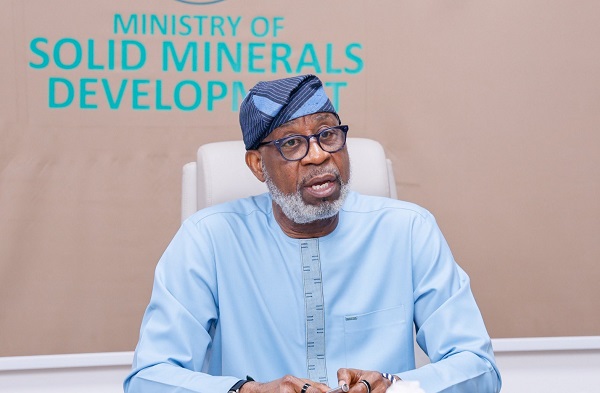
The minister of solid minerals development, Dr Dele Alake, has called for stronger global collaboration to address development financing gaps in emerging economies, stressing that innovative financing mechanisms are critical to unlocking sustainable economic growth in Nigeria.
According to a statement by the minister’s head of press and media department, Kania Maliki A., Alake made the call on Tuesday while speaking virtually at the Green Guarantee Group (GGG) High-Level Stakeholders’ Roundtable on Mainstreaming Financial Guarantees in Nigeria, held in Abuja.
The minister said partnerships among governments, development institutions, private investors and international organisations would help mobilise investments in green development, support small and medium-scale enterprises (SMEs), and accelerate economic transformation.
According to him, innovative funding models that reduce investment risks are essential for attracting long-term capital into strategic sectors such as renewable energy, mining, agriculture, infrastructure and climate-resilient industries.
“To realise our development vision, substantial investments are required. However, many viable projects struggle to attract capital because of market uncertainties and financing constraints. This is where guarantee instruments and innovative risk-sharing mechanisms become very important,” Alake said.
He noted that guarantees are vital tools for de-risking investments, mobilising private sector funding and strengthening climate adaptation and economic transformation efforts.
The minister also highlighted the importance of improving access to finance for Micro, Small and Medium Enterprises (MSMEs), describing them as key drivers of economic growth, job creation and innovation.
He said the roundtable provided an important platform for policymakers, financial institutions, development partners and private sector stakeholders to identify practical solutions to Nigeria’s development financing challenges.
Speaking at the event, Chair of the Green Guarantee Group, Mr Lars-Hendrik Roeller, said guarantees have become globally recognised instruments for reducing investment risks, boosting investor confidence and unlocking private capital for climate and development projects.
Roeller stressed the need to move climate finance discussions beyond policy debates to practical implementation through national initiatives and stakeholder collaboration.
He disclosed that the GGG is working to establish a stronger global guarantee architecture capable of supporting sustainable investments, particularly in developing countries.
According to him, Nigeria’s position as Africa’s largest economy and co-chair of the GGG places it in a strategic position to champion practical financing solutions that can accelerate green industrialisation.
He also revealed plans to deepen international cooperation through an alliance of countries focused on strengthening guarantee systems and expanding climate finance mechanisms.
Co-Chair of the GGG and Permanent Secretary of the Ministry of Solid Minerals Development, Engr Faruk Yabo, said the workshop was designed to achieve three major objectives.
He explained that the first objective was to build a common understanding among government agencies, regulators, development finance institutions, domestic guarantee providers and the private sector on how guarantee instruments can be effectively applied within Nigeria’s economic context.
The second objective, he said, was to assess Nigeria’s existing guarantee and risk-sharing architecture, including institutions such as InfraCredit, NIRSAL, the Nigeria Credit Guarantee Company, the Nigeria Sovereign Investment Authority and the Infrastructure Bank.
The third objective was to examine practical investment opportunities across sectors including renewable energy, agriculture, nature-based solutions and solid minerals through guarantee mapping and stakeholder dialogue.
Yabo said the Green Guarantee Group was established to address a major challenge in climate and development finance — the disconnect between the large pool of global capital available and the limited volume that reaches viable projects in developing markets.
He described guarantees as a bridge connecting institutional investors seeking secure returns with climate and development projects that are often perceived as risky.
“Nigeria’s role as co-chair of the GGG reflects recognition of the country’s enormous investment needs in power, solid minerals, agriculture, infrastructure and the broader green economy,” he said.