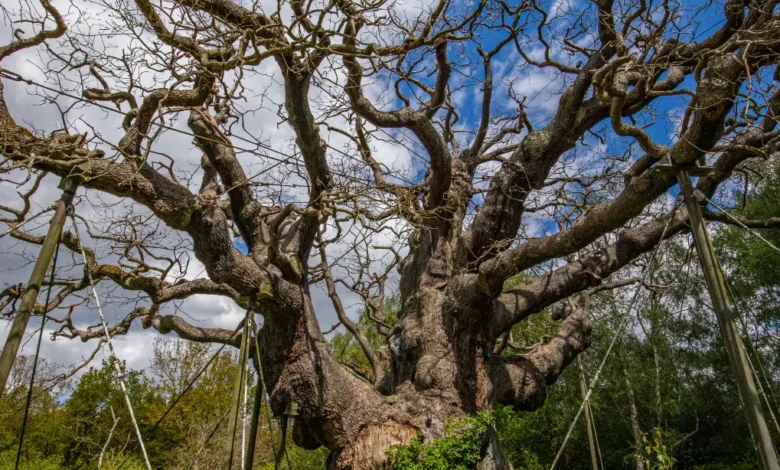
A 1,200-year-old oak tree in England – closely linked to the legend of Robin Hood – is believed by experts to have died.
Known as Major Oak, the tree in Nottingham’s Sherwood Forest has been in visible decline for several years, the Royal Society for the Protection of Birds (RSPB) said on June 18, despite tireless efforts to improve its health and prolong its life.
“This spring, the Major Oak failed to come into leaf and is now believed to have died,” the organisation said in a news statement.
The tree got its name after being mentioned in a book on oaks by former British soldier Major Hayman Rooke in 1790, according to the Associated Press.


But it is more famous for its association with legendary 13th-century outlaw Robin Hood, who allegedly used the tree’s hollow trunk as a hideout.
The tree’s gnarled limbs, sprawling canopy and 11m-trunk have also made it an iconic landmark, drawing millions of visitors every year.
Ed Pyne, Woodland Trust senior conservation adviser, said Major Oak was “one of the country’s most important trees”.
“To see the loss of a tree like this is always incredibly tragic,” he told the BBC. “The Major Oak is perhaps the most famous ancient tree in the UK. We’ve learned so much from the work that we’ve done… that we could go and apply to other trees across the country.”
While it was difficult to determine the exact cause of the oak’s demise, the RSPB said a combination of issues, including poor soil, human interventions and a weakened root system, has been a major factor in the decline of Major Oak.
“Millions of visitors also compacted the sandy soil around its roots, making it difficult for water, nutrients and oxygen to reach the tree,” the charity said.
Additionally, climate change and the associated recent heat waves and droughts have compounded the challenges faced by the tree.
Still, all is not lost.
The tree will continue to be in Sherwood Forest as a “monument” for people and wildlife.
Acorns and cuttings from the tree have grown into saplings, some of which are planted in locations around the world.
The RSPB said this will ensure Major Oak’s “offspring will grow and generate their own acorns – and legends – for centuries to come”.
“The Major Oak will continue to stand at the heart of Sherwood as a natural monument for visitors to come and see, living on in the legend of Robin Hood and continuing to provide as much support to the forest’s ecosystem in death as in life,” said Sherwood Forest’s senior site manager Hollie Drake.