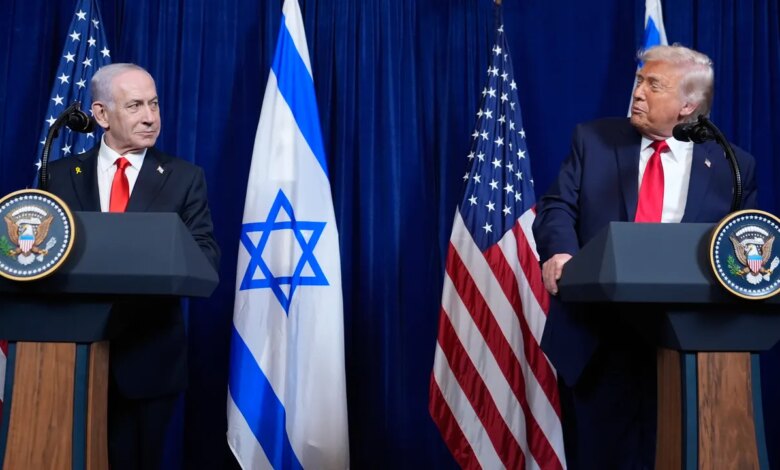
The US and Israel have been close allies since the establishment of the Jewish state in Palestinian lands in 1948, but the Netanyahu government’s increasingly militarised approach across the Middle East appears to be causing growing unease within the Trump administration.
Recent disagreements have surfaced over a range of issues, from Iran and Lebanon to the future balance of power in the region.
In a phone call last week, Trump reportedly expressed frustration with Netanyahu over Israeli actions in Lebanon, while later publicly insisting that the Israeli leader would have to accept any future US agreement with Iran.
“I call the shots. I call all the shots. [Netanyahu] doesn’t call the shots,” Trump said in a recent interview with the Financial Times, adding that the Israeli leader has no choice but to accept a possible American deal with Iran, which might include clauses on Lebanon.
Despite Trump’s apparent strong-arming of Netanyahu, the Israeli leader has repeatedly charted his own course, from Gaza and Lebanon to Iran, carrying out military actions that Washington reportedly sought to avoid and raising questions about the effectiveness of US pressure on its Middle Eastern ally.
The differences have become particularly evident in recent months. Despite reported US objections, Israel struck Iranian oil facilities during the Iran war and, most recently, targeted Beirut’s southern suburbs, fuelling concerns that Israeli military actions could undermine Washington’s broader regional objectives.
Although the US has continued to back Israel politically and militarily, analysts say the relationship is showing signs of a gradual divergence as shifting regional dynamics force Washington and Tel Aviv to prioritise different goals.
“The US paused the Iran war despite Israeli pressure while the Netanyahu administration has not been able to achieve its objectives from Hezbollah’s elimination from Lebanese landscape to change Iranian regime,” Gokhan Batu, an expert on Israel and Levant politics, tells TRT World.
“Due to new Middle Eastern dynamics, Israel has been regionally weakened while Netanyahu lost ground in internal politics. On the other hand, because the US has a global agenda and can not follow Israeli lead on every issue, the Trump administration has begun moving to a different direction from the Netanyahu government in the Middle East,” he adds.
While the US and Israel remain closely aligned on many strategic issues, other analysts also say their priorities are no longer perfectly overlapping.
“Both Trump and Netanyahu want to define their respective spheres of influence in the Middle East. The US wants a Middle East where it can compromise, while Israel wants a Middle East where it can establish sole dominance,” Tuba Yildiz, an expert on Lebanese politics, tells TRT World.
While Trump can live with the current Iranian government if it signs a deal with him, Netanyahu wants a completely different government in Tehran that it can control, according to Yildiz.
While both Israel and the US want Hezbollah removed from the Lebanese political and security landscape, they differ over Lebanon’s future, Yildiz notes.
A stronger Lebanese state backed by a capable national army would serve Washington’s interests, but Israel prefers a balance of power that prevents the emergence of a unified political and military authority, she says.
Trump and Netanyahu also differ on Türkiye’s role in the Middle East, Yildiz adds.
“For Trump, Türkiye’s growing presence in the Middle East, from Syria to Qatar, should be accepted, but for Israel, Türkiye is the biggest threat,” which also contributes to a divergence between the two states over the future of the Middle East, she says.
Special relationship
Despite signs of divergence on some regional issues, analysts, however, caution against overstating the extent of any rift.
The institutional, political and strategic foundations of the US-Israel relationship remain largely intact, limiting how far disagreements between the Trump administration and Netanyahu’s government are likely to go.
In that context, Nimrod Goren, President of the Mitvim Institute, an Israeli think tank, considers a complete break-up between Trump and Netanyahu unlikely.
“The US President is indeed the one currently dictating the level of military escalation in the wars on Iran and on Hezbollah. The Israeli Prime Minister seeks to stir US decision making towards his preferred direction, and has had some successes in doing so,” Goren tells TRT World.
“But whenever Trump puts a red line, Netanyahu complies.”
In the broader picture of how to deal with the Middle East, the two administrations have been “quite aligned”, though there are differences in priorities on certain issues, such as the Lebanese crisis, according to Goren.
But these differences cannot be described as major tensions because “Trump and Netanyahu manage to get along”, he says.