Automatic NDA Admission Bill Faces Opposition Over Merit, Federal Character Concerns

0
ABUJA – A proposed amendment to the Nigerian Defence Academy (NDA) Act seeking to grant automatic admission to graduates of military secondary schools has drawn opposition from defence stakeholders, who argue that the measure could undermine merit-based selection and conflict with the constitutional principle of federal character.
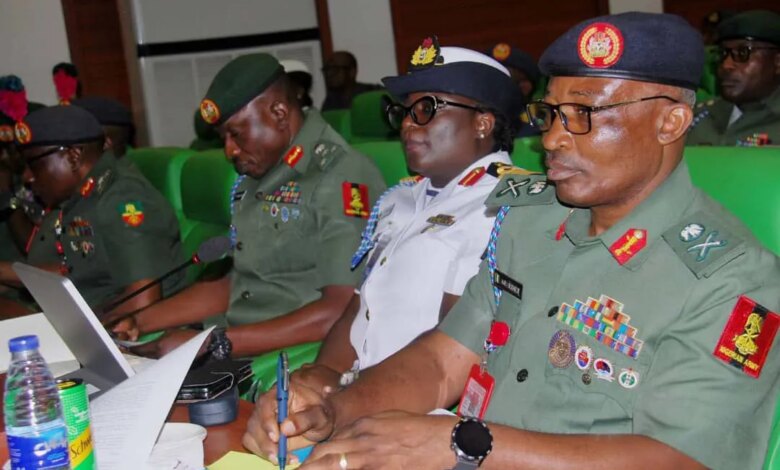
The concerns were raised on Tuesday during the second day of a two-day public hearing organised by the House of Representatives Committee on Defence, chaired by Hon. Babajimi Benson.
Among the bills considered at the hearing was the Bill for an Act to Amend the Nigerian Defence Academy Act, 2024 and for Related Matters (HB.1709), which proposes automatic admission into the NDA for successful graduates of designated military schools.


Presenting the position of the academy, the Director of Military Training, Nigerian Defence Academy, Brigadier General Taiye Ahmed, explained that the bill seeks to amend Section 8(2) of the Second Schedule to the NDA Act by introducing what he described as an “automatic admission, right of first refusal” for graduates of Nigerian military schools.
According to him, the proposed amendment states that: “The board shall offer automatic admission for successful graduates from Nigerian military schools.”
Ahmed said proponents of the bill argue that the measure would help prevent graduates of military secondary schools from becoming susceptible to recruitment by criminal groups or non-state actors because of their military orientation and training.
According to him, the justification advanced by supporters is “to prevent the graduates of the schools from being handy tools in the hands of non state violent actors because of the graduate military background.”
The bill also proposes the inclusion of an interpretation section defining “The Board” as the Board of the Nigerian Defence Academy, “Applicant” as candidates applying to the NDA, and “Nigerian Military Schools” as institutions that provide both military and academic training.
The schools covered under the proposal include the Nigerian Military School, Zaria; Air Force Military School; Air Force Girls Military School; and the Nigerian Navy Military School.
While acknowledging the rationale behind the amendment, Ahmed told lawmakers that the academy does not support the proposal in its present form.
“However it was observed that if the amendment is passed as phrased,it has the potential of creating statutory bottlenecks on the constitutional principle of federal character. The NDA operates on this principle to ensure national unity and equal representation across the 36 states of the federation and the Federal Capital Territory FCT,” he said.
He noted that admission into the NDA has historically been guided by a balance between merit and equitable representation, a framework designed to foster national cohesion within the officer corps of the Armed Forces.
Ahmed further argued that the amendment could be vulnerable to legal challenge on grounds of discrimination against qualified candidates who did not attend military secondary schools.
“Moreover, the proposed amendment could face legal challenges for being discriminatory against applicants who did not attend the military school as it could be perceived as disenfranchising them for admission into the Nigerian Defence Academy.”
The NDA official maintained that graduates of military secondary schools are already afforded equal opportunities under the existing admission process and are not disadvantaged in competing for admission.
“The graduates of military schools currently have equal opportunity to seek admission into the Nigerian Defence Academy to be commissioned as regular combatant officers by competing with other interested Nigerians.”
He added: “The process has consistently ensured that the NDA selects the best candidates irrespective of the secondary school they attended.”
Ahmed also pointed to alternative pathways available to military school graduates who wish to pursue careers in the Armed Forces.
“Moreover graduates of the military schools have the opportunity for immediate enlistment as soldiers, especially the Nigerian Military School, Zaria upon graduation from military secondary schools and thereafter proceed to higher military institutions through military sponsorship. Upon graduation from higher institutions these graduates could apply to be commissioned as officers through the short service commission or the direct short service commission when advertised by any of the three services of the Armed Forces of Nigeria.”
He explained that those who do not secure commissions through those routes can still pursue officer status through executive commission opportunities later in their careers.
“Furthermore those unable to secure admission through the short service commission or the direct short service commission could apply for the executive commission later in their career.”
Defending the current admission framework, Ahmed emphasised that entry into the NDA remains highly competitive and is based on clearly defined academic, physical and psychological standards.
“It is pertinent to state that the NDA has a very strict admission criteria including minimum JAMB score as well as very high standard physical, psychological and medical standard.”
He disclosed that records available to the Armed Forces indicate that candidates from civilian secondary schools often outperform some military school graduates during the selection process.
“Available record in the Armed Forces show that civilian candidates could be better than some military school graduates based on their earlier mentioned criteria to avoid disenfranchising excellent candidates that did not have the opportunity of attending military schools from admission into NDA.”
Ahmed therefore urged lawmakers to preserve the existing system.
“The NDA is of the opinion that the current admission process into the NDA should be maintained.”
In addition to the NDA amendment bill, the committee received submissions on proposed legislation seeking to establish a Joint Doctrine and Warfare Centre to improve operational coordination across the Armed Forces, create an Armed Forces Medical College in Abuja, and establish the National Defence College of Nigeria as a postgraduate degree-awarding institution and centre for strategic research and professional military education.
Speaking at the conclusion of the hearing, Chairman of the House Committee on Defence, Hon. Babajimi Benson, commended stakeholders for their engagement and contributions to the legislative process.
“This is the peoples Parliament. The contributions have been worthwhile,” Benson said.
The hearing forms part of ongoing legislative efforts to strengthen Nigeria’s defence institutions and review existing laws to meet evolving security and operational demands, while balancing institutional reforms with constitutional safeguards and principles of fairness.