Chinese proverb of the day: 'Be not afraid of growing slowly. Be afraid only of … ' — a lesson on why slow progress always beats no progress

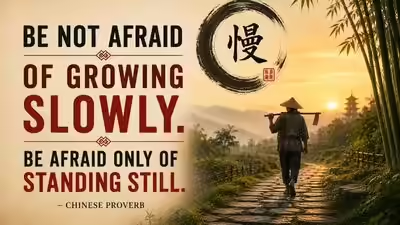
The new language app you downloaded sits untouched on your phone. The gym membership you bought in January has been used twice. The novel you started writing is still stuck on page one. You tell yourself you’ll get to it when you have more time, when you feel more motivated, when conditions are perfect.But the days turn into weeks. The weeks turn into months. And nothing changes.This is the wisdom captured in the Chinese proverb. “Be not afraid of growing slowly. Be afraid only of standing still.” The first is a journey. The second is a choice to stop.“Be not afraid of growing slowly. Be afraid only of standing still.” — Chinese ProverbThe proverb originates from the Chinese culture, the proverb is rooted in the simple wisdom of daily life — farmers knew that a field could be tilled slowly, but only if the work continued without pause . This is a truth about the nature of progress and the consequences of inaction.The saying also appears in a longer form, “Don’t fear slowness, only fear stopping; stop for a moment, and you fall two and a half li behind”. This captures a practical warning about how even a brief halt can have significant consequences.
Proverb of the Day
The proverb reminds us that progress is not always immediate or rapid. It emphasises the importance of continuous growth and development, even if it happens at a slower pace . The fear should not be that you are moving too slowly, but that you have stopped moving altogether.Today, many of us are in a hurry and want to see results instantly. We worry that not seeing results immediately means the attempt has failed. For many, that leads to a series of quick attempts, none of which are tried for a sufficient period of time for anything significant, or even measurable, to have happened. In the end, the attempts go nowhere. Because nothing seems to be working, people give up, and that is the same as standing still .As one source notes, “Slow growth is still growth—it means we are moving forward, learning, and improving, even if the changes are not immediately visible” . Standing still, on the other hand, means no progress or development at all. It implies complacency or fear of failure, which can lead to stagnation.
The deeper meaning


The proverb is not an excuse for laziness or complacency. It does not mean one should deliberately slacken off or take things for granted. What it actually means is to do things at a pace that suits your schedule and lifestyle, while continuing to move forward.Think of the farmer tending their field. The work is slow. It is repetitive. It is unglamorous. But it is also essential. The farmer who stops working for days because the progress feels too slow will have no harvest. The farmer who works a little each day, even in the rain, even when tired, will eventually reap what they have sown.The proverb also teaches us about self-compassion. It tells us not to compare our progress with those around us. It tells us to stay patient. It tells us that every step forward, no matter how small, is a victory worth celebrating . The danger is not that you are moving slower than others. The danger is that you have stopped moving at all.
Why this matters today
We live in an age of instant gratification. Social media shows us overnight successes and people who seem to have it all figured out. We are told we should be constantly improving, constantly achieving, constantly becoming more. The pressure to be fast can be overwhelming.But this proverb offers a different way. It invites us to see growth as a quiet, steady process. It invites us to trust that small steps, taken consistently, lead to big changes. It invites us to let go of the need for speed and embrace the power of persistence.The next time you feel discouraged by how slowly you are progressing, remember the proverb. Be not afraid of growing slowly. Be afraid only of standing still. The journey of a thousand miles begins with a single step — and continues with the next one, and the one after that.