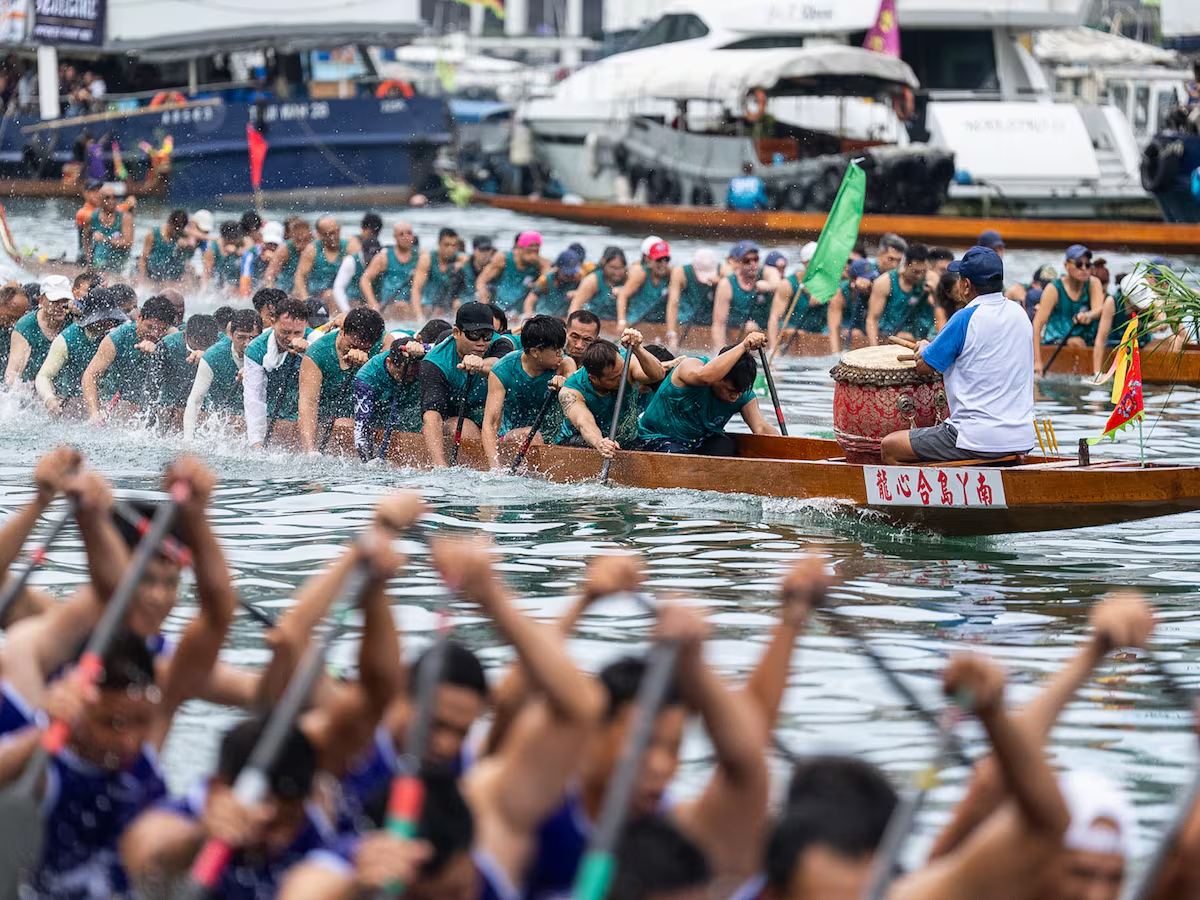
BEIJING (AP) — Dragon boat races, lion dances and other festivities marked the Dragon Boat Festival on Friday across mainland China, Hong Kong and Taiwan. The more than 2,000-year-old holiday is best known for its sporting events, but its origins are rooted in ancient beliefs about health, protection and harmony with nature.
“The fact that this holiday has been preserved for thousands of years shows how much we value our traditional customs,” said Meng Dongmei, a retired resident of Beijing’s Tongzhou district.
Meng said her family observes the holiday through a variety of traditional customs. They prepare zongzi, the sticky rice dumplings associated with the festival, and children wear five-colored bracelets believed to ward off evil.


“We also learned online about a traditional recipe using mugwort leaves, red dates, brown sugar and ginger to boil eggs,” Meng said. “We heard that it could help ward off illness and keep people healthy throughout the year, so we hope that through this festival our family will enjoy good health.”
Thousands to gather for boat races
Beijing’s 2026 celebrations will continue through the weekend at the capital’s Grand Canal.
The three-day event features men’s, women’s and mixed dragon boat races over distances of 100, 200 and 500 meters. Teams from Beijing, Tianjin, Hebei, Shanxi and Guangdong will compete throughout the holiday weekend.
More than 1,000 athletes and 200,000 spectators are expected to gather for the event, organizers said in a press release.
“The competition helped strengthen our team spirit,” said Li Maoshan, a participant in Friday’s races. “It also gave us an opportunity to demonstrate the spirit of perseverance and hard work.”
Beyond the races
Among the cultural features during Beijing’s Dragon Boat Festival were demonstrations of Wing Chun martial arts, a market featuring traditional handicrafts and a performance in which dancers mimic the movements of a lion.
Activities were intended to highlight cultural exchanges between northern and southern China, officials said.
Friday’s lion dance was presented by a group of performers from Guangdong province in southern China. “Wherever there is a festive occasion, you’ll find dragon and lion dances,” said He Weihong, founder of the group. “Dragon boat racing and dragon-and-lion dancing are inseparable, as they are both part of our intangible cultural heritage.”
Ancient customs on health and protection
The festival’s roots run deeper than sporting competitions. It is widely associated with the ancient poet Qu Yuan, who according to legend drowned himself more than 2,000 years ago.
Tradition holds that people raced out in boats to search for him and threw rice into the river so fish would not eat his body. That story is often linked to both today’s dragon boat races and the zongzi still prepared by families across China.
“The Dragon Boat Festival is probably the richest and most diverse of all traditional Chinese festivals,” said Tsinghua University history professor Liu Xiaofeng. “Across different regions, people developed a wide variety of traditions based on ideas connected to the summer solstice and the balance of yin and yang.”
The holiday falls in the fifth month of the traditional Chinese lunar calendar, around the time of the summer solstice. Ancient Chinese viewed this as a period when insects, poisonous creatures and disease became more prevalent, giving rise to a wide range of customs aimed at preserving health and warding off misfortune.
“At its core, the Dragon Boat Festival is about disease prevention, warding off evil and maintaining health,” Liu said.
Some people wear sachets containing medicinal herbs during the festival. Others fumigate their homes with smoke, a practice intended to prevent disease by driving out things considered harmful.
“Chinese people have traditionally placed a special emphasis on happiness, well-being and living in peace and safety,” Liu said. “Nearly all of China’s major festivals are connected in some way to these aspirations.”
Evolving traditions
Participants in Hong Kong’s dragon boat races on Friday wore costumes including a cartoon version of Chinese Taoist deity Ne Zha.
Guided by the thunderous beat of their drummers, crews pulled their paddles through the water in unison, each boat surging toward the finish line as spectators cheered them on. Others watched the races at home as they enjoyed zongzi with their families.
“Today more than 64% of China’s population lives in urban areas and people’s lifestyles have been transformed,” Liu said. “In a large city, it’s difficult to celebrate the festival the way people once did in rural communities. Festivals evolve along with the times.”
Bao Nari, a Beijing resident who spent years away from home while she studied in Japan, said that while boat races were not part of her childhood celebrations, other long-standing Dragon Boat Festival traditions like wearing five-colored bracelets were passed down through her family.
“After coming back, I’m impressed by how much cultural development has progressed here,” Bao said. “This cultural heritage has become deeply rooted in our hearts and it inspires our generation to be more confident.”
___
AP video producer Liu Zheng in Beijing and reporter Kanis Leung in Hong Kong contributed to this report.
Associated Press religion coverage receives support through the AP’s collaboration with The Conversation US, with funding from Lilly Endowment Inc. The AP is solely responsible for this content.
Copyright 2026 The Associated Press. All rights reserved. This material may not be published, broadcast, rewritten or redistributed without permission.