0
Torkwase Nyiekaa
Deputy Speaker of the House of Representatives, Benjamin Kalu, has urged Nigerians not to allow concerns over the possible abuse of state police by governors to derail efforts at addressing the country’s worsening security challenges, insisting that the proposed constitutional amendment establishing state police contains sufficient safeguards against political misuse.
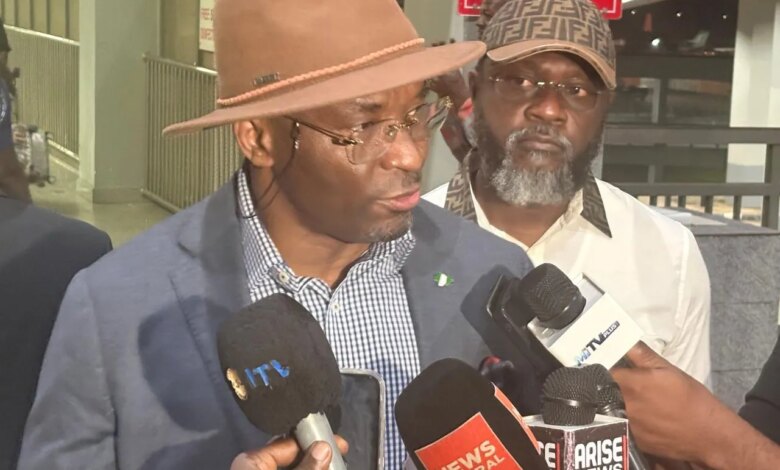
Speaking with journalists in Abuja on Friday after returning from a week-long engagement at Chatham House and the London Climate Action Week in the United Kingdom, Kalu said the National Assembly deliberately built constitutional checks into the proposed legislation to ensure accountability while unlocking the security benefits of decentralised policing.

His remarks come amid sustained national debate over the establishment of state police, with supporters arguing that a decentralised policing system would improve intelligence gathering and response to local security threats, while critics fear that governors could weaponise the institutions against political opponents.
Addressing those concerns, the deputy speaker acknowledged that the fears were understandable but argued that they should not overshadow the broader public interest.
“The fear of a minor percentage of risk should not stop Nigerians from enjoying the major percentage of benefits that is found in that bill.
“Let me ask this question: How many governors have used state high courts to jail opposition members? What is the statistics out there?
“Yes, the fear is there; it is a legitimate fear. But what is more legitimate is that Nigerians should embrace the benefits of state police.
“Because of those concerns, while drafting this document, we ensured that there are clear guardrails defining the powers, duties and operational limits of state police.”
Kalu explained that the constitutional amendment seeks to move policing to the Concurrent Legislative List while establishing national minimum standards that every state police organisation must observe.
According to him, the proposed framework expressly prohibits the deployment of state police for partisan political activities or politically motivated conflicts.
“It is a beautiful piece of legislation that we have put together,” he said.
The deputy speaker disclosed that once the constitutional amendment is concluded, it would be followed by a repeal and reenactment of the Police Act to provide the legal architecture required for the implementation of state police across the federation.
“There is going to be a consequential repeal and reenactment of the Police Act because it is going to be the implementation Act of the constitutional amendment we are making now.
“This means the President will champion the repeal and reenactment of the Police Act, and it is in that Act that many of the operational details Nigerians are currently concerned about will be adequately addressed.”
Beyond the state police debate, Kalu said his engagements at Chatham House provided an opportunity to present Nigeria’s democratic reforms and constitutional innovations to key international stakeholders ahead of the 2027 general elections.
He stressed that Nigeria must remain actively engaged with the international community, noting that global perceptions significantly influence diplomatic relations, investment decisions and international partnerships.
“Nigeria is in the comity of nations; we are not an isolated nation.
“One thing with global politics is that perception is everything. If you don’t communicate and frame your narratives properly, others will frame the narratives for you.”
According to him, discussions at the London-based policy institute centred on Nigeria’s preparations for the 2027 elections, particularly electoral reforms designed to improve transparency and public confidence.
“Elections are coming, international observers will be here, documents will be flying around. We need to let the world know the level of our preparation and the innovations we have introduced into the Electoral Act to enhance credibility.”
Kalu said he informed participants that Section 60(3) of the Electoral Act had established electronic transmission of election results as the default legal position, describing it as one of the major reforms introduced to strengthen electoral integrity.
He also revealed that the National Assembly is working towards placing defence funding on the First Line Charge to guarantee timely and uninterrupted financing of the country’s security architecture.
“We informed them that we are pushing to ensure that financing for the defence sector occupies the First Line Charge so that funding will not be delayed or subjected to interference.”
Speaking on his participation at the London Climate Action Week, the deputy speaker said he used the platform to attract investors to Nigeria’s climate adaptation, mitigation and energy transition programmes.
He added that he showcased the country’s roadmap for a green economy, particularly reforms within the solid minerals sector, noting that the engagements generated considerable interest among development partners and investors.
“I was there wooing investors from around the world to come and participate in Nigeria’s climate adaptation and mitigation efforts.
“I also showcased our roadmap for the green economy, particularly the reforms being driven under the Ministry of Solid Minerals.
“I saw significant interest, especially regarding energy transition. Our allies, particularly the United Kingdom, expressed strong interest in what Nigeria is doing, and I am confident that we will begin to harvest the outcomes of those engagements in the coming days.”
Kalu also appealed to Nigerians, especially young people, to become ambassadors of the country’s image by projecting balanced narratives that acknowledge challenges while highlighting progress.
He disclosed that the London trip was privately funded by himself and members of his team, saying patriotism should not always depend on government sponsorship.
“This trip was not sponsored by government. I sponsored it together with some members of my team because we believed it was time to project Nigeria positively to the world.
“It is not always about what government can do for you; it is also about what you can do for your country.”
He further cautioned against using social media to amplify only negative narratives about Nigeria, arguing that such portrayals have long-term implications for the country’s international reputation.
“We do not have any other country but this. If we destroy its image, we become strangers wherever we go.
“We know we have challenges, and we should criticise constructively, but we must also tell the positive stories. Leadership will come and go, but you will remain a Nigerian for life.
“When I spoke at Chatham House, I made it clear that we did not come to say Nigeria has arrived. We are only 27 years into our democracy, while many countries we are compared with have over 200 years of democratic experience.
“If we are patient and continue building our institutions, we will get it right. Let us keep Nigeria first in the way we project our country to the world because the narratives we create are being leveraged internationally to define who we are.”