0
Stakeholders at the 30th anniversary of Motoring World held at MUSON Centre, Lagos Island
The Federal Government has disclosed that it is reviewing Nigeria’s automotive policy to accommodate emerging technologies such as electric vehicles (EVs), Compressed Natural Gas (CNG)-powered vehicles and other alternative energy solutions, even as former Corps Marshal of the Federal Road Safety Corps (FRSC), Dr Boboye Oyeyemi, called for a long-term and consistent policy framework that prioritises local manufacturing and value creation over revenue generation from vehicle imports.
The position was made known on Thursday during the 30th anniversary celebration of Motoring World in Lagos, themed: “Celebrating Three Decades of Excellence in Automotive Journalism.”


Speaking as chairman of the occasion, Oyeyemi said Nigeria possesses one of the largest automotive markets on the African continent, but lamented that the country had failed to maximise its enormous potential because of inconsistent policies and inadequate support for indigenous manufacturing.
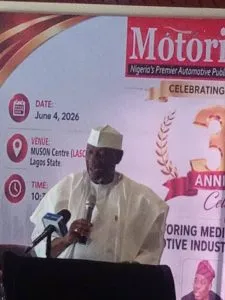
Dr Boboye Oyeyemi, former FRSC Corps Marshall
According to him, Nigeria’s population of over 240 million people, an estimated vehicle fleet of 21 million units, a road network stretching beyond 204,000 kilometres and rapid urbanisation provide huge opportunities for vehicle assembly, component manufacturing, automotive financing, electric vehicle infrastructure and other related services.
The former FRSC boss, who is also Chairman of the Chartered Institute of Logistics and Transport (CILT), noted that despite these advantages, the nation’s automotive industry remains underdeveloped and heavily reliant on imported used vehicles.

He regretted that the National Automotive Industry Development Plan (NAIDP) and other regulatory frameworks had undergone repeated reviews and restructuring without delivering the sustained industrial growth expected of a country with Nigeria’s size and market potential.
Oyeyemi observed that several investors had entered and exited the industry, while many assembly plants had struggled to survive owing to policy uncertainties.
According to him, Nigeria’s automotive manufacturing industry remains at an early stage of development and lacks the supply chain depth, skilled workforce and policy consistency required to make locally produced vehicles globally competitive.
He said the country’s automotive policy architecture, including the NAIDP, delivery frameworks and assembly plant licensing regime, had been altered several times without generating the industrial momentum required to transform the sector.
“Investors have come and gone, assembly plants have opened and closed, and the Nigerian consumer continues to drive imported vehicles, mostly second-hand, often poorly maintained and frequently unsafe, when they should be driving vehicles assembled in Nigeria to international standards,” he said.
Oyeyemi stressed that government policies should be designed to stimulate local value addition and domestic production rather than focusing mainly on the revenue generated through duties imposed on imported vehicles.
He also expressed concern over road safety, describing it as the most critical human aspect of the transportation sector. According to him, road crashes continue to claim too many lives and require sustained intervention by relevant authorities and stakeholders.
The former FRSC Corps Marshal commended Motoring World for its consistent advocacy and contributions to the development of Nigeria’s automotive industry over the past three decades, describing the publication as a key stakeholder in the sector’s growth.
Meanwhile, the Minister of Industry, Trade and Investment, Dr Jumoke Oduwole, announced that the Federal Government was updating the nation’s automotive policy to align with emerging technological developments and global trends in sustainable mobility.
Represented at the event by the Ministry’s Desk Officer for the Automotive Industry, Samuel Adetoro, the minister said the review was intended to reposition Nigeria’s automotive ecosystem to meet future transportation and industrial demands.
She described the automotive sector as a critical pillar of the country’s industrialisation agenda, noting that it possesses enormous potential to create jobs, attract investments, deepen local manufacturing and reduce dependence on imported vehicles.
According to Oduwole, although the existing policy had provided a framework for the growth of vehicle assembly operations in Nigeria, rapid technological advancements and changing global realities had made it imperative to revise the policy to address current and future mobility requirements.
She stated that the incorporation of electric vehicles, CNG-powered automobiles and other alternative energy technologies into the revised framework would place Nigeria in a stronger position to compete within the evolving global automotive landscape.
The minister reiterated the Federal Government’s commitment to building a more sustainable and resilient automotive industry capable of supporting economic growth and enhancing the country’s industrial competitiveness.