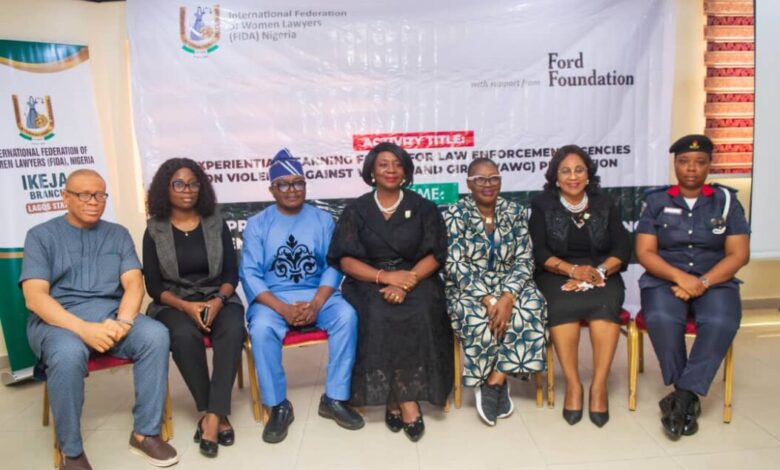
The International Federation of Women Lawyers (FIDA) Nigeria has taken commendable initiative to address rising cases of domestic violence in the country.
The lawyers were worried that women were going through brutal experience in the hands of people who indulge themselves in violating rights of women hiding under unexplainable reasons.

The FIDA, in line with its advocacy framework on Tuesday, provided a knowledge-sharing opportunity to various arms of law enforcement agents and other key agencies of government involved in dealing with gender-based issues in view of rising cases of such incidents across Nigeria.
Touched by the latest developments, the Ikeja branch of the FIDA organised the ‘Human Rights Includers Dialogue on Promoting Gender-Sensitive Cultures in Law Enforcement Agencies Towards Preventing Gender-Based Violence’ in Lagos.
The dialogue session demonstrated the groups’ shared commitment to eradicating this pressing human rights crisis.
Stella Mbachu, the Vice Chairperson of the Education Branch of the FIDA, in her opening remarksk emphasised that statistics surrounding violence against women and girls remained alarming, demanding a coordinated and robust and emphatic response from all an sundry, particularly working together with the law enforcement and security sectors.
Drawing attention of participants to relevant data, Mbachu noted that almost one in every three women have been subjected to either physical, sexual or some form of violence in their lifetime.
“Closing the gap, therefore, between these three figures, we see that accessing and getting justice requires serious dialogue, utilising specialised response strategies and working with community trust.
“FIDA Nigeria has held previous dialogues with other institutions such as the faith-based institutions, traditional leaders of relevant communities in our society, all in quest to see how we can surmount this and prevent gender-based violence,” she said.
She said the group was engaging the law enforcement agencies because of their belief that they were the frontline defenders of the rule of law and they were usually the first responders, adding, “Those people first reach out whenever there’s an issue of violence or harmful practices or any issues regarding the protection of women in our various communities. We believe strongly that you hold the power to dismantle the culture of violence, the culture of silence, the culture of pretense and endurance that permeates our society and all that surrounds gender-based violence.”
Mbachu called for broader understanding and collaboration “to educate and to better protect and ensure that when they reach out to us, we’re able to do the right thing, informing, guiding and dealing with these perpetrators and opponents of the law so that we can gradually bring an end to gender-based violence.”
Continuing she explained that, “The aim of this dialogue, therefore, is to provide a strategic solution-oriented platform designed to examine and to understand the challenges faced by our various law enforcement agencies in dealing with these issues of gender-based violence. It also seeks to refine the collective operational capacity and to find workable practical solutions in dealing with gender-based violence.”
In particular, she said, “We would like to examine and hopefully strengthen, for instance, preventing protocols, developing proactive security processes and measures, including early warning systems to protect women and girls, particularly in high-risk environments. We’re looking at surmounting the various challenges faced by law enforcement agencies, understanding their challenges as they face, you know, as they carry out these tasks in the course of dealing with it and hopefully finding practical solutions to the challenges. Looking at trauma-informed investigations and also the capacity of key personnel in conducting sensitive interviews and prioritizing the physical and psychological safety of survivors, thereby increasing effective cooperation andi hopefully conflict-shelters.”
She appealed for interagency cooperation, fostering the seamless collaborating network with referral pathways between the security agencies, social services, medical professionals and legal support systems in order to bring an end to gender-based violence.
“We believe most strongly that the insights and actionable frameworks that we’ve learned from this dialogue, which is being held today, will directly enhance the field operations and community engagements that will also help us to reduce the reduction of cases of gender-based violence, particularly for women and girls in the legal state.”
Also, speaking, Oluwafemi Abe, facilitator FIBA, spoke of the urgent and community engagement on the issue, need for more capacity building, more training.
Abe said, “But one thing that must be done is that even when you are having training, you are having awareness in this community. Speak to them in the language you understand. Partner with law enforcement agencies like we are doing today.
“So when they have a case, they can treat those cases from the human right lens. The community leaders themselves need to be empowered, they need to be enlightened. There is need for training of the gatekeepers.”
The campaign, according to Abe, should be taken to churches, the mosques, and other religious centers to train them, including their capacity to understand these things.
Also speaking, Dr. Lucas Koyejo, NHRC Director, Lagos State, called for strict enforcement of the law.