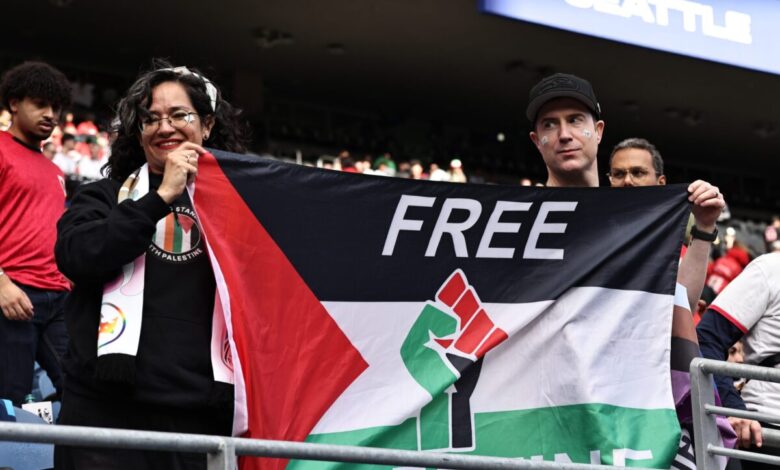
The Palestinian national team did not qualify for the 2026 FIFA World Cup.
Yet Palestine became one of the tournament’s defining presence, not through goals or victories, but through the constant display of Palestinian flags in the stands, expressions of solidarity with Gaza, and chants that echoed across stadiums, host cities, and public viewing areas around the world.
This phenomenon went far beyond isolated gestures of support.

The 2026 World Cup confirmed that Palestine has secured a place in the global political conscience. In the United States, the principal military and diplomatic ally of Israel, thousands of fans turned football stadiums into platforms calling for a ceasefire in Gaza and expressing solidarity with the Palestinian people.
This was not unprecedented. During the 2022 World Cup in Qatar, the Palestinian flag became one of the tournament’s most visible symbols. At the time, many analysts attributed the phenomenon to the competition taking place in an Arab country. The 2026 tournament challenged that interpretation.
The recurrence of these demonstrations across stadiums in the United States, Canada, and Mexico suggests that public support for Palestine has evolved from a regional expression into a truly global movement.
This trend also reveals a widening gap between the positions of many Western governments and the views of large sectors of international public opinion. While the United States continues to provide political, military, and financial support to Israel, millions of people increasingly see Palestine as a symbol of the struggle for human rights, international justice, and the right of peoples to self-determination.
For decades, Israel has invested heavily in its public diplomacy, or hasbara, seeking to shape international perceptions of the conflict. The scenes witnessed during the World Cup suggest that this strategy is facing growing challenges. The spontaneous display of Palestinian flags at one of the world’s most watched sporting events indicates that the battle for global public opinion has entered a new phase, one in which governments no longer fully control the circulation of narratives.
Football has once again demonstrated that it has never been politically neutral. Throughout history, World Cups have reflected ideological disputes, protests against racism, campaigns for human rights, and expressions of solidarity with peoples living under occupation or discrimination.
The insistence of sporting authorities on separating sport from politics stands in stark contrast to the reality in the stands, where supporters use the visibility of the tournament to express values and causes they regard as universal.
The 2026 World Cup also exposed FIFA’s double standard. While Iran competed under significant restrictions—including members of its coaching staff being denied entry visas to the United States and repeated obstacles stemming from political tensions between Washington and Tehran—FIFA remained largely silent in the face of the devastation in Gaza and the growing international accusations against Israel.
Perhaps the tournament’s most enduring legacy will be the emergence of a new form of people’s diplomacy, in which supporters, athletes, artists, and social movements increasingly shape the global narrative.
Thousands of fans raised the Palestinian flag as a symbol of solidarity, transforming the World Cup into a stage for political expression that FIFA itself sought to avoid.
A single flag raised before television cameras can reach hundreds of millions of people, carrying a message that transcends borders, languages, and cultures.
Palestine may have been absent from the competition itself, but it was present in something no sporting statistic can measure: its capacity to mobilize consciences.
By transforming the stadiums into spaces of international solidarity, the 2026 FIFA World Cup demonstrated that, for millions of people, Gaza cannot be forgotten. In the struggle for global public opinion, Palestine achieved a victory that no scoreboard can record.
The views expressed in this article belong to the author and do not necessarily reflect the editorial policy of Middle East Monitor.