WASHINGTON – The United States and Iran on June 17 released the text of their agreement to end the Middle East war, with Tehran committing to dilute its enriched uranium while being allowed to resume oil sales.
Washington commits to waive some sanctions and to facilitate the release of a US$300 billion (S$386.5 billion) reconstruction fund for Iran supported by regional nations when a final agreement is reached on the Islamic republic’s nuclear programme, according to the text.
Readouts of the agreement, which is slated to be signed in Switzerland this week, were released by US officials and Iranian state media.
US President Donald Trump said on June 17 that he was prepared to “bomb the hell” out of Iran if they violated the agreement, which he said could be signed as soon as June 18.


It was previously expected that it would be signed on June 19 by Iran’s chief negotiator and Parliament speaker, Mohammad Bagher Ghalibaf, and US Vice President J.D. Vance.
But Iran said on June 17 that it was considering a plan for its president and Trump to sign the deal which is intended to stop nearly four months of hostilities that have roiled the Middle East and the global economy.
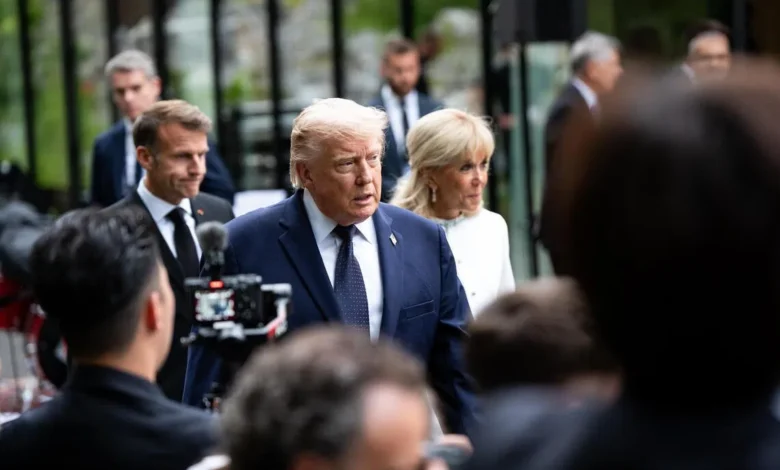
Trump, who is currently attending a G7 summit in the French town of Evian, near Switzerland, said, “The deal we reached with Iran on Sunday will be signed shortly, tomorrow (June 18), maybe the next day (June 19).”
He told reporters that he “might” stay in Europe for the signing but added that as a memorandum of understanding “it might not be the kind of a document I should be signing.”
Iran insisted the deal was represented a US “failure”.
“The agreement is a record of US failure. People will see it and judge,” Iran’s chief negotiator Mohammad Bagher Ghalibaf said on state TV late on June 17 after the text was released by both sides.
Highlighting the global impact of any deal, China said that its top diplomat had impressed on Tehran that it was “key” for all sides to “genuinely implement” their commitments.
While the agreement is essentially a prelude to a more detailed negotiation on Iran’s nuclear programme and other issues, it has provoked strong reaction from different quarters.
US Senator Bill Cassidy from Trump’s own Republican Party was scathing about the agreement which he said would allow Iran to rebuild.
“Iran’s nuclear ambitions were not curbed, and they have learned that threatening the Strait of Hormuz works,” he said. “Sanctions will be lifted, and the bombing has stopped. This is the worst foreign policy blunder in decades.”
Head of the pro-Tehran Lebanese Shiite movement Hezbollah, Naim Qassem, described the deal as a “great victory” for Iran.
He thanked Tehran for insisting that it cover Lebanon, which was drawn into the conflict when Hezbollah fired rockets at Israel on March 2 in support of Iran.
In a televised address, Qassem called on followers to take advantage of the agreement and “expel Israel” from Lebanon.
After the formal signing of the agreement, a two-month negotiating period will begin, with the much-anticipated reopening of the Strait of Hormuz – a vital conduit for global oil and gas supplies – as the first step.
Under the terms of the deal released by US officials, Iran will dilute its enriched uranium stocks, possibly by “down-blending on site under the supervision of the IAEA” – the UN’s nuclear watchdog.
“The fact that they’re conceding to that is a major, major win for the United States of America,” a US official said of the nuclear issue on a call with reporters on condition of anonymity.
The US also commits to facilitating the release of a US$300 billion fund for the reconstruction and economic development of Iran in the event of a final agreement on Iran’s nuclear programme, according to the text.
But the official said the US would not be required to contribute financially.
Tehran would also be allowed to resume its oil sales as soon as the agreement is signed this week, while all sanctions would be lifted if a final agreement is reached at the end of a 60-day negotiating period, the same source added.
Oil prices have tumbled in recent days as optimism grew of a lasting Middle East peace agreement, but reversed course on June 17.
Prices briefly jumped five per cent as uncertainty spread about the signing, before stabilising later in the day.
While violence declined in Lebanon following the announcement of the deal, Israeli strikes on the south have killed at least five people since then, according to state media, which also reported Israeli raids on south Lebanon on June 17.
Israel’s army said five soldiers were wounded, one of them severely, “as a result of an explosive drone impact in southern Lebanon”, the first such announcement since the US-Iran deal.
The Israeli military also said its air force intercepted “several rockets” launched toward soldiers operating in south Lebanon, without reporting casualties. AFP