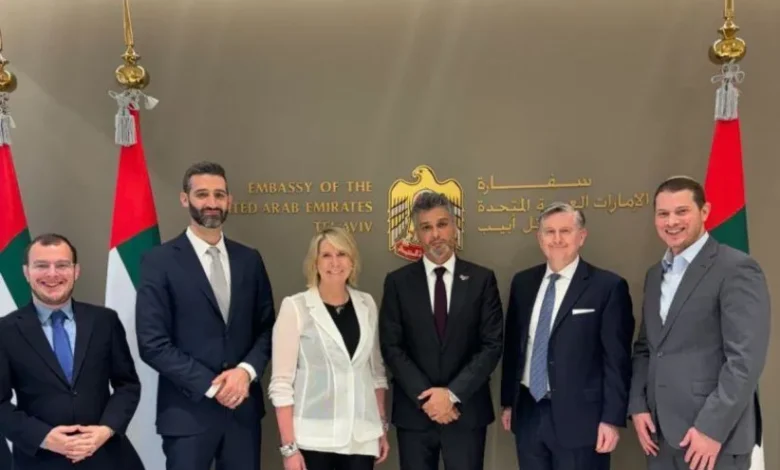
On June 22 Israel’s Ministry of Defense posted a statement about “deepening ties Eastward.” The statement was about the ministry’s Director General leading an official defense delegation to India. Meanwhile, the Israel Defense Forces posted a photo of a meeting on June 21 between the Chief of the Hellenic Navy General Staff, Vice Admiral Dimitrios-Eleftherios Kataras and the Commander of the Israeli Navy, Vice Admiral Eyal Harel.
The Director General of the Ministry of Defense, Amir Baram noted that, “India is a key strategic partner of the State of Israel. This important visit, the result of a lengthy bilateral preparation process, reflects the great importance that India and Israel attach to expanding their growing defense and industrial alliance – but no less so, the depth of the bond between our two nations.”
He went on to add that this is “a bond rooted in shared values, deep cultural appreciation, and mutual trust that goes well beyond mere interests. That is what makes this partnership unique, and the joint projects we are advancing together all the more meaningful.”
The two meetings are important. They illustrate the important defense and security ties that Israel has with India and Greece. When one considers the more expanded bloc of countries that Israel has positive relations with, such as Cyprus, as well as Bahrain and the UAE, this forms a long line that connects the Indian Ocean to the Mediterranean.


This is a key example of the role that Israel and its friends can play in the India-Middle East-Europe Economic Corridor (IMEC). The corridor has been discussed over the last several years. It is part of a growing list of connections that have formed in the region that link Europe and Asia.
Region’s instability can be tied to Hamas’s Oct. 7 attack, meant to stall peace initiatives
The Middle East Institute noted in June 2026 that IMEC “is a proposed multinational infrastructure initiative aimed at upgrading connectivity between the three regions through integrated trade, energy, and digital networks. Announced at the Group of 20 (G20) Summit in New Delhi in September 2023, IMEC is envisioned partially as a counterweight to China’s international infrastructure project, the Belt and Road Initiative (BRI).”
The institute’s article notes that the “the multinational initiative consists of two main segments: an Eastern Corridor linking India to the Persian Gulf and a Northern Corridor connecting the Gulf to Europe via the Levant and Mediterranean. Its multimodal infrastructure, including railways, deep-water seaports, electricity grids, and high-speed data cables, could potentially reduce shipping costs by billions and shipping times by up to 40%, compared to traditional routes. At present, however, the corridor in its original form is effectively on hold due to regional instability.”
The instability is related to the conflicts in the region, particularly the Israel-Hamas War and its aftermath. Hamas attacked Israel on October 7, at least in part, to sabotage Israel’s growing ties in the wake of the 2020 Abraham Accords. The fact that initiatives such as the Abraham Accords appear to have stalled, in terms of major public meetings and new members, illustrates the challenge for Israel.
New initiatives have seen rejuvenation after Gaza ceasefire
Other initiatives, such as one called I2U2 and the Negev Forum as well as the Atlantic Council’s N7 Initiative, have all appeared to be in a kind of limbo over the last several years.
Now there is potential movement. With the wars winding down and the US and UN-backed peace deal in Gaza; as well as the US-Iran talks in Switzerland, there is opportunity for a brave new world to emerge.
How might this happen? Military and trade ties are important. Countries such as Pakistan are playing a key role in the Iran talks. India, a friend of Israel, generally has been a rival of Pakistan. Qatar is also playing a role. Meanwhile, Saudi Arabia, Egypt, Turkey and Pakistan are also working together increasingly on regional policy. For some in Jerusalem this represents a potential challenge.
While many public meetings have been on a kind hiatus in terms of the Abraham Accords, India, Israel, Greece and Cyprus have continued to hold key engagements. The recent meetings with the Greek navy is an important example. The IDF noted that “the visit reflects the depth of the security relationship between Israel and Greece and the shared commitment to further strengthen strategic and operational cooperation between the two countries.”
Meanwhile in India “the Director General of the Israel Ministry of Defense (IMOD), Maj. Gen. (Res.) Amir Baram, held a series of high-level meetings with India’s Defense Minister, Defense Secretary, Chief of Defense Staff, and other senior officials from India’s Ministry of Defence, during which both sides discussed avenues for deepening bilateral defense and industrial cooperation,” Israel’s Ministry of Defense noted.
The ministry went on to note that “this visit reflects the Defense Minister and the Ministry’s strategy to expand defense exports as a tool for strengthening the IDF’s force build-up, shaping foreign policy, and bolstering the Israeli defense industry and economy. It is part of a broader effort to widen Israel’s circle of strategic partnerships with an eastward focus and deepen cooperation with key nations in the region.”