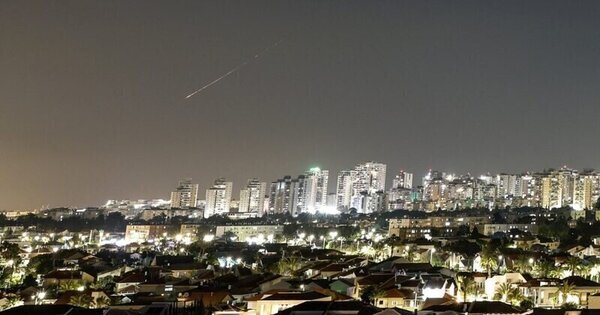
The Israeli military said its forces targeted Iranian regime sites early on June 8 in retaliation for Tehran’s attacks on Israel and shortly after US President Donald Trump said he told Prime Minister Benjamin Netanyahu not to strike back.
“The Israeli Air Force struck military targets belonging to the Iranian terror regime in western and central Iran a short while ago,” the Israel Defense Forceswrote on Xearly on June 8 without immediately elaborating.
Iranian state TV said explosions were heard in cities throughout the country, in including Tehran, Karaj, Tabriz, and Isfahan. Details were not immediately available.
The strikes come after Iran fired a barrage of missiles toward Israel in its first attacks on the country since a shaky cease-fire took effect on April 8, saying it was in retaliation for Tel Aviv’s military strikes on Beirut.
Despite Tehran’s action, Trump had said a deal with Tehran to turn a cease-fire into a peace settlement was still “very close,” adding that he did not want Iran’s missile strikes on Israel to blow up the peace process.
“I am going to call Bibi right now and tell him not to retaliate,” Trump was quoted as telling Axios reporter Barak Ravid in a phone interview, using the Israeli leader’s nickname.
“Israel had its strike and Iran had its strike. We don’t need another one,” Trump said, according to Ravid.
The White House did not immediately comment on Israel’s retaliatory strikes.
IRGC Confirms Attack
Iran’s Islamic Revolutionary Guard Corps (IRGC) confirmed that it had launched missiles toward Israel on June 7, saying they were in retaliation for Israeli attacks on Lebanon earlier in the day.
It added that “more crushing and regretful blows” would follow if Tel Aviv continues its offensive in Lebanon.
Trump told Fox News that he was “not happy” about those Israeli attacks beforebeing quoted bymedia outlet Axios that the Iranian strikes “didn’t hit anyone. I hope Israel doesn’t respond.”
While talks between the US and Iran to end the war in the Middle East have appeared to stall over key issues such as the reopening of the Strait of Hormuz and Tehran’s nuclear ambitions, Iranian officials have maintained that the conflict between Israel and Lebanon is also central to efforts to end the regional war.
“We’re very close. I would say an agreement would be signed on Monday, Tuesday or Wednesday of this coming week. And now this takes place,” Trump told Fox, adding Iran needs to “get back to the table and make a deal.”
Trump later told The Financial Times that the latest Iranian strikes would not impact current negotiations with Tehran and that “the deal is going on.”
SEE ALSO:
Any Iran Deal Must Be Measured By Actions, Not Promises, Says Former Ambassador Lisa Gable
The IRGC said it hit the Ramat David airbase southeast of Haifa with ballistic missiles. The specific site was not immediately confirmed by Israel.
Israel Defense Forces (IDF) said air raid sirens sounded in several areas across the country “following the identification of missiles launched from Iran toward the State of Israel.”
US President Trump said he will call the Israeli leader and “tell him not to strike back” at Iran.
“The IDF intercepted all missiles from Iran thus far. The IDF has currently identified additional launches fired toward the State of Israel,” it said.
“The Aerial Defense Array is currently identifying and intercepting threats.”
The IDF added that Tehran “committed grave mistake” by firing the missiles.
Israel Strikes Beirut Suburbs
The development came hours after Israeli forces struck the suburbs of Lebanon’s capital for the first time since Washington announced a renewed truce between Beirut and Tel Aviv last week.
SEE ALSO:
Trump Says Netanyahu ‘Won’t Have Any Choice’ But To Accept US-Negotiated Deal
Iran’s Parliament speaker, Mohammad Baqer Qalibaf, on June 7 said Tehran viewed latest Israeli strikes on Beirut as evidence that the United States and Israel do not believe in dialogue and “only understand the language of power.”
Israel has been launching strikes targeting militants in Lebanon from Hezbollah — which has been labeled a terrorist organization by Washington, while the European Union has only blacklisted its armed wing — since March 2, two days after the start of the US-Israeli war with Iran, when Hezbollah forces opened fire in support of Tehran.
Hezbollah is a militant group and political party that controls much of southern Lebanon.
The Israeli military vowed to carry on with its military campaign on the territory of its northern neighbor and would step up attacks on Hezbollah.
“The [Tehran] regime is attempting to establish a new equation through direct attacks on Israeli territory in response to IDF operations in Dahiyeh,” military spokesman Brigadier General Effie Defrin said in a televised statement.
A truce that has been in place since April has reduced fighting between Israel and Hezbollah but has not stopped it; hundreds of people have been killed in strikes since then, and each side has accused the other of numerous violations.
With reporting by RFE/RL’s Radio Farda
Israel Strikes Back After Iranian Missile Attack
Share
Copy link
Facebook
X (Twitter)
LinkedIn
Email
Share
Share
Copy link
Facebook
X (Twitter)
LinkedIn
Email
Share
Follow us
Facebook
X (Twitter)
Youtube
Instagram
Follow us