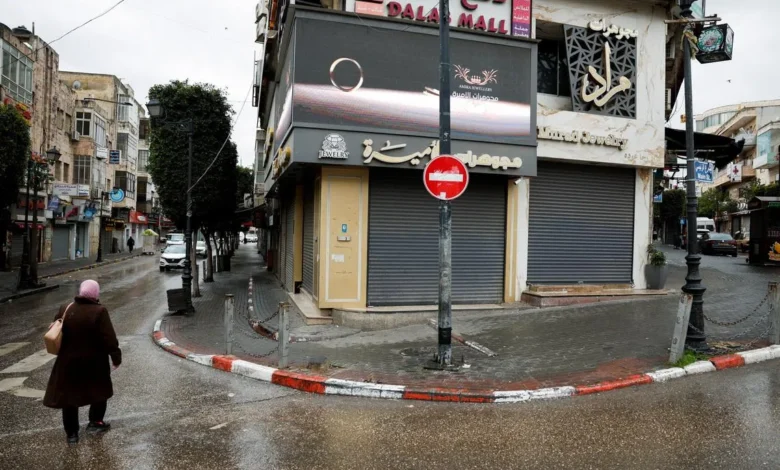
JERUSALEM – One of two Israeli banks giving Palestinians access to financial services plans to end the relationship in September, a move Palestinian officials warn could put further pressure on an economy already in turmoil.
The West Bank economy is heavily reliant on Israel and, in the absence of a sovereign currency, the shekel is the primary currency in use. Yet banks operating in the Palestinian territory have no direct access to Israeli financial institutions, leaving transactions dependent on Israeli correspondent banks for clearing.
Two lenders, Israel Discount Bank and Bank Hapoalim Ltd, have for years acted as a clearinghouse for the West Bank’s economy, acting as intermediaries in transactions between Israeli and Palestinian banks. Anything from the deposit of salaries to Palestinians working in Israel, and customs payments to Israeli authorities relating to imports into the West Bank.
Discount Bank is preparing to step away from that role in September, cutting off the five banks it services in the West Bank from the financial system, the deputy governor of the Palestine Monetary Authority, Mohammad Manasra, told Bloomberg.

Bank Discount, which has not made an announcement publicly, declined to comment. It currently provides correspondent services to Cairo Amman Bank, Arab Bank, Al-Quds Bank, Bank of Jordan and Jordan Ahli Bank. Hapoalim is the go-between for five others.
“These institutions handle payments for essential imports such as electricity, water, fuel, and animal feed,” Manasra said. He warned that the West Bank could eventually see the supply of goods and services grinding to a halt.
The West Bank is heavily reliant on trade with Israel, importing US$3.65 billion (S$4.6 billion) worth of goods from Israel in 2024, more than half the total, and exporting US$1.47 billion, or 85 per cent of its shipments abroad.
The Palestinian Authority is already facing a mounting financial crisis due to Israel’s decision to halt the transfer of taxes it collects on behalf of the PA, which accounts for about two thirds of its revenues. No funds have been delivered since May last year and Palestinian officials say the backlog now amounts to some US$7.5 billion.
That’s forced the cash-strapped PA, that handles daily affairs in parts of the occupied West Bank, to partially withhold salaries to its employees, cut services in hospitals and schools, and reduce welfare support, among other things.
Israel froze Gaza’s share from the tax payments after Hamas attacked Israel in October 2023 before completely stopping transfers, saying the money was being used in what it says is as a “pay for slay” scheme. It refers to a PA program offering a stipend to Palestinians imprisoned by Israel, including those convicted of terror attacks, and their families.
Israeli Prime Minister Benjamin Netanyahu’s government opposes the programe, which has also drawn criticism from the US and European Union.
Rooted in the Oslo Accords that were signed between Israel and the Palestinian Authority in the early 1990s, corresponding bank services grew more challenging as multiple nations moved to instate economic sanctions on “terror” entities, including Israel which legislated its Counter Terror Act in 2016.
Israeli banks handling such operations became increasingly exposed to terror-financing (CFT) compliance risks which could result in criminal prosecution and civilian lawsuits in the US and in Israel.
To keep them from terminating these services, the Israeli government decided in 2018 to give correspondent banks immunity from domestic lawsuits and indemnity from cases filed abroad that allege involvement in terrorism financing. These agreements were periodically extended by the Finance Ministry.
Finance Minister Bezalel Smotrich has voiced unease with the arrangement since the 2023 Hamas attack on Israel.
Bank Discount said in its first quarter financial statement that the current arrangement with the Israeli government expires on May 31, but Manasra said it has since been extended through June 14. The Israeli Finance Ministry wasn’t available for immediate comment on whether they have been extended again.
The Israeli Finance Ministry said that it “manages the issue of letters of indemnity routinely and professionally, based on broad considerations of terror financing, money laundering, and financial stability, per the Israeli security cabinet’s guidance”. BLOOMBERG