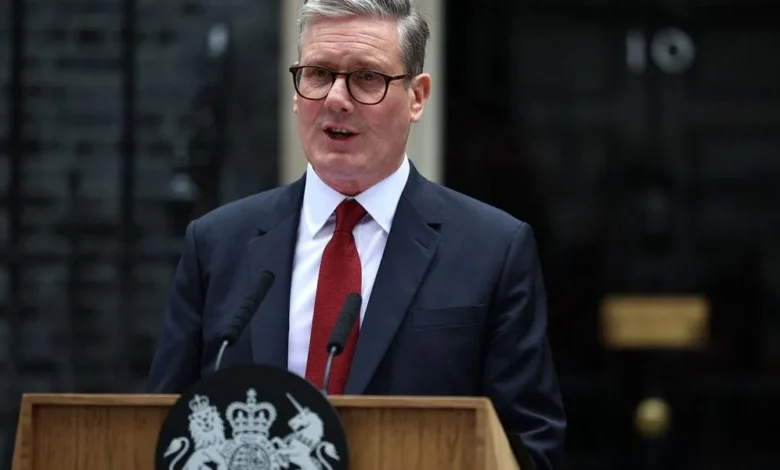
Sir Keir Starmer has announced that he will resign as UK Prime Minister after losing the confidence of Labour MPs. Starmer confirmed his decision in an emotional statement outside 10 Downing Street on Monday, saying he had accepted the decision of his parliamentary party with “good grace.”
For more updates on the UK, follow the latest UK news.
His resignation opens the way for a Labour leadership contest over the summer. A new Labour leader is expected to be in place by the time MPs return to Parliament in September. The winner of the contest will also become the next prime minister because Labour still holds a majority in the House of Commons.
Speaking outside No 10, Starmer defended his record in office and in opposition. He said he had helped rebuild Labour, tackled antisemitism in the party and restored public trust in areas such as the economy, defence and national security.
Read related news:
Keir Starmer faces fresh pressure after Trump says he is ‘failing badly’
Blair says Labour needs clear plan before any move against Keir Starmer
Trump humiliated Keir Starmer as he was forced to queue for a handshake.


But he admitted that Labour MPs were now asking a different question: whether he was still the right person to lead the party into the next general election.
“I have heard the answer of my parliamentary party to that question, and I accept that answer with good grace,” he said.
Starmer also paid tribute to his wife, Victoria, and their children. He said that after leaving “the biggest job in the country,” he would spend more time on what he called “the most important job” — being a husband and father.
Labour leadership contest to begin
Starmer said Labour’s ruling National Executive Committee would set out the timetable for the contest. Nominations are expected to open in July and close before the start of the parliamentary summer recess.
If more than one candidate secures enough nominations from Labour MPs, party members and affiliated supporters will take part in a leadership election. If only one candidate qualifies, the party could move quickly to confirm a successor.
Andy Burnham, who recently returned to Parliament after winning the Makerfield by-election, is widely seen as the leading contender to replace Starmer. His victory gave him a direct route back into Westminster and increased pressure on the Prime Minister.
Burnham has confirmed that he will stand for the Labour leadership. Former Health Secretary Wes Streeting has also been mentioned as a possible contender, although reports said he may back Burnham instead of running himself.
The contest comes after months of pressure on Starmer’s leadership. Labour suffered heavy losses in local elections, and many MPs became worried about the party’s chances at the next general election.
Starmer’s time in office was also affected by policy U-turns, internal divisions, public frustration over the cost of living, pressure on public services and growing concern over immigration.
His resignation means Britain is set to have another change of prime minister within a short period. Since the Brexit referendum in 2016, the UK has seen repeated leadership changes, including David Cameron, Theresa May, Boris Johnson, Liz Truss, Rishi Sunak and Keir Starmer.
Opposition parties have already called for a general election. Reform UK leader Nigel Farage said it would be wrong for Labour to change prime minister without going back to the public.
However, under the UK parliamentary system, a general election is not automatically required when a prime minister resigns. The next Labour leader can become prime minister if they are able to command the confidence of the House of Commons.
Starmer’s resignation marks a dramatic end to a premiership that began with a large Labour victory in the 2024 general election. At the time, he promised stability, economic repair and a new political direction after years of Conservative rule.
But less than two years later, pressure from inside his own party has forced him to step aside.
For Labour, the next few weeks will be crucial. The party must decide whether to rally behind one candidate or hold a full leadership contest. The choice will shape the direction of the government and the political battle before the next election.
For Britain, the resignation adds another chapter to a period of political instability in which prime ministers have struggled to keep public trust, party unity and economic confidence at the same time.