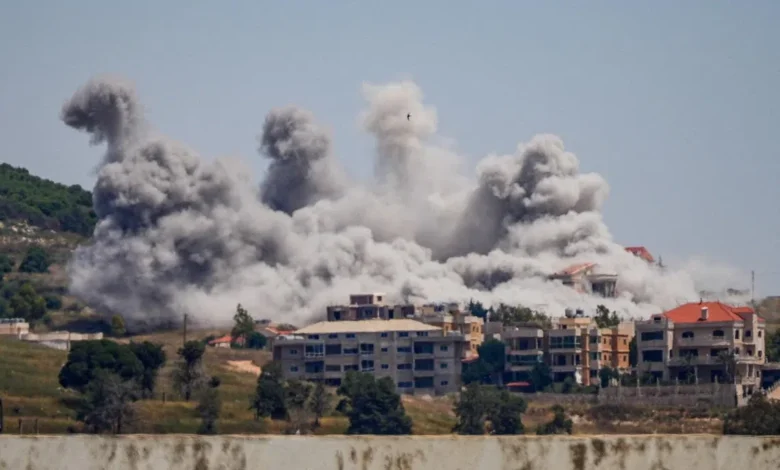
DUBAI, June 4 – Israel and Lebanon agreed to implement a new ceasefire after U.S.-mediated talks, the Trump administration said, raising hopes for progress toward ending the wider U.S.-Israeli war with Iran.
Tehran has made a ceasefire in Lebanon a condition for any peace deal with Washington, and has suggested in recent days that it could intervene directly in support of its proxy Hezbollah if Israel keeps up or escalates attacks there.
Lebanese President Joseph Aoun said on Thursday that the ceasefire would come into force within 24 hours of all concerned parties approving it, appearing to refer to Hezbollah, which has not commented on the agreement.
But casting doubt on the robustness of the truce, Israel’s Defence Minister Israel Katz said on Thursday the military would continue to strike in Lebanon for the time being and would not be withdrawing from the south.

The deal comes after a flare-up in violence across the region. Israeli strikes killed at least six people in southern Lebanon and U.S. and Iranian forces traded attacks in the Gulf on Wednesday in one of the most intense bouts of fighting since a separate ceasefire halted large-scale U.S.-Israeli bombing of Iran in early April.
Iranian forces struck Kuwait, damaging its airport and injuring dozens, while the U.S. military carried out strikes near the Strait of Hormuz. The strait, through which a fifth of the global oil and liquefied natural gas supplies normally flow, remains largely closed more than three months after the U.S. and Israel launched their strikes on Iran.
Oil prices on Thursday lost some of the previous day’s gains on hopes that the Lebanon ceasefire could help Washington and Iran find a diplomatic off-ramp from their war.
U.S. President Donald Trump, who is under pressure to bring down fuel prices, suggested there could be progress in negotiations with Iran as soon as this weekend.
“If it happens, it could happen over the weekend,” Trump told reporters in the White House’s Oval Office on Wednesday, without elaborating on what he expected to happen within that timeframe.
Trump said that parties were working to separate the issue of reopening the strait from the conflict in Lebanon.
KUWAIT AIRPORT STRUCK
Wednesday’s strikes on Kuwait damaged airport facilities and diplomatic missions, killing one person and injuring more than 60 others, Kuwaiti authorities and state media said.
Iran’s elite Revolutionary Guards said they did not fire at Kuwait’s airport and blamed the destruction on U.S. interceptor missiles that failed to hit their targets, according to Iranian state media.
The U.S. military said that was not accurate, and that Iranian drones targeted the airport deliberately.
Iranian media reported the Revolutionary Guards also attacked the headquarters of the U.S. Fifth Fleet in Bahrain and a U.S. airbase. U.S. Central Command denied its bases had been hit and said Iranian ballistic missiles failed to strike their targets in the region.
CENTCOM said it had carried out a new round of “defensive strikes” in southern Iran, targeted missile launch sites and Iranian boats seeking to lay mines, and conducted strikes on Qeshm Island near the strait after attempted Iranian attacks.
IRAN SETS CONDITIONS FOR PEACE
Last week, Iran and the U.S. signalled progress towards a tentative initial agreement to halt the war and reopen the strait, but the two sides have yet to sign off on the deal, which would leave more complex negotiations for later.
Iran’s Supreme Leader Ayatollah Mojtaba Khamenei said in a message on Thursday that Iran’s enemies had already been defeated on the battlefield and were now seeking to sow internal divisions.
“In order to confront these plans everyone must be patient, clear-minded, maintain unity, harmony, mutual trust, and not be in agreement with the enemy,” he said in a message read on his behalf during ceremonies marking the anniversary of the death of the Islamic Republic’s founder, Ruhollah Khomeini.
Khamenei has not been seen in public since he succeeded his father, who was killed in an airstrike at the start of the war.
In addition to Tehran conditioning a deal on an end to fighting in Lebanon, it also wants access to billions of dollars in oil revenue, waivers on sanctions on crude exports, a lifting of a U.S. blockade on its ports and continued leverage over the strait.
Trump has said his top priority is to stop Iran from acquiring nuclear weapons. Iran says its atomic programme is for peaceful purposes. In a podcast interview released on Wednesday, Trump said Iran had agreed not to have a nuclear weapon and that Khamenei was involved in negotiations. REUTERS