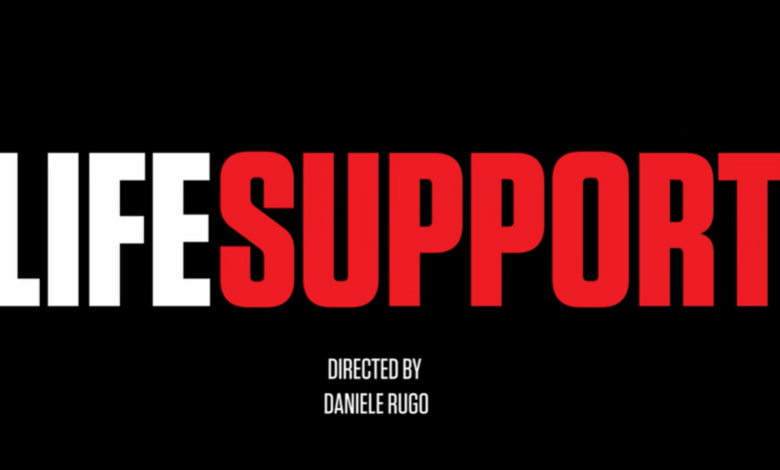
Hospitals represent life. The killing of people inside them, the doctors in Life Support say, is a line that should never have been crossed. Daniele Rugo’s 93-minute documentary opens with British doctors talking about Gaza, their connection to it, the resilience of the people there and a love of life that even decades of siege has not extinguished, before showing what happened when that line was crossed, again and again, over two years.
The film had its world premiere at Sheffield DocFest on 13 June 2026, where it was nominated for the festival’s Tim Hetherington Award, followed by a Q&A with Rugo and contributors Dr Ana Jeelani and Prof Nick Maynard. A public premiere follows at Curzon Mayfair on 9 July. Most of what is on screen was shot by the doctors themselves, on their phones, in the middle of treating patients. MEMO was given an early preview of Life Support ahead of its public premiere at Curzon.
Rugo’s starting point, as he puts it, was simple: surgeons, physicians and nurses went to Gaza to support their Palestinian colleagues and ended up as “the sole international observers” of a genocide. Foreign media have been barred from entering Gaza throughout the war. The doctors who passed through Medical Aid for Palestinians (MAP), Healthcare Workers 4 Palestine and similar routes were, for long stretches, among the only outsiders able to see what was happening inside the enclave.


The names will be familiar to anyone who has followed British medics’ accounts since October 2023: Dr Victoria Rose, the London-based reconstructive surgeon who has worked in Gaza since 2016 and has been on four missions since the war began; Prof Nick Maynard, the Oxford gastrointestinal surgeon who helped set up Gaza’s cancer services; and Dr Tanya Haj Hassan, the paediatric intensive care doctor and one of the few international witnesses to reach the north of the Strip. Dr James Smith, Dr Deborah Harrington, Dr Khaled Dawas and Dr Ana Jeelani also appear.
Their testimonies, painfully delivered, are as heart-wrenching as they are inspirational. Rose recalls using her own initiative to take essential medical kit into Gaza in 23 suitcases. Jeelani describes operating without electricity or proper instruments, on wounded children who often needed repeated surgery. Maynard, who has worked in other war zones, says the scale of destruction in Gaza was on a different level.
Outside the hospitals hours of unseen footages filmed a dystopian landscape of buildings razed as far as the eye can see, alongside the daily life that somehow continues around it. This footage is vital because the film is not only about the wounded, the starving and the dead, but about the destruction of the institutions that make human life possible: hospitals, schools, religious buildings and the civic centres that sustain a people, a culture and a civilisation.
What the doctors describe is not only the bombing of buildings, but the destruction of the conditions that allow human existence to continue. This gives the film its wider charge: it is not only a record of war, but of what the doctors repeatedly understand as genocide.
“This is a war on civilians,” Haj Hassan says, describing wards filled with children and elderly women. The cases the doctors treat reflect Gaza’s population under siege: children, women, the elderly and the displaced. They speak of Palestinian medics operating after being told their own relatives had been killed, and of health workers fainting from hunger and exhaustion mid-shift. The footage from inside Al-Shifa hospital after Israel’s withdrawal, including the mass graves hospital staff were left to exhume themselves, is among the hardest material in the film to sit through.
The film also addresses one of the central justifications used by Israel for its attacks on Gaza’s hospitals: the claim that they were being used by Hamas. The doctors answer this directly. Despite hearing the allegation repeated by Israeli officials and echoed by Western governments, they say they saw no evidence to support it. For them, the destruction of Gaza’s hospitals cannot be explained away as a military necessity. It is part of a wider assault on everything that sustains life.
READ: Israeli Supreme Court rejects appeal against Palestinian doctor’s detention, lawyer says
That is where the film’s argument about genocide becomes unavoidable. Maynard says he did not use the word lightly and initially resisted it. But after what he witnessed in Gaza, he reached a different conclusion. The film follows that moral and intellectual shift carefully, showing how doctors who entered Gaza to provide medical care came out asking how such devastation had been allowed to continue.
The documentary then widens the lens, turning to genocide scholars to explain the role of dehumanisation. They describe it as a common feature of genocides, from Rwanda onwards: a process by which a people are stripped of their humanity before violence against them is normalised. In Gaza, the film suggests, that process has been visible not only in language, but in the targeting of the very environment needed for human life to continue. As one contributor puts it, Palestinians have been dehumanised “in a way that we’ve not seen anywhere else in modern times.”
The doctors do not leave Gaza as they entered it. They arrive to treat the wounded and support Palestinian colleagues, but what they see makes it impossible for them simply to return home and move on. “You cannot witness what is happening in Gaza and not emerge enraged and determined to stop it,” one doctor says. That sense of responsibility runs through the film: having seen what they have seen, the doctors know that silence is no longer possible.
The film also shows how Israel’s policy of starvation became another weapon deployed against Palestinians. We see what that meant for Gaza’s children, and for the parents and doctors trying desperately to keep them alive with almost nothing. The documentary links this suffering to the Gaza Humanitarian Foundation, whose aid distribution system turned the search for food into a life-and-death situation for Palestinians.
Yet Life Support is not only a film about suffering. It also shows how Palestinians continue to hold on to their humanity, dignity and will to live amid conditions designed to break them. The doctors help carry Gaza’s story to the outside world, but they are not the centre of it. At the centre are the Palestinian doctors, nurses and medical teams who keep treating patients with almost nothing, relying on courage, skill and sheer determination to keep people alive.
Rugo brings the same concern with memory and violence that shaped his previous film, The Soil and The Sea, which documented mass graves from Lebanon’s civil war. In Life Support, he works with editor Masahiro Hirakubo to hold together material that is often extremely painful to watch without losing sight of the people at the heart of the film: the doctors, the patients and the Palestinian medical workers trying to keep Gaza alive.
The film’s sound is equally important. Palestinian composer Habib Shehada Hanna is joined by Robert Del Naja and Euan Dickinson of Massive Attack, giving the documentary a soundtrack that deepens its emotional force. The film’s executive producers include Hollywood star Susan Sarandon, Melissa Barrera, Farah Nabulsi and Asif Kapadia. Ken Loach has called the film “compulsory viewing.”
He is right. Life Support does not try to make its subject easier to watch, and it should not. What it leaves you with is a record of who kept Gaza’s hospitals running, what it cost them, and how much of it the world chose not to see.
READ: Gaza doctors were building a health system – then came the war