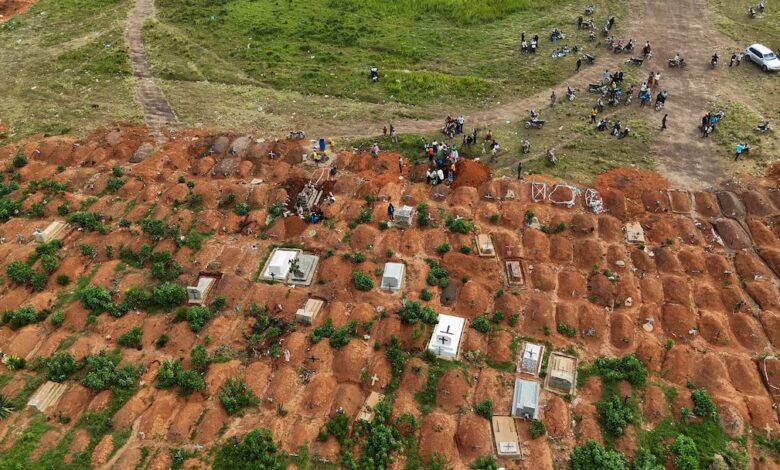
A growing public health emergency is unfolding in eastern Democratic Republic of the Congo, where at least 30 people have died in a displaced persons camp amid fears that Ebola infections may be spreading undetected among thousands of vulnerable residents.
The deaths, recorded since early May at the Kigonze displacement camp in Bunia, Ituri Province, have triggered concern among health officials and humanitarian organizations already battling an Ebola outbreak in the region.
Medical workers say the situation is particularly worrying because many of the deceased reportedly exhibited symptoms commonly associated with Ebola, including high fever, severe headaches and persistent vomiting.
Camp authorities described the spike in fatalities as unprecedented, noting that the number of deaths far exceeds what is typically recorded within the settlement.


A representative of the camp, Désiré Grodya Bapi, expressed concern over the worsening situation.
“People were not dying like this before. This is something we have never experienced,” he said.
The Kigonze camp is home to more than 15,000 people displaced by years of armed conflict in eastern Congo. Aid agencies report that overcrowding, poor sanitation and limited access to healthcare have created conditions that could accelerate the spread of infectious diseases.
Humanitarian workers said efforts to determine the exact cause of the deaths have been hampered by resistance from residents, many of whom have refused to allow medical personnel to test bodies before burial.
According to officials from Catholic aid organization Caritas, several bodies, including those of women and children, were discovered awaiting burial in recent weeks.
A Caritas official, Justin Zanamuzi, said repeated attempts to secure consent for medical examinations were unsuccessful.
“We tried to convince families to allow doctors to carry out checks, but there was complete resistance,” he said.
Health authorities disclosed that laboratory tests conducted earlier this month confirmed Ebola infections in some victims. Additional samples from more recent fatalities have reportedly produced results suggesting possible Ebola cases, heightening fears that transmission may be occurring silently within the camp.
Residents say the humanitarian situation has become increasingly dire.
One camp resident, Kato Lonu, who reportedly lost two children during the crisis, described the conditions as devastating.
“People are dying one after another, and there is nothing we can do,” he lamented.
Aid agencies have linked the worsening crisis to deteriorating living conditions in displacement camps across eastern Congo, where inadequate sanitation facilities and shortages of clean water continue to pose serious health risks.
Humanitarian groups warn that reduced international funding for water, sanitation and hygiene programmes has weakened disease-prevention efforts at a time when displacement figures are rising due to ongoing violence in the region.
Officials believe the Ebola outbreak, formally declared in mid-May, may have begun spreading weeks earlier before being detected by health authorities.
With fear, mistrust and poor sanitary conditions complicating containment efforts, humanitarian workers caution that the true scale of infections and deaths in Kigonze camp could be significantly higher than current figures suggest.