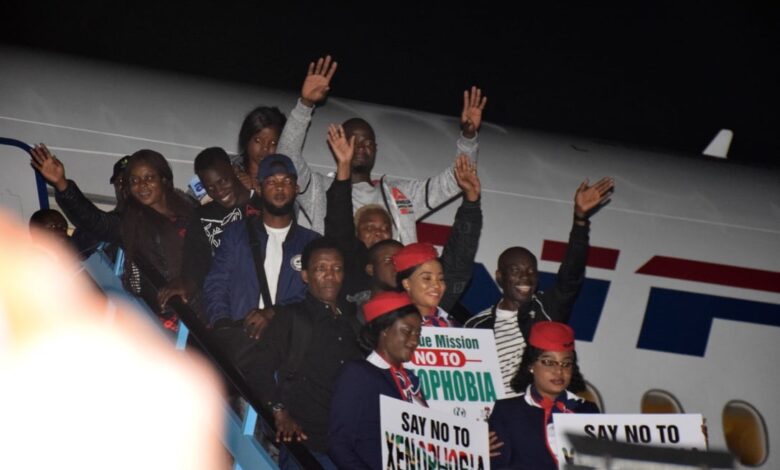
The Nigerian government has commenced the screening of more than 1,000 citizens in South Africa ahead of plans to evacuate those willing to return home following a recent surge in xenophobic attacks targeting foreign nationals.
The move comes 39 days after two Nigerians were killed during the attacks in South Africa.
In one widely shared clip, a group of locals confronted a Ghanaian national, questioning his presence and accusing migrants of abandoning their home countries instead of improving them.
The situation intensified after the Nigerian Consulate in Johannesburg confirmed the killing of two Nigerians — Amaramiro Emmanuel and Ekpenyong Andrew.


The New Daily Prime reported April 27, 2026, two Nigerians, Amaramiro Emmanuel and Ekpenyong Andrew, in separate incidents linked to escalating tensions in South Africa.
The Nigerian Consulate in Johannesburg confirmed this through the Consul-General, Ninikanwa Okey-Uche, who said Emmanuel died from injuries allegedly sustained after being beaten by personnel of the South African National Defence Force (SANDF) on April 20, while Andrew was arrested a day earlier in the Booysens area of Pretoria following an alleged altercation with officers of the Tshwane Metro Police. His body was later found at the Pretoria Central Mortuary.
The screening exercise, which began on Thursday, is being coordinated by officials from Nigeria and South Africa as part of arrangements for the repatriation process.
The spokesperson for Nigeria’s Ministry of Foreign Affairs, Mr. Kimiebi Ebienfa, on Friday, confirmed that authorities expect over 1,000 Nigerians to undergo the verification process.
“Total figure not out yet,” Ebienfa said. “We are expecting over a 1,000 persons.”
According to him, the exercise involves officials from both countries, as well as South African immigration and police authorities, who are working to verify the identities and immigration status of those seeking repatriation.
The screening is expected to end on Saturday, after which authorities will determine the final number of eligible returnees and make arrangements for evacuation flights.
The repatriation effort follows renewed anti-foreigner violence in parts of South Africa, where Nigerians, Ghanaians and Mozambicans have reportedly been among the most affected groups.
In a statement issued earlier this week, the Nigerian High Commission in Pretoria disclosed that it had secured special waivers from South African authorities to facilitate the departure of affected Nigerians, including those facing immigration-related infractions.
The mission said the agreement would allow such individuals to leave the country through the repatriation programme rather than face detention or other immigration enforcement measures.
The latest development comes shortly after Ghana repatriated nearly 300 of its citizens from South Africa in what officials described as the first phase of a broader evacuation programme involving close to 800 registered nationals.
Read related news:
Xenophobia: Nigerians register for evacuation in South Africa
Report: Migrants shackled, forced to eat food off chairs, “like dog;
Charities face rising threats amid anti-immigrant tensions
FG demands probe, accountability from South Africa over Killings, xenophobic protests
Ebienfa noted that Nigeria had submitted its repatriation list before Ghana but that Ghanaian nationals were processed first.
He added that Ethiopia is expected to be the next country to undertake a similar evacuation exercise once Nigeria’s screening process is completed and logistical arrangements are finalised.
Tensions escalated after a South African citizen-led group reportedly issued a June 30 deadline demanding the removal of undocumented migrants from the country.
The ultimatum triggered fears of further attacks against foreign nationals and prompted several African countries to begin discussions on the safety and welfare of their citizens.
NiDCOM, UN urge South Africa to be accountable
The Federal Government of Nigeria and the Nigerians in Diaspora Commission (NiDCOM) had called on the government of South Africa to ensure that perpetrators of recent xenophobic attacks are brought to justice.
NiDCOM chair, Abike Dabiri-Erewa, expressed deep concern over the worsening security situation, despite ongoing diplomatic engagements between both countries.
She noted that the climate of fear is affecting daily life, with children of Nigerian descent reportedly avoiding school, while business owners are reluctant to open shops due to fears of looting, harassment, and targeted attacks. Community leaders, she added, have reported fresh incidents of violence and intimidation within the last 72 hours.
“We state clearly that NIDCOM rejects the profiling and generalisation of all Nigerians. Crime has no nationality,” the statement reads.
Earlier, the Secretary-General of the United Nations, António Guterres, had called on South Africa to take decisive action against rising xenophobic attacks and the intimidation of foreign nationals.
In a statement delivered by his spokesperson, Stéphane Dujarric, Guterres expressed serious concern over incidents reported in parts of KwaZulu-Natal and the Eastern Cape, condemning both criminal acts and rhetoric that incites violence against migrants.
“Violence, vigilantism and all forms of incitement to hatred have no place in an inclusive, democratic society,” he said.
South African opposition politician Malema slams xenophobic attacks
Popular South African opposition figure, Julius Malema, has also criticised citizens involved in xenophobic attacks against foreign nationals, questioning the justification often tied to job losses.
Addressing the issue, Malema, who leads the Economic Freedom Fighters (EFF), challenged those targeting foreigners to demonstrate their own economic contributions.
“I want to speak about the xenophobic and afrophobia that we are practicing here in South Africa today,” he said.
“I want to challenge you who say ‘Zimbabweans take your jobs, Nigerians take your jobs’ and you march, close shops, and beat up people. Tell us after doing that, how many jobs have you created?”
He criticised the destruction of businesses owned by migrants, noting that such actions often eliminate employment opportunities rather than create them.
“You beat people because they took jobs. You closed a shop that hired five people and you say they take our jobs. After closing that shop, how many jobs have you created?” he asked.
Malema also took aim at what he described as a lack of skills among some perpetrators, arguing that blaming foreigners distracts from deeper structural issues.
FG assures Nigerians of safe process
Nigerian authorities have however assured affected citizens that efforts are underway to ensure a smooth and orderly repatriation process while continuing diplomatic engagements with South African officials to address concerns surrounding the attacks.
The Foreign Ministry is expected to announce further details regarding flight schedules and the number of cleared returnees once the screening exercise is concluded.