0
Prof. Toyin Adisa, Director of the Centre of Work, Organisation and Technology (CWOT) at the University of East London, United Kingdom, has urged Nigerian businesses, universities and policymakers to embrace emerging technologies or risk being left behind in the rapidly evolving global economy.
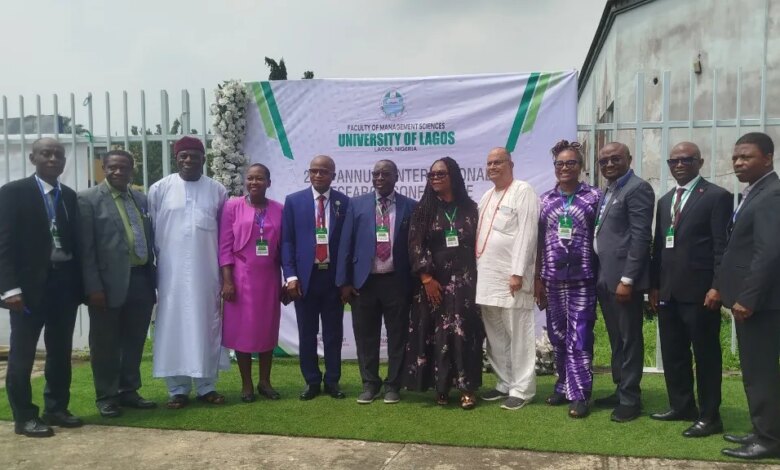
Adisa made the call while delivering a keynote address at the just concluded 2026 Annual International Research Conference organised by the University of Lagos (UNILAG), where he examined the impact of the Fifth Industrial Revolution on work, businesses and education.
He noted that technology has become deeply integrated into nearly all every aspect of human life, transforming the way people work, communicate and collaborate.


According to him, the world has moved beyond the era of purely technology-driven industrial systems associated with the Fourth Industrial Revolution into the Fifth Industrial Revolution, which places equal emphasis on human well-being, sustainability and technological advancement.
“The Fifth Industrial Revolution aligns industrial performance with social and environmental values. It promotes a balance between production efficiency and human well-being,” he said.
Adisa explained that while businesses are increasingly benefiting from technological innovations through improved efficiency, better decision-making and expanded market opportunities, organisations in Nigeria face significant hurdles in adapting to the changing landscape.
Among the major challenges identified were low levels of technological literacy among small businesses, poor internet access, unreliable electricity supply, cybercrime threats and resistance to adopting new business models.
He stressed that small and medium enterprises (SMEs), which he described as the backbone of Nigeria’s economy, must be equipped with the knowledge and tools required to thrive in the digital age.
“How many small businesses have the knowledge of current technologies, and what are we doing to help them fit into the Fifth Industrial Revolution while preparing them for the Sixth?” he asked.
The Professor of Organisational Behaviour and Human Resource Management called on researchers and academics to develop practical, solution-driven studies that address the realities confronting Nigerian businesses rather than focusing solely on theoretical work.
“Our research should provide solutions to social problems. Academics have a lot of roles to play in bringing forth innovative and practicable research that will help small businesses adapt to this revolution,” he said.
Adisa also identified cybersecurity as an emerging concern, warning that increased reliance on technology exposes businesses to greater risks from cybercriminals.
Looking ahead, the scholar predicted that advances in automation and artificial intelligence would continue to reshape workplaces across the world, with greater integration between humans and intelligent machines.
Earlier in her welcome and declaration of the conference open, Prof Folasade Ogunsola, Vice-Chancellor of the University of Lagos (UNILAG), emphasised on the importance of strategic relevance in challenging economic conditions, describing the theme of the conference; “Business Innovations, Sustainability, And Resilience: Navigating The Future” as timely and significant due to the current economic challenges bedevilling the country and the world in general.
Represented by Prof Olufunke Bammeke, the Director of Academic Planning, the VC urged the resource persons and attendees to generate meaningful discussions and decisions that benefit society and the global community.
Declaring the conference open, the VC expresses gratitude to the organising committee and welcome the large attendance to the ‘university of first choice’.
The Dean, Faculty of Management Sciences, Prof Abdulhameed Sulaimon, represented by Professor Ouluseyi Shadare welcomed the participants and expressed warm appreciation to the sponsors and partner organisations for consistent support.
He emphasised the need for businesses to embrace innovation, sustainability and resilience in navigating today’s rapidly changing global environment, saying organisations now operate in an era shaped by technological advancement, economic uncertainties, changing work patterns and environmental concerns, making innovation and resilience essential for survival and growth.
According to him, researchers and practitioners have a responsibility to generate evidence-based solutions that can influence policy, strengthen business strategies and contribute to societal development.
The faculty also reaffirmed its commitment to promoting impactful research capable of driving sustainable economic growth, responsible business practices and resilient communities.
In his welcome note, Dr Oladimeji Abiodun, the Chairman organising committee explained that the conference focuses on business innovations, sustainability, and resilience, aiming to address the contemporary challenges and opportunities in the business world.
Acknowledging the ongoing rapid changes in technology, the environment, the economy, and societal expectations that affect business dynamics, Dr Abiodun called for a collective responsibility among researchers and professionals to create evidence-based solutions that bolster sustainable development and community resilience.
He expressed appreciation to the Vice-Chancellor, Prof Ogunsola, the host and Dean, Faculty of Management Sciences, Prof Abdulhameed Sulaimon, and partner organisations for their support as he encouraged participants to engage actively and collaboratively to foster a spirit of learning and innovation.