NRC Grants Lagos Permanent Rail Operating Licence for Red Line, Backs Multi-Operator Railway System

0
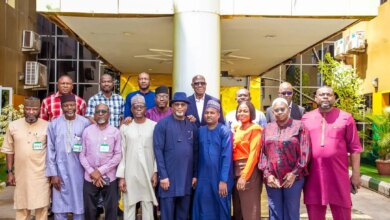
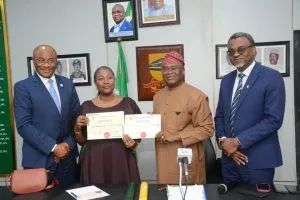
The Managing Director of Nigerian Railway Corporation, Dr Kayode Opeifa, (second right), presenting the permanent Operating Licence and the permanent Track Access Licence to the Managing Director of the Lagos Metropolitan Area Transport Authority, (LAMATA) Engr Mrs Al Abimbola Akinajo, (second left), at the NRC Headquarters, on Tuesday. With them are; the Technical Adviser, Rail Transport, LAMATA, Engr. Olasunkanmi Okusaga, and the NRC Director of Operations, Akin Osinowo. PHOTO: NRC MEDIA TEAM
The Nigerian Railway Corporation (NRC) has formally presented a Permanent Operating Licence to the Lagos State Government for the operation of the Lagos Rail Mass Transit (LRMT) Red Line, marking a major milestone in Nigeria’s railway sector and signalling the country’s transition towards a regulated multi-operator rail system.
Speaking during the licence presentation ceremony in Lagos on Tuesday, the Managing Director of the NRC, Kayode Opeifa, described the development as a historic turning point in the evolution of Nigeria’s rail transport industry.
He noted that for 128 years, since the establishment of the NRC in 1898, the corporation had remained the country’s sole developer and operator of railway services.
However, he said the issuance of the permanent licence reflects a new era in which multiple operators can function within a carefully regulated railway system, in line with international best practices.
According to Opeifa, the move does not diminish the statutory responsibilities of the NRC but rather expands opportunities for collaboration and investment in rail transportation across the country.
The NRC boss recalled that the journey towards the Red Line began in April 2012 when former President Goodluck Ebele Jonathan approved the transfer of two federal railway tracks to the Lagos State Government to facilitate the development of the LRMT Red Line.
He said the decision laid the foundation for one of Nigeria’s most ambitious urban rail projects, which commenced passenger operations on 15 October 2024 after its inauguration by President Bola Ahmed Tinubu.
Opeifa explained that beyond granting access to the railway corridor, the NRC had partnered closely with the Lagos State Government by providing technical support, training and capacity development for personnel responsible for operating the Red Line.
He disclosed that the corporation had earlier granted Lagos State a temporary operational licence to enable implementation of the Track Sharing Agreement while operational assessments were being conducted ahead of the issuance of a permanent licence.
“Today, we are taking another significant step by presenting the Permanent Operating Licence to the Lagos State Government through the Lagos Metropolitan Area Transport Authority,” he said.
According to him, the licence grants LAMATA the authority to operate rail services along the shared railway corridor under the provisions of the Track Sharing Agreement, while also empowering the Lagos State Government to develop and operate other rail systems in line with internationally accepted standards.
The NRC Managing Director described the achievement as evidence of the mutual trust, cooperation and shared vision that have characterised the partnership between both institutions.
He commended the Lagos State Government for its sustained investment in public transportation, particularly the rail sector, including the acquisition of modern rolling stock to meet the increasing transportation demands of residents.
Opeifa observed that modern railway development requires long-term planning, significant financial investment and sustained political commitment, qualities he said Lagos State has consistently demonstrated.
Describing rail transport as the backbone of efficient mass transit in major cities around the world, he stressed that continued investment in railway infrastructure would provide safe, reliable, environmentally sustainable and high-capacity transportation while reducing pressure on congested road networks.
He also urged other state governments across the federation to invest in rail infrastructure and services to complement the Federal Government’s efforts to expand Nigeria’s railway network.
According to him, greater investment in rail transportation would reduce traffic congestion on highways, lower logistics costs, improve passenger mobility, stimulate commercial and industrial activities, and contribute significantly to national economic growth.
Opeifa reaffirmed the NRC’s commitment to building productive partnerships aimed at creating an integrated, efficient, safe and sustainable railway system capable of supporting Nigeria’s development aspirations.
He also praised the assessment team whose operational evaluations paved the way for the issuance of the permanent licence, describing their professionalism and diligence as instrumental in ensuring that the LRMT Red Line met the required operational standards.
The ceremony concluded with the formal presentation of the Permanent Operating Licence by the NRC to the Lagos State Government, a move expected to strengthen urban rail transportation in Lagos and serve as a model for railway development and state participation across Nigeria.