One Woman Had Three Major Procedures for Scoliosis. The Other Never Went Under the Knife

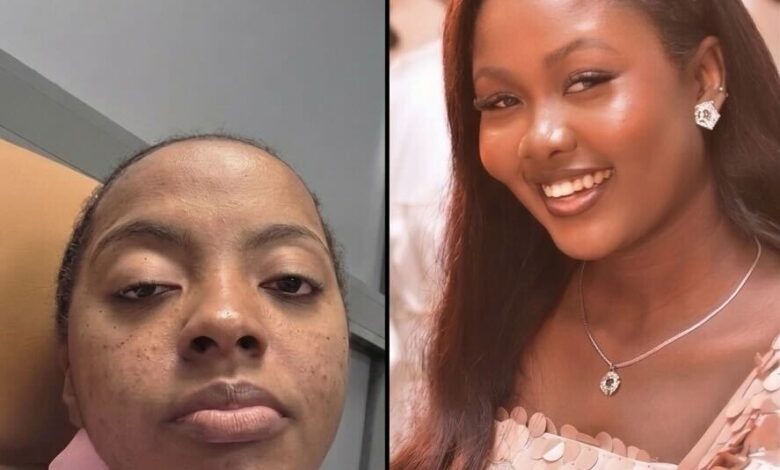
June is Scoliosis Awareness Month, and for millions of people living with a curved spine, the road from diagnosis to treatment is rarely smooth. While mild curves occur at equal rates in all genders, due to hormonal fluctuations and more rapid growth spurts at puberty, women are up to 10 times more likely to develop curves that are severe enough to require medical treatment.
In Nigeria, where access to information and the right care can feel like walking through fire, two women somehow found their way through it.
Debbie was eleven when her back started hurting.
When she informed her parents about this persistent pain, they came to a conclusion that made the most sense at the time. They looked at her school bag, decided it was probably too heavy for her back to handle, and tried their best to massage the pain away every night for about two months. The night massages seemed to ease the pain until the day a bulge appeared and completely flipped the script.

Her parents realised that this was more serious than they’d thought, and immediately took her to the Teaching Hospital in her state. At first, they went to the paediatric unit, where the doctors ran tests, suspected tuberculosis and placed her on medications that made things worse. Eventually, they referred her to the orthopaedic unit, where a surgical consultant took one look at her spine and broke the news to them.
It was scoliosis, and the surgery could not be done in Nigeria. They told her that if anyone dared to operate on her locally, she would most likely be paralysed. But unfortunately, her parents couldn’t afford to take her abroad for treatment.
Debbie was a child, sitting in that office. She could not fully understand the conversation, but watching her mother weep profusely was enough.
For a long time after, she prayed and held onto hope the way you hold onto something when there is really nothing else to hold, while her parents, like most Nigerians, kept speaking life into her. People stared at her, and those who were bold enough asked questions while others offered prayers. Her family and close friends never once treated her like she was broken, and that made all the difference.
Since nothing could be done at the time, she and her parents left it to God, and she just kept living. For 21 years, she lived with the scoliosis completely unmanaged, with no treatment to stop her curve from deteriorating with every passing year.
Bennie’s diagnosis arrived when somebody else noticed something first.
Someone from her school noticed something off about the way she walked and, out of concern, mentioned it to her mother, who took her to the National Orthopaedic Hospital in Igbobi, Lagos, during the school holidays. She was thirteen, and the doctors, after attending to her, read her diagnosis: adolescent idiopathic scoliosis. “Idiopathic” means that it has no known cause. The scoliosis had simply arrived, without any grand entrance, and found a home in her spine.
She burst into tears right there in the hospital. She genuinely thought her life was over, and throughout that day, she kept asking her parents if they had noticed anything weird from birth, as though an earlier warning would have changed something. They said no. What held her together in that moment was her mother. She did not cry, not in front of her. Instead, her mother told her firmly that the diagnosis would never stop her life.
Those were the words she’d needed to hear, and Bennie carried them long after that day.
Surgery was immediately recommended to her parents, and although plans were put in place for it, every one of them fell through, until the family just stopped talking about it altogether.
“Looking back, I truly believe that was God’s hand at work,” Bennie says. The path that fell through would have taken her under the knife. The path she eventually found was far gentler.
The years passed for both women. They went to school, built lives and moved through the world with a condition that the people around them did not always know how to respond to.
For Bennie, scoliosis never shook her sense of self, but it quietly rearranged aspects of her life. After her diagnosis, her mother called the school principal and had her removed from the dance group and stripped of her prefect position. House chores were banned. Anything that might strain her spine was taken away.
She understood that her mother’s actions came from a place of love, yet she still felt the loss. As an adult, scoliosis followed her into her relationships with partners whose concerns always selfishly circled back to childbearing.
She recalls a partner once asking her, “How will you carry a child?”
Working remotely meant that on the days the pain crept in, she could simply rest or reach for a muscle rub without it derailing her entire day. She had made up her mind early on that scoliosis would not stop her from achieving what she needed to achieve. And it did not.
With no treatment to fund, scoliosis never became a financial burden for Debbie. She learned over the years to avoid long walks and standing for too long, and pushed through the harder stretches like university and NYSC on sheer will and faith.
The experience was more visible and harder to navigate in public, with the boldness of strangers who asked without hesitation or sensitivity, and the prayers from well-wishers who looked at her body as something to be fixed. She received it all with grace and kept going.
In 2018, Debbie contacted a surgeon, but he went incommunicado after the initial consultations, and she adjusted. Later in the year, she found a community called Beyond A Curved Spine and shared her story with them. When they welcomed her with open arms, she felt like she was not alone in this. Her parents remain supportive, but connecting with other scoliosis warriors felt different.
By 2024, when the community hosted a webinar featuring a scoliosis surgeon named Dr Mutaleeb Shobode, her condition had already begun to take a serious toll on her. Her breathing was getting worse, she could not stand for long, and the pain had become something she could no longer push through. Her curve had reached 154 degrees, while surgery is typically recommended at 40.
She had been living, breathing and praying with a spine that had curved so deep over twenty-one years of no treatment. She would still be living like that if she hadn’t listened to Dr Shobode talk about spinal fusion.
(Debbie’s back pre-surgery)
“He spoke about it as if it were a simple procedure. I could feel his competence from where I was seated,” Debbie says.
The way Dr Shobode talked about spinal fusion stayed with her. She knew, right there and then, that she had to take control of her life. She booked an appointment with him and flew from Port Harcourt to Lagos without telling anyone.
By the time she left her consultation with the surgeon, the fear she had walked in with had transformed into full-blown confidence. She only called her family after she had made her decision.
2024 was Bennie’s turning point, too, but her path to treatment started differently.
In May, the fatigue became difficult to ignore, the spinal pain was worse than before, and her breathing grew difficult in a way that concerned her. She visited platforms like YouTube, Instagram and Google, and desperately dug through everything she could find. The algorithm, she will tell you, was very helpful, leading her to a woman called daywithviv who runs a platform called Scoliofitness, teaching exercises and speaking openly about physiotherapy as a treatment path for scoliosis.
Bennie went down a rabbit hole, going through every post and video, and from that moment on, she knew physiotherapy was the treatment destined for her, though not without some scepticism at first. Trusting content she had found on the internet over medical professionals was not something she took lightly, but the more she researched and the more results she saw, the harder it became to dismiss.
Surgery had never felt like a safe or appealing option. She had come across stories of people who went under the knife only for their curve to regress, and others who still lived with chronic pain long after the procedure. She also had a life she was not willing to put on hold. She loved dancing, going out, living freely, and physiotherapy was the only path that allowed her to keep all of that intact.
“What I noticed,” she observes, “was that no African, Nigerians especially, ever recommends physiotherapy for scoliosis. They focus on surgery, but foreigners have so much information about physiotherapy. I started wishing I wasn’t in Nigeria.”
Armed with enough information about physiotherapy and fully convinced that it was the right path for her, she walked into the hospital knowing what she wanted, discussed her curve angle of 45 degrees with a doctor, and started physiotherapy treatment shortly after.
(Bennie’s back pre-therapy)
While Bennie was just beginning her treatment journey, Debbie was preparing for something far more intense. Her surgery was not one procedure. It was three. Because her curve was so severe, her ribs had grown crowded and scattered over the years, in ways they were never meant to, and the procedures did not come cheap. The bill ran into double-digit millions, a sum that was covered miraculously through the support of friends and her workplace.
The first procedure was an anterior release. Surgeons cut away some of her ribs to create space and give her spine room to stretch. She recovered well enough from that stage of the surgery that her doctor brought her back to the theatre the very next day.
Then came the halo pelvic traction, a device attached to her skull and pelvis and tightened gradually every single day to pull her spine incrementally straighter. The halo pelvic traction was not supposed to be torturous, but after two weeks, the rods began to bend, straining her neck and causing her waist such pain that at some point she could not sit down for anything. Standing became her only option for all activities, like eating and going to the restroom.
She wore it for six weeks and two days.
What do you think about this?
Drop your opinion in the comment section.
FOLLOW US & Share this with someone who needs to see this.