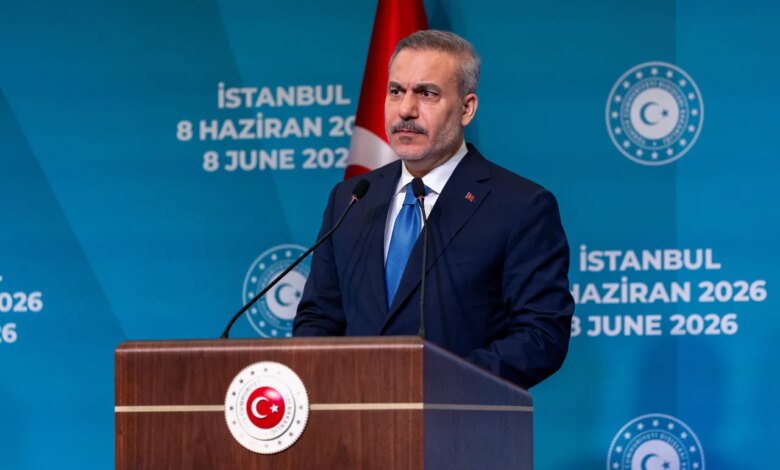
Turkish Foreign Minister Hakan Fidan has said that achieving peace in the Russia-Ukraine war is essential for the stability and security of the region, while emphasising the growing strategic importance of cooperation among Türkiye, Azerbaijan, and Georgia.
“The war continuing in our north directly affects the security of our region. We see achieving peace in the Russia-Ukraine war as essential for the stability and security of our region. We believe that this diplomatic process and efforts towards peace must continue with determination,” Fidan said on Monday.
The minister spoke at a joint press conference following the 10th Trilateral Meeting of the Foreign Ministers of Türkiye, Azerbaijan, and Georgia at Ciragan Palace in Istanbul, alongside his Azerbaijani and Georgian counterparts, Jeyhun Bayramov and Maka Botchorishvili.
“We are all following with concern the current impasse in both the battlefield and diplomatic process. The steps taken by the parties to turn this deadlock to their advantage are unfortunately further increasing tensions on the ground,” he said.
Referring to recent attacks in the Black Sea and Sea of Azov, Fidan said they demonstrated the potentially severe consequences of the conflict and extended condolences to Azerbaijan over the latest incident that resulted in loss of life.
Results-oriented platform
Fidan said the trilateral mechanism had evolved into a results-oriented platform that fosters trust across the region.
“Today, we are holding the tenth meeting of the trilateral mechanism that we established with a sense of regional ownership. Our meeting has once again demonstrated that this mechanism has become a platform for consultation that produces results and builds confidence in our region,” Fidan said.
The mechanism, which has operated uninterruptedly for nearly 14 years, has contributed to political dialogue, economic integration, transportation, energy security, trade, and stronger people-to-people ties, he added.
“We see this mechanism not only as serving the common interests of our three countries, but also as one of the guarantees of peace, stability, and sustainable prosperity in the South Caucasus,” Fidan said.
Energy security, Middle Corridor highlighted
Fidan stressed that geopolitical tensions, economic uncertainty, and growing concerns over energy security have increased the value of regional cooperation.
“In such a period, the environment of peace and cooperation we have established in our region represents genuine strategic value,” he said, noting that stronger connectivity among the three countries contributes to stability, energy supply security, and economic resilience from Europe to Asia.
According to Fidan, the strengthening role of the Middle Corridor has become the most tangible manifestation of that objective.
He also described the June 2 ceremony marking the Georgian section of the Baku-Tbilisi-Kars railway reaching full operational capacity as a significant milestone and said maximising the benefits of the corridor would generate greater added value for the region.
Azerbaijan-Armenia peace process
Fidan said the three ministers reaffirmed a shared understanding that stability, peace, and prosperity in the South Caucasus should be built on sincere and constructive cooperation.
“We want our region to be known for development projects rather than conflicts and for shared prosperity and connectivity projects rather than divisions,” he said.
He described the ongoing peace process between Azerbaijan and Armenia as the most promising example of that vision.
“We support the peace process between Azerbaijan and Armenia. We also hope that Azerbaijan’s legitimate concerns will be addressed and that the peace agreement will be signed without delay,” Fidan said.
“To us, the main opportunity and goal before the South Caucasus is this: as the foundations of peace grow stronger, connectivity projects will produce even stronger results. As connectivity strengthens, the social and economic foundations of peace will become more firmly rooted,” he said.