Procurement Firms Inflated FG Contracts By N303bn, $304m In Nine Months—Investigation

…Closes 95 Procurement Complaints Against MDAs
The Federal Government saved more than N303bn, $304.9m and €1.74m from inflated contract costs between January and September 2025 following procurement reviews conducted by the Bureau of Public Procurement (BPP), documents exclusively obtained by THE WHISTLER have revealed.
The internal documents detailed procurement oversight activities carried out across Ministries, Departments and Agencies (MDAs) during the nine-month period under review, showing how the bureau reduced contract sums before granting approvals for execution.
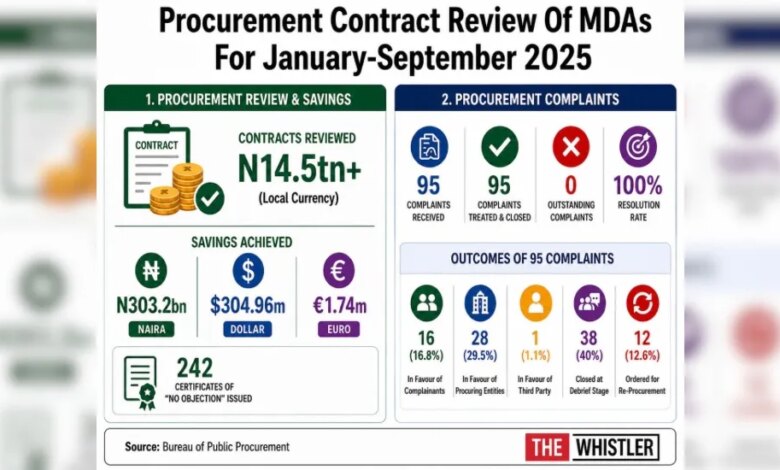
Findings by THE WHISTLER showed that the BPP issued 242 Certificates of “No Objection” after reviewing projects submitted by MDAs in line with the provisions of the Public Procurement Act (PPA), 2007, Public Procurement Regulations and extant procurement guidelines.


The documents stated, “Following substantial compliance with the provisions of the Public Procurement Act, 2007, Public Procurement Regulations and extant Guidelines on public procurement, the Bureau issued Two Hundred and Forty-Two (242) Certificates of ‘No Objection’ to MDAs from January to September, 2025.”
The “No Objection” certificate is a mandatory approval issued by the BPP before federal agencies can proceed with the award of major contracts.
To obtain a Certificate of “No Objection” to Contract Award from the Bureau of Public Procurement (BPP), Ministries, Departments and Agencies (MDAs) are required to satisfy a number of strict conditions designed to ensure transparency, accountability and value for money in public spending.
Under the Public Procurement Act (PPA) 2007, the BPP only grants the certificate after a procuring entity demonstrates compliance with due process requirements, proves the availability of funds for the project and provides evidence that the procurement procedure followed statutory guidelines.
One of the key conditions is that the proposed contract must exceed the approval threshold of the procuring entity before it can be referred to the bureau for review. Depending on the category of procurement and revised thresholds, contracts above N100m for goods and services or between N500m and N1bn for works are typically subjected to BPP scrutiny.
The procuring entity must also provide evidence that funds for the project have already been appropriated in the approved budget. This usually involves submitting copies of the relevant pages of the budget showing the allocation for the proposed project.
In addition, the bureau requires proof that the procurement process was competitive and transparent. MDAs are expected to submit evidence of newspaper advertisements, bid invitations and records showing that contractors were given equal opportunity to participate in the bidding process.
Where alternative procurement methods such as restricted or direct procurement are adopted, the procuring entity must present prior approval from the BPP authorising such methods.
As part of the review process, the bureau also demands a detailed bid evaluation report, records of public bid openings, attendance sheets of participating bidders and the priced financial bids submitted by contractors.
The BPP further evaluates the proposed contract sum against internal estimates or consultant valuations to determine whether the pricing is reasonable and not inflated.
For contractors recommended for award, the bureau requires proof of statutory compliance, including registration on the National Database of Federal Contractors, Consultants and Service Providers.
The conditions form part of measures introduced under the procurement law to curb contract inflation, eliminate irregularities in public procurement and ensure that government projects deliver value for public funds.
According to details contained in the documents obtained by THE WHISTLER, MDAs initially submitted local currency contracts valued at N14.85tn for review in the first nine months of 2025.
However, after scrutiny by the bureau, the reviewed project cost dropped to N14.55tn, resulting in savings of N303.2bn.
The report specifically put the figures at N14,851,649,153,169.90 as the requested project cost and N14,548,442,579,799.90 as the reviewed project cost, leaving total savings of N303,206,573,369.44.
Similarly, dollar-denominated projects initially valued at $5.42bn were reviewed downward to $5.12bn, resulting in savings of about $304.96m.
The bureau also reviewed euro-denominated projects from €43.39m to €41.65m, leading to savings of €1.74m.
The figures underscore the scale of procurement adjustments undertaken by the BPP as the federal government intensifies efforts to curb inflated contracts, block leakages and enforce value-for-money standards in public spending.
The documents noted that the approvals were issued only after the affected MDAs demonstrated “substantial compliance” with procurement laws and regulations.
Further findings by The WHISTLER showed that beyond contract reviews, the bureau also concluded investigations into all procurement-related complaints received during the period under review.
According to the documents, no procurement complaint remained unresolved as at the end of September 2025.
The report stated, “No outstanding Complaints are on-going as at the end of the period under review as the Ninety-Five (95) Complaints were treated and closed in line with the provisions of Section 54 of the Public Procurement Act, 2007.”
The bureau described the development as evidence of improved service delivery and enhanced transparency in the procurement process.
It added, “The number of closed Complaints relative to the nil number of on-going Complaints indicates an improved service delivery, which promotes transparency, equity, accountability in conformity with the provisions of the PPA, 2007.”
An analysis of the 95 complaints reviewed by the bureau showed that 16 cases, representing 16.8 per cent, were concluded in favour of complainants, while 28 complaints, representing 29.5 per cent, were resolved in favour of the procuring entities.
One complaint, representing 1.1 per cent, was resolved in favour of a third party.
The documents further revealed that 38 complaints, accounting for 40 per cent of the total cases, were closed at the debrief stage, while 12 cases, representing 12.6 per cent, were directed to be re-procured after irregularities were identified in the procurement process.
What do you think about this?
Drop your opinion in the comment section.
FOLLOW US & Share this with someone who needs to see this.