Over the years, tiny Qatar has emerged as a pivotal regional mediator, deploying balanced approaches to critical crises stretching from the Gulf to the Horn of Africa with a high degree of success. More recently, Doha has had to navigate increasingly volatile conflicts closer to home, most notably the fallout from the current U.S.-Israeli war on Iran.
By positioning itself as an indispensable diplomatic conduit, Doha has transformed its inherent geographic vulnerability into a strategic asset, proving that in a region often defined by rigid ideological blocs, pragmatic functional diplomacy remains the only viable path toward stability.
This approach acknowledges the unyielding reality of geography: Iran is a permanent fixture of the regional landscape. Consequently, Doha’s policy is built on the premise that neighbors, whether they approve of Tehran’s policies or not, must prioritize sustainable engagement over the cycle of permanent confrontation.

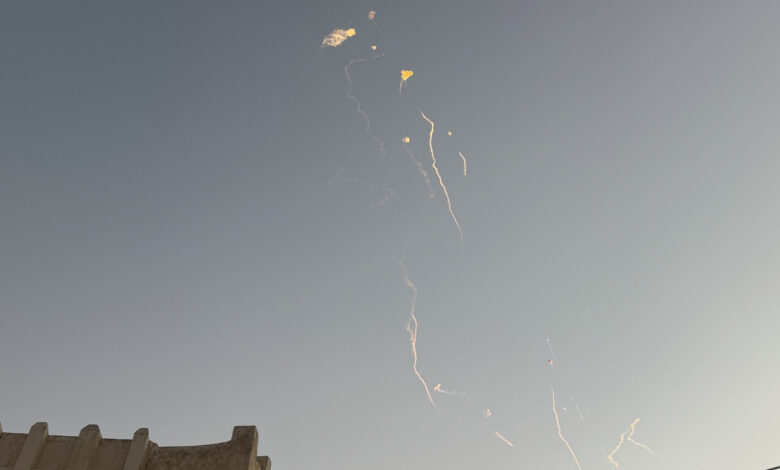
Despite finding itself on the receiving end of significant Iranian missile and drone barrages during the opening weeks of the 2026 war—a direct consequence of its role as the host for the largest U.S. military base outside US territory, at Al-Udeid—Doha has pointedly returned to the route of mediation. While other regional powers have found themselves sidelined by their own military postures or perceived lack of neutrality, Qatar has leveraged its functional middle status to maintain a seat at the table. This diplomatic dexterity is not merely a choice of style but a calculated necessity born of its specific surroundings. For Qatar, the shift from ideological alignment to geographic realism is most visible in its complex relationship with Tehran—a partnership dictated more by the shared coordinates of the massive offshore gas fields than by the shifting winds of unpredictable political calculations. Even as strikes on the Ras Laffan industrial hub forced a temporary declaration of force majeure on energy exports, Doha remained the only capital capable of facilitating the high-stakes negotiations over tens of billions in frozen Iranian assets. This underscores a sobering reality: in the Gulf, one can choose their allies, but they cannot choose their geography.
Historically, both Qatar and Oman have distinguished themselves as the two Gulf nations capable of maintaining a delicate equilibrium between their GCC commitments and their relationship with Tehran.
For decades, when regional tensions have threatened to spill over into open conflict, Doha and Muscat have frequently acted as the “safety valves” of the Gulf.
Through its history of mediation—ranging from the 2008 Lebanon crisis to the 2020 U.S.-Taliban deal—Qatar has demonstrated a strategic preference for the “table” over the “trigger.” This role has become particularly vital in June 2026; following the intense military escalations of Operation Epic Fury, Doha has once again positioned itself as the indispensable broker. While Oman pioneered the pre-war “Rome and Muscat rounds” in early February, the post-war phase has seen Qatar take the lead in facilitating the current negotiations for a 60-day ceasefire extension. By managing the release of $12 billion in frozen Iranian assets, a top Iranian demand, Doha isn’t just mediating a dispute; it is providing the essential financial “carrots” required to prevent a regional conflagration that would devastate the global energy market. In this context, Qatar’s intervention is a masterclass in regional survival, proving that functional dialogue remains a more effective deterrent than the most advanced missile defense systems.
The most acute test of Qatar’s “Geography over Ideology” diplomacy has been its response to the Israeli genocide in Gaza. Since it start in October 2023, Doha has successfully mediated three major breakthroughs: the initial November 2023 truce, the January 2025 pause, and the current October 2025 Comprehensive Peace Plan. These interventions have solidified Qatar’s position as the primary interlocutor between the West and the Palestinian resistance. Critically, Qatar’s hosting of the Hamas political office since 2012 was a direct response to a U.S. request during the Obama administration to facilitate a trackable, manageable channel for dialogue. By maintaining this policy, Doha has provided the only functional venue where hostage releases and humanitarian truces could be negotiated. In a region where other capitals have opted for either total isolation or rigid normalization, Qatar’s willingness to engage with all parties—regardless of their international standing—proves that a “neutral ground” is not just a diplomatic luxury, but a humanitarian necessity.
READ: Iranian attacks damaged 20 US military sites since war began, satellite imagery shows
Unlike other GCC neighbors who rushed to sign the Abraham Accords—effectively decoupling their security from the Palestinian cause—Qatar has maintained direct technical links to Israel without formalizing diplomatic normalization.
By refusing to follow the path of the UAE or Bahrain, Doha has demonstrated that regional influence does not require abandoning the Palestinian file.
Instead, it has leveraged its unique position to act as a vital financial and humanitarian conduit, overseeing the reconstruction efforts in Gaza after previous wars and managing the flow of aid that keeps the territory from total collapse. This approach proves that true mediation requires keeping lines open to all without being pulled into their ideological orbits. In the volatile landscape of 2026, Qatar’s refusal to normalize serves as its greatest diplomatic asset; it remains the only state capable of speaking to both the Israeli security establishment and the Palestinian resistance, bridging a gap that formal normalization has, ironically, only widened.
However, the current U.S.-Israeli military campaign against Iran has exposed the precarious limits of this “balanced” approach. Despite Doha’s years of investment in de-escalation, the outbreak of war on Iran last February saw Qatar caught in a violent pincer. Two days after the initial U.S.-Israeli strikes on Iranian nuclear sites on February 28, Tehran responded with a barrage of drones and missiles targeting Qatar’s Ras Laffan LNG complex—the very heart of the state’s economic power. This escalation forced QatarEnergy to declare force majeure on several European deliveries, a stark reminder that while geography dictates Qatar’s diplomacy, it also makes the state a primary collateral victim in any regional conflagration.
Ultimately, Qatar’s geography before ideology tactics represent a sophisticated, albeit high-stakes, survival strategy in a region where external traditional security alliances come with high price tag. Doha has effectively turned a potential flashpoint over the frozen Iranian cash into a mechanism for regional cooling down. While critics may view this pragmatism as a dangerous double game, the reality suggests otherwise: in a landscape where the “Abraham Accords” and various normalization projects failed to prevent the direct U.S.-Israeli agrresion on Iran, Qatar’s functional middle ground remains a viable exit ramp.
Whether this model can withstand the pressures of a fragmenting international order remains to be seen, but for now, Doha has proven that in the heart of the Gulf, the “table” is a far more resilient tool than the trigger.
The views expressed in this article belong to the author and do not necessarily reflect the editorial policy of Middle East Monitor.